Most PPC ads do not fail because of targeting or budget. They fail because the message does not connect. In Google Ads, people click only when your headline instantly matches their intent. In Meta Ads, people stop scrolling only when your copy hits the right emotion or problem within seconds. If your messaging is unclear, even the best campaign setup will struggle with low CTR, expensive clicks, and poor conversions.
That is why copywriting formulas matter. They give you a repeatable structure to write ads that grab attention fast, build trust quickly, and push the reader toward action without sounding salesy.
In Part 1, we covered the most classic and widely used formulas. If you have not read it yet, start with Part 1 of the 50 Best Copywriting Formulas for Creative Ads That Convert. In Part 2, we move into the next 15 (16 to 30) conversion-focused frameworks that work especially well for PPC campaigns. These formulas are designed to reduce hesitation, strengthen credibility, and improve response across Google Search Ads, Meta feed ads, landing pages, and retargeting campaigns.
Each formula below includes a simple breakdown and a real example you can use immediately in your next ad.
Benefit and Conversion Focused
16) PASTOR
Problem, Amplify, Story, Transformation, Offer, Response
PASTOR is a conversion-focused framework that blends emotional depth with structure. It starts by clearly identifying a problem that the reader recognizes. That problem is then amplified by showing the cost, frustration, or lasting impact of leaving it unsolved. A short story follows, helping the reader relate on a human level. The transformation stage shows what changes after the solution is applied. Only then is the offer introduced, followed by a direct response request.
This formula works very well for sales pages, service ads, webinars, and email campaigns.
Example:
Problem: Writing ads feels inconsistent and confusing
Amplify: That leads to wasted spend and missed opportunities
Story: Many advertisers face this until they adopt a structure
Transformation: Ads become clearer and easier to scale
Offer: A proven copy formula guide
Response: Get instant access today
17) HEART
Hook, Empathy, Authority, Resolution, Trust
HEART focuses on emotional connection before persuasion. The hook captures attention, while empathy shows that the writer truly understands the reader's situation. Authority establishes credibility without being aggressive. Resolution explains how the problem can be solved, and trust reassures the reader that taking action is safe and reasonable.
This formula is ideal for service-based businesses and trust-sensitive offers.
Example:
Hook: Most ads fail for one simple reason
Empathy: Writing effective copy can feel frustrating
Authority: This framework has guided real campaigns
Resolution: A Clear structure removes uncertainty
Trust: Practical, tested, and easy to apply
18) SPIN
Situation, Problem, Implication, Need Payoff
SPIN is a logical persuasion model that moves readers toward self-realization. Instead of pushing a solution immediately, it helps the reader understand the situation, identify a problem, and recognize the consequences of inaction. Once the need becomes clear, the payoff shows how the solution improves the outcome.
This formula works well for consultative selling and high-value offers.
Example:
Situation: Ads are essential for consistent leads
Problem: Messaging often lacks clarity
Implication: Poor clarity reduces response and increases cost
Need Payoff: Structured copy improves results and confidence
19) EPIC
Engage, Promise, Inform, Close
EPIC is a balanced formula that combines clarity with persuasion. It engages the reader with a relevant opening, sets a promise about the value they will receive, informs them with useful details, and then closes with a clear action step. Each stage builds momentum toward conversion without pressure.
This formula is effective for landing pages and promotional ads.
Example:
Engage: Struggling to write ads that convert
Promise: This framework simplifies the process
Inform: Learn how structure improves messaging
Close: Start using the formula today
20) FOUR Ps
Promise, Picture, Proof, Push
FOUR Ps focuses on benefits and belief. The promise sets a clear expectation. The picture helps the reader visualize the outcome. Proof removes doubt by adding credibility. The push encourages action by clearly stating what to do next.
This formula is highly effective for direct response ads and lead capture pages.
Example:
Promise: Write clearer ads with less effort
Picture: Campaigns that attract better responses
Proof: Used across multiple active accounts
Push: Apply the framework now
Trust and Persuasion Oriented
21) STAR
Situation, Task, Action, Result
STAR is a credibility-driven framework that explains results through a clear sequence of events. Instead of making bold claims, it shows how outcomes were achieved. The situation sets context, the task explains the challenge, the action shows what was done, and the result presents the measurable or visible outcome. This structure helps readers trust the message because it explains the process rather than simply stating success.
This formula works especially well for case studies, testimonials, and service pages.
Example:
Situation: Ad response rates were declining
Task: Improve clarity without increasing spend
Action: Applied structured copy formulas
Result: Higher engagement and better lead quality
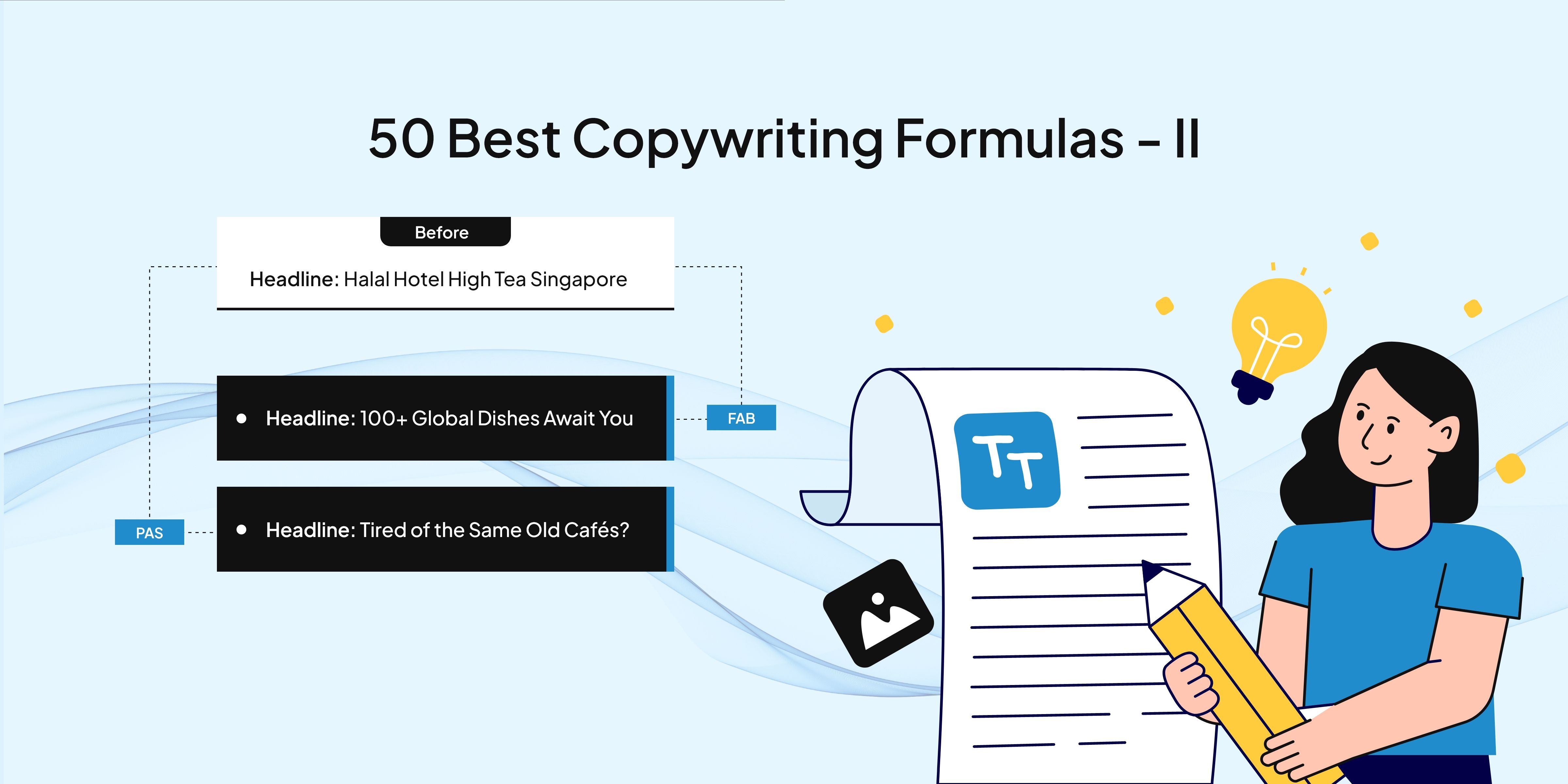
22) CAB
Context, Action, Benefit
CAB is a simple persuasion formula that explains value quickly. It first provides context so the reader understands the situation. Then it shows the action taken or solution introduced. Finally, it highlights the benefit that matters most to the reader. This keeps the message grounded and practical.
This formula works well for short ads, feature highlights, and landing page sections.
Example:
Context: Many ads fail due to weak structure
Action: Use proven copy frameworks
Benefit: Clear messaging that drives response
23) SOFA
Solution, Outcome, Feature, Action
SOFA starts with the solution rather than the problem, making it ideal for readers who already know what they want. It immediately shows the outcome they can expect, supports it with a relevant feature, and ends with a clear action. This reduces friction and keeps the message focused.
This formula is effective for warm audiences and product-focused promotions.
Example:
Solution: A clear copywriting framework
Outcome: Stronger ad messaging
Feature: Step-by-step structure
Action: Start using it now
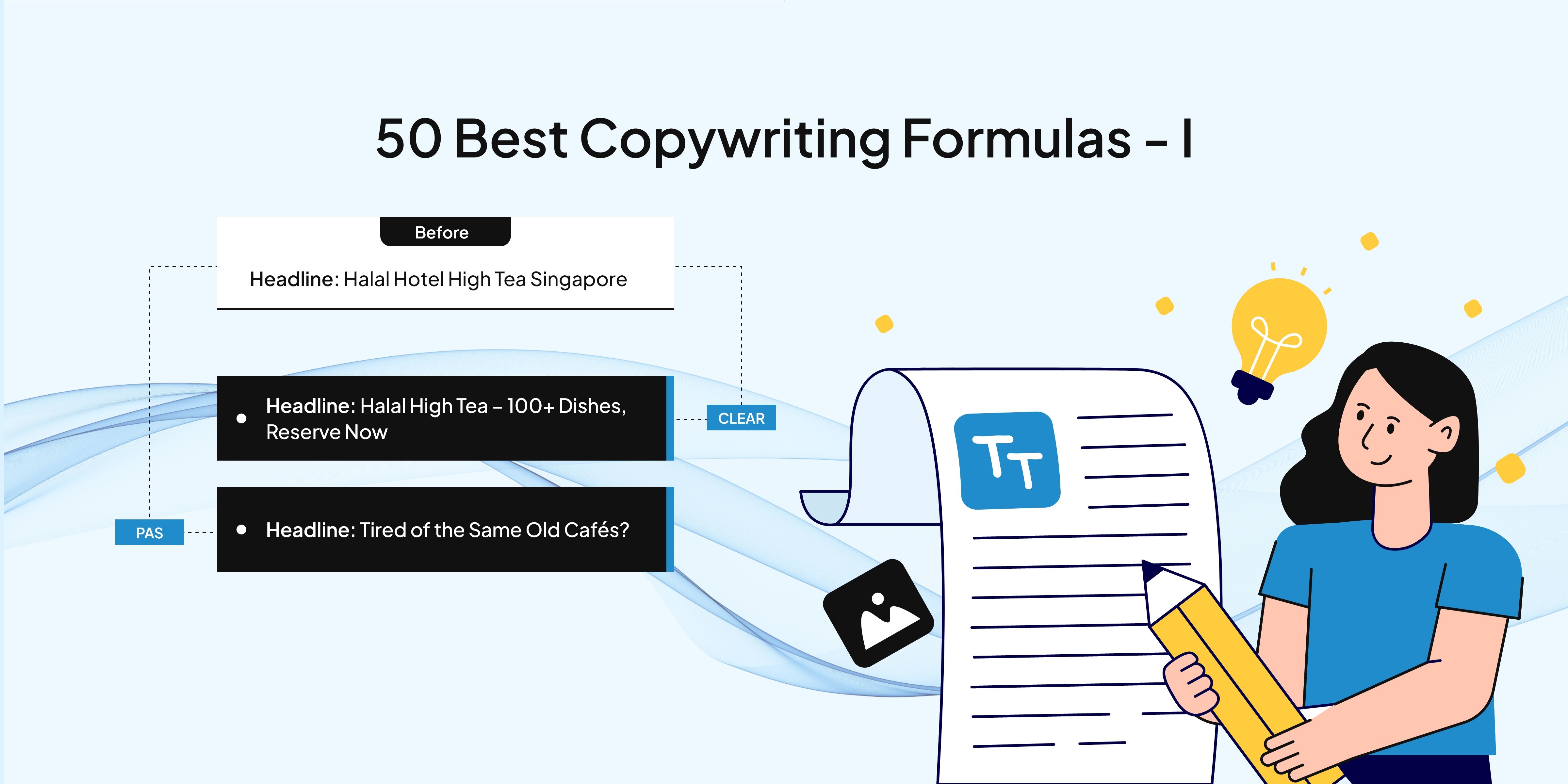
24) CLEAR
Concise, Logical, Engaging, Action-Oriented, Relevant
CLEAR is a quality control framework rather than a storytelling structure. It ensures the copy is easy to read, logically organized, engaging enough to hold attention, focused on action, and relevant to the reader's needs. This formula improves trust by removing confusion and unnecessary detail.
This approach works well for homepage copy and brand messaging.
Example:
Concise: Key benefits presented without fluff
Logical: Ideas flow naturally from problem to solution
Engaging: Messaging keeps the reader interested
Action-Oriented: Encourages a clear next step
Relevant: Focused on what matters most to the audience
25) PROVE
Promise, Reason, Outcome, Verification, Engagement
PROVE builds persuasion through justification and evidence. The promise sets an expectation. The reason explains why the promise is realistic. The outcome shows what changes after using the solution. Verification adds proof through data or experience. Engagement invites the reader to interact or learn more.
This formula works well for skeptical audiences and high consideration offers.
Example:
Promise: Improve ad copy clarity
Reason: Structured frameworks reduce guesswork
Outcome: Better response quality
Verification: Tested across real campaigns
Engagement: Explore the full guide
Direct Response and Short Form Ads
26) ABCD
Attention, Benefit, Credibility, Direction
ABCD is a compact persuasion framework created for short ads where every word must earn its place. It starts by stopping the reader, then quickly explains what is in it for them. Credibility is added to reduce doubt, and direction tells the reader exactly what to do next. This formula removes friction by keeping the message focused and easy to act on.
It works very well for paid ads, banners, and short landing page sections.
Example:
Attention: Your ads are being ignored
Benefit: Clear copy improves response
Credibility: Tested across real campaigns
Direction: Download the framework now
27) CTA
Context, Trigger, Action
CTA goes beyond a basic call to action. It sets context so the reader understands why the action matters, introduces a trigger that creates urgency or relevance, and then presents the action step. This makes the call feel logical rather than forced.
This formula is effective for buttons, short ads, and email prompts.
Example:
Context: Writing ads takes too much time
Trigger: New campaigns launching this week
Action: Use the copy framework today
28) PAPA
Problem, Agitate, Promise, Action
PAPA is a fast-moving formula that compresses emotional persuasion into a short format. It highlights a problem, increases its importance by showing the downside, then offers a clear promise before asking for action. This approach works well when space is limited but impact is needed.
This formula is ideal for social ads and quick promotions.
Example:
Problem: Ads fail to convert
Agitate: That wastes budget and effort
Promise: Structured copy improves clarity
Action: Get the guide now
29) SUCCES
Simple, Unexpected, Concrete, Credible, Emotional, Story
SUCCES focuses on memorability. It ensures the message is easy to understand, surprising enough to stand out, specific rather than vague, supported by credibility, emotionally relevant, and tied together with a short story or scenario. This helps short ads stay memorable even after quick exposure.
This formula works well for brand recall and viral-style ads.
Example:
Simple: Most ad copy fails because it tries to be clever instead of clear.
Unexpected: A single change in structure turned confusing messages into ads people actually read.
Concrete: The framework uses five clear steps that remove guessing and save time.
Credible: It has been applied in live campaigns, not theory.
Emotional: The clarity reduces frustration and brings confidence back to writing ads.
Story: It all started with fixing one message that was not working.
30) FAST
Focus, Advantage, Specifics, Trigger
FAST removes excess and sharpens the message. It forces the copy to stay focused on one idea, highlight a clear advantage, support it with specifics, and include a trigger that encourages immediate action. This keeps short ads direct and effective.
This formula is ideal for mobile ads and headline-driven campaigns.
Example:
Focus: Better ad copy
Advantage: Clear structure
Specifics: Step-by-step formulas
Trigger: Start using it today
Wrapping Up
These 15 copywriting formulas are not just writing techniques; they are practical PPC frameworks you can apply directly to Google Ads and Meta Ads. When your messaging follows a proven structure, it becomes easier to capture attention, communicate value quickly, build trust, and drive action. This results in better CTR, stronger conversion rates, and less wasted ad spend.
The real advantage of these formulas is consistency. Instead of guessing what angle to write next, you can choose a structure based on your campaign goal, audience intent, and funnel stage. This makes testing ad variations faster and scaling winning campaigns much easier.
And this is not the end. In Part 3, we will cover the final set of copywriting formulas that are designed for modern ad platforms, short attention spans, retargeting campaigns, and high intent conversions. Just a reminder, if you missed the first set of formulas, read Part 1 of 50 Best Copywriting Formulas for Creative Ads That Convert before moving to Part 3. If you want your PPC ads to feel sharper, more persuasive, and easier to scale, Part 3 will give you the frameworks to do exactly that.