

Search Is Changing. Is Your SEO Agency Keeping Up?
Here is a pattern catching a lot of business owners off guard. Your rankings in the dashboard look fine, holding at position one or two, yet the traffic those rankings used to send keeps slipping. If that sounds familiar, it is probably why you are now looking at hiring an AI SEO agency.
What changed is where the answer lives. When Google shows an AI Overview at the top of the page, the click through rate for the top result drops by nearly 60%, even when your ranking has not moved. By early 2026, about 68% of US Google searches ended without a click to another website (Search Engine Land). On top of that, a growing share of your customers skip Google entirely and ask ChatGPT, Perplexity or Gemini.
That is why "AI" now appears on almost every agency homepage. The catch is that a bad hire rarely fails loudly. It fails slowly, over months of fees and reports that look busy but never turn into customers.
This guide covers what AI SEO agency services actually include, a quick test to see whether you even have a problem, how to compare agencies properly, the red flags worth walking away from, and what you should realistically expect to pay.
What Are AI SEO Agency Services, Anyway?
AI SEO agency services help your business get found in both Google's regular results and in AI generated answers, using AI tools for the heavy data work and human experts to set the strategy and check the output.
The foundation has not changed. Someone still has to fix the technical faults on your site, publish pages that answer what buyers actually search for, and earn mentions and links from other trusted websites. What is new is the extra layer of work aimed at AI answers, and the fact that AI now speeds up the research, drafting and analysis behind all of it.
Two terms come up constantly, so here they are in plain English. GEO, short for generative engine optimization, is the work of getting your business understood and named inside tools like ChatGPT, Gemini and Perplexity. AEO, short for answer engine optimization, is about structuring your content into clear, direct answers that search engines and AI assistants can lift out and show on their own.
Here is the part a lot of agencies skip over. In an AI answer, ranking on page one is not the win anymore. Being named in the answer is. People almost never click the little source links inside a Google AI Overview, only around 1% of the time (Pew Research Center), so the real prize is getting mentioned and cited in the answer itself. A capable AI SEO agency is working toward that, not just a blue link that fewer and fewer people click.
First, Find Out If You Even Have a Problem (A 10 Minute Test)
Before you pay anyone, spend ten minutes checking whether AI search is actually costing you, because the answer tells you how urgent this really is.
Open ChatGPT, Perplexity and Google. Then run the questions your customers would actually type, not your own brand name. Things like "best [your service] in [your city]", "top [your category] companies", or "[a competitor] alternatives". Branded searches do not count here, because the tools already know you exist the moment you hand them your name.
For each answer, note four things:
-
Does your business get named at all?
-
Where do you land, first mentioned or buried near the bottom?
-
Which competitors show up instead of you?
-
Is anything the AI says about you wrong or out of date?
Run each question two or three times, since the answers shift between runs. If competitors keep getting named and you do not, that gap is your problem, and closing it is exactly what a good GEO focused agency should be able to do. If you already show up well, you may not need to switch agencies at all, just make sure your current one keeps you there.
Want to track this properly rather than by hand? Tools like Otterly.ai, Peec AI, Profound and Ahrefs Brand Radar monitor how often AI tools name and cite you over time. A serious AI SEO agency will either use one of these or have its own method, and should be happy to show you the numbers.
Does Your Business Really Need One?
You probably need an AI SEO agency if buyers research you online before they commit, and your visibility has stalled even though you are still "doing SEO."
Watch for these specific signs:
-
Your rankings held steady but your organic traffic quietly fell, which usually means AI answers are absorbing the clicks you used to get.
-
You ran the 10 minute test above and competitors kept showing up in ChatGPT or Perplexity while you did not.
-
Your market is one where people ask a lot of questions before buying, software, healthcare, finance, high value services, where AI answers already carry real weight.
-
Your current team or agency goes quiet or defensive when you ask what they are doing about AI search.
A traditional agency can still be the right call, though. If you are a local business with a small site and most of your leads come from Google Maps or people searching your name, you may not need the extra AI layer yet. And if your current partner is already delivering real leads, there is no reason to switch just because "AI" is the word of the year.
AI SEO Agency vs. Traditional Agency: Which One Fits You?
An AI SEO agency suits businesses that need to show up in AI answers as well as Google, while a traditional agency suits businesses that mainly need steady Google rankings.
AI SEO agency pros: faster research and content production, and a strategy built for where search is heading. Cons: the field is new, quality varies a lot, and some agencies use "AI" as a label for cheap automated content.
Traditional agency pros: proven methods and a long track record you can check, often at a lower price. Cons: some haven't adapted to AI search, so you may slowly lose visibility where your buyers now look.
Quick verdict: If your buyers research before they buy and your market is crowded, an AI SEO agency is worth a serious look. If you're a local business that mainly needs Maps visibility and steady rankings, a strong traditional agency may serve you just as well. Either way, judge the process and the results, not the label.
What Services Should You Look For?
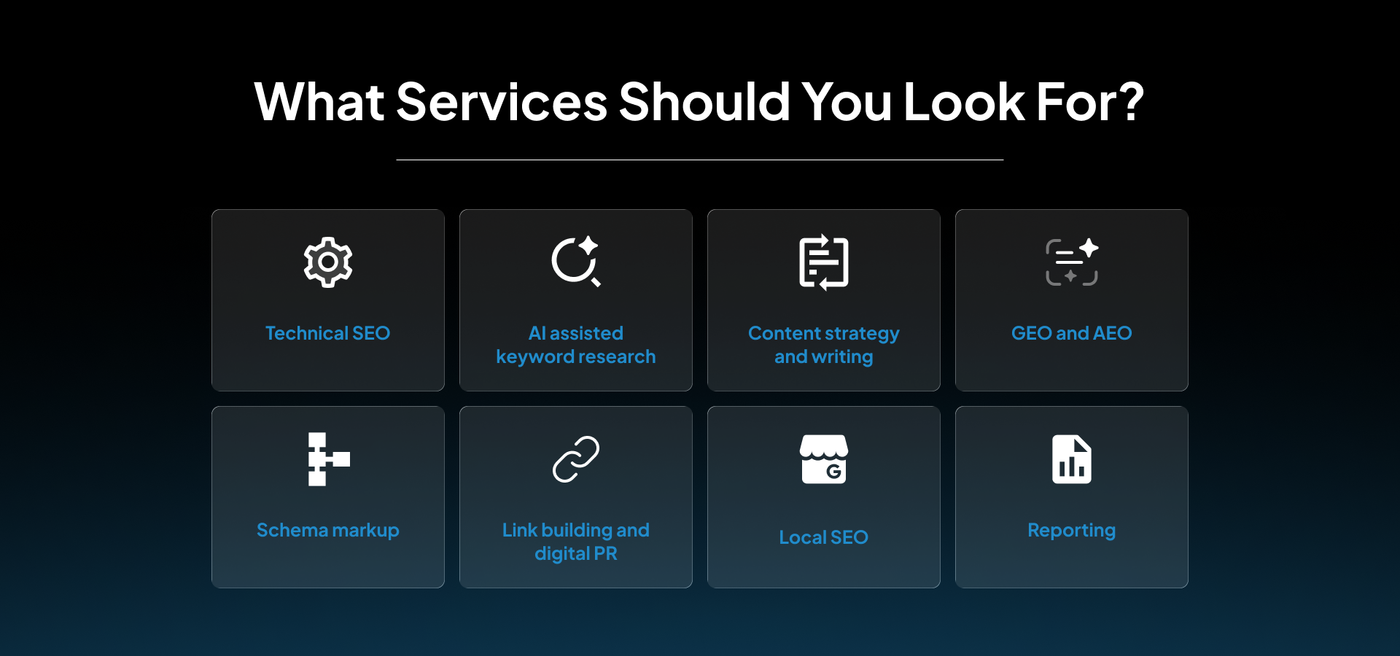
A good agency covers the SEO fundamentals and the newer AI answers work under one plan, and can explain what each piece actually does for your business.
-
Technical SEO: finding and fixing the behind the scenes faults, slow pages, broken links, pages Google cannot read properly, that quietly cap everything else you do.
-
AI assisted keyword research: using AI to surface what buyers search for and ask AI tools, with a person deciding which topics are worth spending your budget on.
-
Content strategy and writing: planning and producing pages that answer real questions better than whatever ranks today, then keeping them current as the topic moves.
-
GEO and AEO: shaping your content, structure and off site mentions so AI tools describe you accurately and name you in answers, not just rank you.
-
Schema markup: small pieces of code that spell out to search engines exactly what a page is, a product, a review, an FAQ, so it can show up as a richer result.
-
Link building and digital PR: earning mentions and links from relevant, credible sites, which is also one of the strongest signals for whether AI tools trust and repeat your name.
-
Local SEO: tightening your Google Business Profile, reviews and local listings if you serve specific areas or want to appear in the map results.
-
Reporting: clear monthly updates on rankings, traffic, leads and how often AI tools mention you, written so you can see what moved and why.
Which AI Models Should They Optimize For, and How Do They Track It?
A good AI SEO agency optimizes for the specific AI tools your buyers actually use, and tracks whether you get named and cited in each, not just whether you rank.
The AI tools worth covering in 2026 are Google AI Overviews and AI Mode, ChatGPT, Perplexity, Gemini and Microsoft Copilot. They do not all work the same way. Some answer mainly from a live scan of the web, others answer from what they already learned plus a bit of live browsing, and Google's lean mainly on Google's own search results. You cannot tune each one directly, so the real work is strengthening the signals they all rely on, clear and accurate content, solid page structure, consistent business information, reviews and mentions on other websites, then checking the result inside each tool.
So ask which surfaces an agency focuses on and why. If your customers research on ChatGPT and Perplexity, an agency that only talks about Google is missing where your buyers already are. And since AI Overviews now appear on a sizable share of Google searches, and far more in research heavy niches like health and finance (Search Engine Land), Google's AI answers are rarely optional either.
Tracking is where real GEO work separates itself from guesswork. Rather than one off checks, a serious agency runs a fixed list of the questions your buyers ask, on a schedule, and logs a few clear numbers:
-
Visibility, or inclusion rate: how often you get named across that set of prompts.
-
Citation rate: how often you are not just mentioned but cited with a link back to your site.
-
Share of voice: your mentions measured against your competitors' for the same questions.
-
Position and tone: whether you show up early or buried, and whether the tone about you is positive, neutral or flat out wrong.
Tools like Otterly.ai, Perc AI, Profound, Ahrefs Brand Radar and the Semrush AI toolkit automate this logging across engines, and Google Analytics can flag referral visits arriving from AI tools. A capable agency shows you these numbers moving month over month, not a single screenshot from pitch day.
How Do You Choose the Right Agency? (7 Things to Check First)
The trick is to turn every vague promise into evidence, so here are seven things to check before you sign, and what a good answer actually looks like for each.
-
Industry experience and case studies. Ask for two or three examples from businesses like yours, with real numbers and a client you can call. A strong agency walks you through before and after traffic, leads or AI mentions and explains exactly what they changed. A weak one shows a wall of logos and a vague "we grew traffic 300%" with no context behind it.
-
A real balance of AI and human expertise. AI is fast at research and drafting, but it invents facts and misses context, so you want people setting strategy and editing content before anything goes live. Ask who writes and who checks. If the honest answer is "the AI handles most of it," expect thin, generic pages.
-
Transparent tools, process and reporting. They should name their tools, explain their process in plain English, and show you a sample report before you commit. If you cannot follow how they work, you cannot judge whether it is working, and "proprietary method" with no detail usually means there is not much underneath.
-
White hat, Google compliant methods. White hat simply means following search engine guidelines instead of trying to trick them. Ask where links come from and how content gets produced. Bought links, private blog networks and mass produced pages can get your site penalized, and digging out of a penalty takes months you will be paying for.
-
Customized plans, not cookie cutter packages. A real proposal reflects your site, your competitors and your goals. If the plan could be sent to any business with the name swapped out, it probably was. Good agencies run an audit before they quote; weak ones quote you a fixed package on the first call.
-
Communication and support. Find out exactly who your day to day contact is, how often you will hear from them, and how fast they reply. Agencies that are slow to respond while they are still selling to you almost never speed up once you are the one paying.
-
Pricing and contract flexibility. Look for clear pricing and a sensible exit, usually around 30 days notice. A confident agency does not need to trap you in a year-long contract, and a short first term lets you judge the actual work before you commit to more.
What Red Flags Should Make You Walk Away?
Some pitches sound impressive but are actually warning signs, so walk away when you hear these.
"We guarantee you'll rank number one." Nobody controls Google's algorithm, and Google's own guidance tells site owners to be wary of anyone promising specific rankings. An agency making that promise is either misleading you or planning risky tactics that can backfire on your site.
"Our AI publishes 50 articles a month." Volume is not the goal, and it is often the problem. A flood of unedited AI pages tends to be thin, generic and sometimes wrong, and Google's spam policies target content mass produced to game rankings, no matter who or what wrote it.
Vague reports, secret methods and long lock-ins. Be wary of reports that never tie back to leads, "proprietary" link sources they will not explain, and contracts that bind you for a year with no way out. A confident agency is happy to show its work and let the results, not the paperwork, keep you around.
What Should You Ask Before You Hire Them?
Ask these on the discovery call and judge the answers by how specific they are, because specifics are the hard thing to fake.
-
"How do you use AI, and where do humans step in?" A good answer names the tasks AI handles, research, first drafts, data analysis, and names the point where a person reviews and edits. "We use the latest AI" tells you nothing.
-
"How do you measure ROI?" ROI, or return on investment, is what you get back for what you spend. You want to hear about leads, calls and revenue, not just rankings and traffic. If the entire answer is about rankings, they are measuring the wrong thing.
-
"How do you track whether I show up in AI search?" A real answer describes a repeatable method, running a set list of prompts, logging mentions and citations, often a named tool, and admits these trackers are still maturing. Anyone claiming perfect AI tracking is overselling.
-
"Can I see case studies in my industry?" If they have none, it is not an automatic no, but ask how they plan to get up to speed on your market, and be more cautious about any timeline they promise.
How Do You Know If a Proposal Is Actually Good?
A good proposal reads like a plan you could hold them to, with specific deliverables, numbers and dates, not just a list of services.
Clear goals, KPIs and timelines. KPIs, or key performance indicators, are the specific numbers you will track, like organic leads or sales from search. Each should come with a realistic timeframe. Be suspicious of fast promises, because most SEO takes months to build up, so a proposal pledging big wins in weeks is either guessing or cutting corners.
Defined deliverables and tools. You should see what you actually get each month, so many pages written, so many fixes made, outreach done, plus the tools they will use. "Ongoing optimization" with nothing specific under it is not a deliverable, it is a placeholder.
Reporting you will actually read. Expect a monthly report and a short call, in plain language, that connects the work to leads and revenue instead of burying you in charts. If the sample report is all rankings and no business outcomes, that is how they will report once you have signed.
How Much Do AI SEO Services Cost?
AI SEO cost depends on how much work your site and market need, but here are the usual pricing models with rough 2026 ranges to anchor your budget.
Those figures are rough 2026 ranges from industry pricing surveys and skew toward the US and other English speaking markets, so treat them as a starting point, not a quote. For context, the most cited survey puts the average agency retainer near $3,200 a month, while the most common band sits around $500 to $1,000. For a fuller breakdown of what each budget actually buys, see our guide to how much SEO services cost.
Your price mostly comes down to the size of your site, how competitive your market is, and how much content and link building the plan needs. A local plumber with a 20 page site and a national software company are simply not buying the same thing, even when both are sold as AI SEO services.
And the cheapest option often costs more later. Very low prices usually mean mass produced content, poor quality links or almost no human attention, which can leave your site needing a cleanup before real work can even begin. You end up paying twice, once for the cheap work and again to undo it.
Your Simple Step by Step Checklist for Choosing an Agency
Choosing an SEO agency gets much easier when you run every candidate through the same six steps.
-
Set goals and budget. Decide what success looks like and what monthly AI SEO cost you can sustain for at least six months.
-
Shortlist. Pick three to five agencies that work with businesses of your size and type.
-
Check reviews. Read Google and Clutch reviews, and ask for references you can actually call.
-
Book a discovery call. Use the questions from section 7 and note how specific each answer is.
-
Compare proposals. Line them up against sections 5 and 8, not just on price.
-
Start with a pilot. Begin with a short engagement or a defined project before signing anything long term.
How Can You Get the Best Results After You Hire One?
You'll get the most from an AI SEO agency by treating it as a working partnership, not a service you switch on and forget.
-
Share goals and data access. Give them access to Google Analytics, Search Console and your CRM (your customer database) so they can see what actually turns into sales.
-
Review content for brand voice. You know your customers better than anyone, and a quick review keeps content accurate and sounding like you.
-
Hold regular check-ins. A monthly call keeps priorities aligned and stops small issues from becoming lost months.
-
Track leads and revenue, not just rankings. Rankings are a means to an end. Judge the work by the qualified leads and sales it brings in.
Conclusion
The right AI SEO agency can prove its results, explains how it blends AI with human judgment, and ties every report back to leads and revenue. Look past the label, check the methods, and be wary of anyone promising guarantees. A short pilot will tell you more than any sales deck.
FAQs
What does an AI SEO agency actually do?
An AI SEO agency improves a business's visibility in Google and in AI tools like ChatGPT and Perplexity through technical fixes, content, link building and answer optimization. It uses AI to speed up research, while human specialists set strategy and check quality.
How do I know if an AI SEO agency is legit?
A legitimate AI SEO agency shows case studies with real numbers, explains its methods clearly, and never guarantees specific rankings. Ask for references you can call, and walk away if it's vague about where its links or content come from.
Is it better to hire an AI SEO agency or build an in-house team?
An agency usually makes more sense when you need several skills quickly without hiring specialists and paying for tools yourself. An in-house team becomes the better choice when SEO is central to your business and there's enough steady work to keep specialists busy full time.
Do AI SEO services work for small businesses?
Yes, AI SEO services can work well for small businesses, especially when customers research online before buying. The plan just needs to fit the business, focusing on local search, a handful of high value pages and a sustainable budget.
Is AI generated content safe for SEO?
AI generated content can be safe for SEO when a knowledgeable person edits it, checks the facts and adds real experience. The risk comes from publishing unedited, generic content at scale, which tends to be unhelpful and can fall under Google's spam policies.
Will Google penalize AI generated content?
No, Google doesn't penalize content simply because AI helped create it, since it evaluates quality and helpfulness regardless of how content was produced. However, content mass produced mainly to manipulate rankings can be treated as spam, whether a person or a tool wrote it.
Can AI replace an SEO agency?
AI tools can handle many SEO tasks, such as keyword research, drafting and data analysis, but they can't replace experienced people's judgment and accountability. Most businesses get better results from skilled people using AI well than from AI tools working alone.
How much do AI SEO services cost?
AI SEO cost varies widely with site size, market competition and scope of work, so there's no single standard price. Most agencies charge a monthly retainer, and a trustworthy one gives you a custom quote after reviewing your site.
Why are some AI SEO agencies so cheap?
Very cheap AI SEO agencies usually keep costs down with fully automated content, low quality links and little human review. That approach saves money at first but often leads to weak results or expensive cleanup later.
Who owns the content and data after the contract ends?
Ownership of content, site changes and analytics data depends on your contract, so check those terms before you sign. It's also smart to set up accounts like Google Analytics and Search Console in your own business's name from day one.