

SEO is how you help your business show up when people search on Google. When someone types "plumber near me," SEO helps decide whether they find you or the shop down the street.
That matters because buyers check you out online first. According to BrightLocal's Local Consumer Review Survey (2026), only 4% of US consumers say they never read online reviews of local businesses. Almost everyone looks you up before they call.
This guide covers what small business SEO services are, what's included, what they cost, and how to spot a bad deal. One note up front I run an organic SEO agency, NFlow. I'll still tell you when hiring one, including mine, isn't worth it.
What Are SEO Services?
SEO services are the work an SEO provider does to help your website rank higher on Google and show up in AI answers. That work includes fixing technical problems, finding what customers search for, improving your pages, building your local presence and reporting results each month.
An SEO provider is the freelancer, agency or consultant you hire to do this work.
Each month, your provider fixes site errors, updates pages, refreshes content, works on your Google listing, earns links and sends a report.
SEO services for small businesses look different from big company SEO. A national retailer chases thousands of search terms. A small business needs fewer pages, a tight local focus and wins you can count in calls.
SEO vs. AEO vs. GEO
-
SEO: helping your site rank in regular Google results.
-
AEO : shaping your content so tools like Google's AI Overviews can pull a direct answer from it.
-
GEO : helping AI chat tools like ChatGPT and Perplexity mention or cite your business.
Small business search engine optimization still comes first, because AI answers often draw on pages that already rank. According to a 2025 industry study, 76% of AI Overview citations come from pages in Google's top 10. No single tactic guarantees an AI citation.
What's Included in Small Business SEO Services?
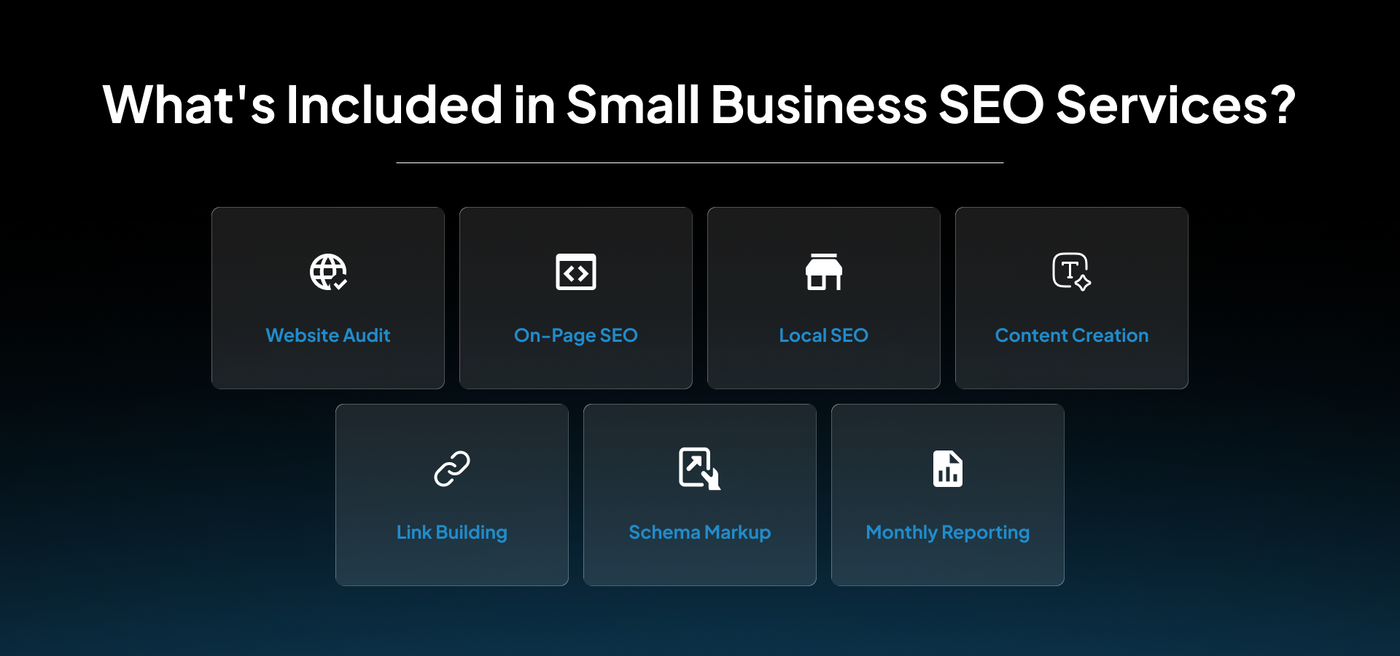
Small business SEO services usually include eight parts: a technical audit, keyword research, on-page SEO, content, local SEO, link building, schema markup and monthly reporting. Each part should come with proof you can see, such as a list of fixes, a keyword map or a report tied to calls and leads.
Website audit and technical fixes
Technical SEO for small businesses makes sure Google can find, load and read your site. It covers speed, mobile layout and indexing (Google storing your page so it can appear in results). Proof: an audit that ranks problems by priority, then a log of what got fixed.
Keyword research and search intent
A keyword is the phrase people type into Google. Search intent is the goal behind it, like buying, comparing or learning. Your provider picks terms real customers use and matches each one to a single page. Proof: a keyword map showing which page targets which phrase.
On-page SEO
On-page SEO means improving things on your own pages: titles, headings, text, images and the links between your pages. As a former content writer, I know people scan before they read, so clear headings help readers and Google. Proof: before-and-after page changes.
Content creation and updates
New service pages, location pages, FAQs and articles give Google more reasons to show you. Refreshing an old page often beats writing a new one. Proof: a content calendar and links to new or updated pages.
Local SEO and Google Business Profile
Your Google Business Profile is the free listing that appears in Google Maps and the local "map pack." Local SEO services for small businesses fix your profile, clean up directory listings and help you earn reviews. Proof: profile data showing calls, direction requests and website clicks.
Link building and brand mentions
A backlink is a link from another website to yours. Google treats good ones as a sign of trust. Small business link building services should earn links from local news, partners and industry groups. Proof: a list of every link you can check yourself.
Schema markup and AI search visibility
Schema markup is code that labels facts on your page, like hours or prices, so search engines read them correctly. It never guarantees special results or AI mentions. Proof: a clean result in Google's Rich Results Test.
Monthly reporting
A good report shows impressions (how often you appeared in search), clicks, CTR (click-through rate, the share of searchers who clicked) and, most important, leads. Proof: data from Google Search Console and GA4 accounts you own.
How Much Do Small Business SEO Services Cost?
According to a 2026 survey of 300+ SEO agencies, local and small business SEO services typically cost $500 to $1,500 a month, and small businesses competing nationally should expect $1,500 to $3,000. A full technical audit runs $1,500 to $5,000, and hourly rates usually range from $50 to $200.
The survey covers agencies worldwide, and 43.3% of them charge under $1,500 a month. The same 2026 report puts typical North American retainers at $2,500 to $10,000+, so US prices sit toward the higher end. All small business SEO pricing varies by market and scope.
Affordable SEO services for small businesses are plans a few extra customers could pay for. If one new client is worth $2,000, a $1,000 retainer can make sense.
What Do You Get at Each Price Level?
Most SEO packages for small businesses fall into three levels: a starter plan for one location, a growth plan for steady content and links, and a scale plan for several locations or national goals. Higher tiers buy more work, not magic.
Prices are rising: 54.3% of agencies raised rates in 2025 to 2026, most often to cover AI search work (2026 survey). Common add-ons from the same report: link building at $500 to $3,000+ a month, content at $100 to $500+ per piece, and AI search optimization from $900 a month.
The 3-Question Budget Test
Answer these first:
-
What is one new customer worth to you over a year?
-
How many extra customers a month would cover the fee?
-
Can you keep paying for 6 to 12 months before you see a return?
If question two needs more than a handful of customers, or question three is a no, start smaller or wait.
What Makes SEO Cost More or Less?
SEO costs more when your keywords are competitive, your goals are national, your website needs repairs, you need lots of new content, or you work in a strict industry like health, law or finance. SEO costs less when you serve one local area with a healthy site and modest competition.
Here's what drives a quote.
-
Keyword difficulty: "Personal injury lawyer Houston" needs far more content and links than "dog groomer in Boise."
-
Local vs. national goals: SEO for local business websites focuses on one area, so it costs less. A 2026 agency survey puts local SEO at $500 to $1,500 a month, while enterprise campaigns run $5,000 to $15,000+.
-
Your site's current condition: A slow or broken site needs repairs before growth work.
-
How much content you need: Ten service areas may need ten location pages.
-
Strict industries: Google holds health, legal and money topics to a higher standard, because bad advice can hurt people. Expect expert review.
SEO services for startups often cost more per result, because a brand-new domain has no history.
How Long Does SEO Take to Work?
SEO usually shows early signs in 3 to 6 months and steadier results in 6 to 12 months or longer. Timing depends on competition, site age and health, and budget.
How long does SEO take for a new page? Longer than most owners hope. According to an industry study (2025), only 1.74% of newly published pages reached Google's top 10 within a year. The average #1 page was 5 years old.
A rough timeline for a local business:
-
Months 1 to 3: Technical fixes, profile cleanup, first page updates. Rankings may barely move.
-
Months 3 to 6: Impressions rise, map rankings improve and a few new calls come in.
-
Months 6 to 12: More pages rank and leads grow.
Early signs it's working
-
Impressions in Google Search Console climb month over month.
-
Your Google Business Profile shows more calls and direction requests.
-
You show up in the map pack for more nearby searches.
-
Long, specific searches start sending visitors.
Is SEO Worth It for a Small Business?
SEO is worth it for a small business when customers search for what you sell, each customer is worth enough to cover the fee, and you can wait 6 to 12 months. SEO is not worth it if you need sales this month, have no budget runway, or sell something nobody searches for.
Paid ads stop when you stop paying. Pages that rank keep bringing visitors with no fee per click, which often lowers your cost per customer over time.
The best SEO strategies for small businesses measure money, not just visits. Track these:
-
Google Search Console: impressions, clicks and the searches that found you.
-
GA4 (Google Analytics 4): form fills and purchases from organic search.
-
Call tracking: a unique phone number that counts calls from search.
Worked example (illustrative example, not a real result)
-
Cost: $1,200 a month × 12 months = $14,400
-
Leads from organic search in year one: 60, so $14,400 ÷ 60 = $240 per lead
-
If 1 in 3 leads books a $1,500 job: 20 × $1,500 = $30,000 in sales
If the math only works with wild guesses, put the money into ads or referrals for now.
Which Small Businesses Get the Most From SEO?
Small businesses get the most from SEO when customers search before they buy and each sale is worth a lot. Home services, law firms, dentists, clinics and other local service businesses usually see the strongest payoff. Restaurants win mostly through maps and reviews.
-
Home services (plumbers, HVAC, roofers, electricians): Urgent "near me" searches drive calls. Watch for fake competitor listings in the map pack.
-
Law firms: High case values justify the spend, but competition is fierce.
-
Dentists and healthcare clinics: Patients search by service and area. Medical content needs expert review.
-
Real estate agents: Neighborhood guides attract buyers early. Big listing sites dominate, so target local topics.
-
Restaurants and cafes: Maps, photos and reviews matter most. BrightLocal (2025) found 74% of US consumers check two or more review sites.
-
Salons, spas and wellness studios: Service and booking searches convert well. Keep hours, prices and photos current.
-
Gyms and fitness studios: Class and location pages win local searches. Demand swings by season.
-
Auto repair shops and dealers: Repair searches show clear buying intent. Dealers compete with large car marketplaces.
-
Accountants and financial advisors: Helpful guides build trust. Money topics face stricter quality standards.
-
Online stores: Product and category pages drive sales. Duplicate pages can hold you back.
-
B2B and SaaS companies: Longer buying cycles reward in-depth content. Measure demo requests, not just traffic.
-
Coaches and training providers: Narrow, helpful articles build authority faster than broad ones.
-
Wedding, event and photography businesses: Portfolio and local venue pages attract couples. Compress images for speed.
SEO takes longer and costs more in crowded fields like personal injury law, plastic surgery and finance.
-
A bad SEO agency promises guaranteed rankings, buys cheap links, publishes unchecked AI content, keeps you out of your own data, and locks you into long contracts with vague deliverables. Two or more means walk away.
-
Here are the SEO agency red flags to check first, and the green flags to look for instead:
How to Choose the Right SEO Provider
The right SEO provider explains their plan in plain English, shows results from businesses like yours, gives you full access to your data, and ties every report to leads. Ask every candidate the same questions and choose on proof, not promises.
The best SEO company for small businesses is the one that fits your goals and budget. Whether you hire an AI SEO agency, a traditional agency or a small business SEO consultant, ask these:
-
What would you fix first on my site, and why?
-
Which keywords would you target, and how did you pick them?
-
Can I see results from a business like mine?
-
Who does the work, and are any tasks outsourced?
-
How do you earn links, and can I see examples?
-
How do you use AI, and who reviews the content?
-
Will I own my Analytics, Search Console and Google Business Profile?
-
What will each monthly report show?
-
How do you track calls and leads?
-
What are the contract length and exit terms?
What a good proposal and audit should include
A good proposal lists specific findings from your site, a 90-day plan, monthly deliverables and how success gets measured. My content-writer test: if the proposal is full of jargon, the reports will be too.
Why niche case studies matter
A win for an online store tells you little about ranking a dental office. Ask for examples in your industry or a similar local market.
If AI search matters to you, see how to choose the right AI SEO agency.
Conclusion
The best place to start with SEO is your free Google Business Profile and a quick check of your site in Google Search Console. Those two steps show where you stand today before you spend a dollar on an SEO provider.
FAQ
What are SEO services?
SEO services are the work an SEO provider does to help your website rank higher on Google and appear in AI answers. Typical services include technical fixes, keyword research, on-page updates, content, local SEO, link building and monthly reports tied to calls and leads.
Can a small business do SEO on its own?
Yes, a small business can handle basic SEO on its own. You can set up your Google Business Profile, ask for reviews, write clear service pages and use free Google Search Console. Hiring help makes sense when competition is high or technical problems slow you down.
Can AI tools replace an SEO service?
AI tools can speed up research, drafts and audits, but they can't replace an SEO service on their own. Someone still needs to check facts, set priorities, fix technical issues and earn real links. Google judges content by quality and helpfulness, however it was made.
How do I get my business to show up in AI answers?
To show up in AI answers, start with strong SEO, since AI tools often cite pages that already rank. Answer common questions clearly on your site, keep business details consistent everywhere, earn mentions from trusted sites and use schema markup. No tactic guarantees an AI citation.
Is local SEO different from regular SEO?
Yes. Local SEO focuses on showing up in Google Maps and nearby searches, using your Google Business Profile, reviews and local directory listings. Regular SEO focuses on ranking web pages for broader searches. Most local businesses need both, with local SEO as the starting point.
Do I need a long-term contract?
No, you don't need a long-term contract to get good SEO. Many providers offer month-to-month terms or a short starting commitment. If you do sign a longer contract, make sure it lists clear monthly deliverables and includes a fair exit clause.
What should a monthly SEO report include?
A monthly SEO report should show impressions, clicks, rankings for key terms, Google Business Profile calls and, most important, leads or sales from organic search. It should also list the work done that month, what's planned next and any problems that need your attention.