

An SEO marketing campaign is a time-boxed, goal-driven effort to improve a website's organic visibility for a specific set of keywords, pages, or business outcomes. It has a start date, a defined scope, and a number attached to it unlike general SEO work, which just keeps rolling forever.
By the end of this guide you'll have a framework you can actually run: seven steps in the order they should happen, a 90-day timeline, realistic cost ranges, and the metrics that tell you whether any of it worked.
A quick note on why 2026 changes things. Google's AI Overviews now sit above the traditional blue links for a large share of informational queries, so the click you used to win at position three might not exist anymore. Meanwhile paid search costs keep climbing in competitive B2B and legal verticals, pushing more businesses back toward organic. A campaign built the way campaigns were built in 2021 leaves a lot on the table.
This is written for in-house marketers, founders running SEO themselves, and anyone briefing an SEO agency who wants to know what "good" looks like before signing.
What Is an SEO Marketing Campaign?
An SEO marketing campaign is a coordinated set of SEO activities executed over a defined period to achieve one measurable goal, such as ranking a service page in the top five or growing organic leads from a specific product category.
The difference between a campaign and general SEO work is boundaries. General SEO is maintenance: fix broken links, publish when you can, check Search Console occasionally. A campaign says this page, these keywords, this quarter, this number.
In practice it looks like this. A B2B software company wants demo requests from organic. Scope: one pillar page plus six supporting articles, a technical cleanup of the product section, internal links routed to the demo page, outreach to twelve industry publications. Timeline: 90 days. Success metric: organic demo requests, not rankings.
SEO Campaign vs SEO Strategy: What's the Difference?
An SEO strategy is the long-term plan that defines which topics and audiences a business will own in search; an SEO campaign is a time-boxed execution of one part of that plan.
Direction versus movement. Your strategy might be "become the reference site for organic SEO in the mid-market." That doesn't expire. A campaign inside it might be "rank the organic SEO services page in the top five for its four primary commercial keywords by end of Q2."
-
Duration. A strategy runs 12+ months with no fixed end. A campaign runs 30 to 180 days, then stops so you can evaluate.
-
Scope. A strategy covers the whole site and brand. A campaign targets a specific cluster or funnel stage.
-
Output. A strategy produces priorities. A campaign produces published pages, fixed errors, earned links, and a report.
-
Failure mode. A strategy fails slowly and quietly. A campaign fails visibly at the 90-day review, which is exactly why campaigns are useful.
You need both. Campaigns without a strategy become disconnected bursts of activity. A strategy without campaigns never gets executed.
How to Do an SEO Marketing Campaign in 7 Steps
A complete SEO marketing campaign runs through seven sequential steps: setting a single goal and baseline, mapping keywords to intent, analyzing competitor gaps, fixing technical foundations, building full-funnel content, optimizing on-page and internal links, and optimizing for AI search.
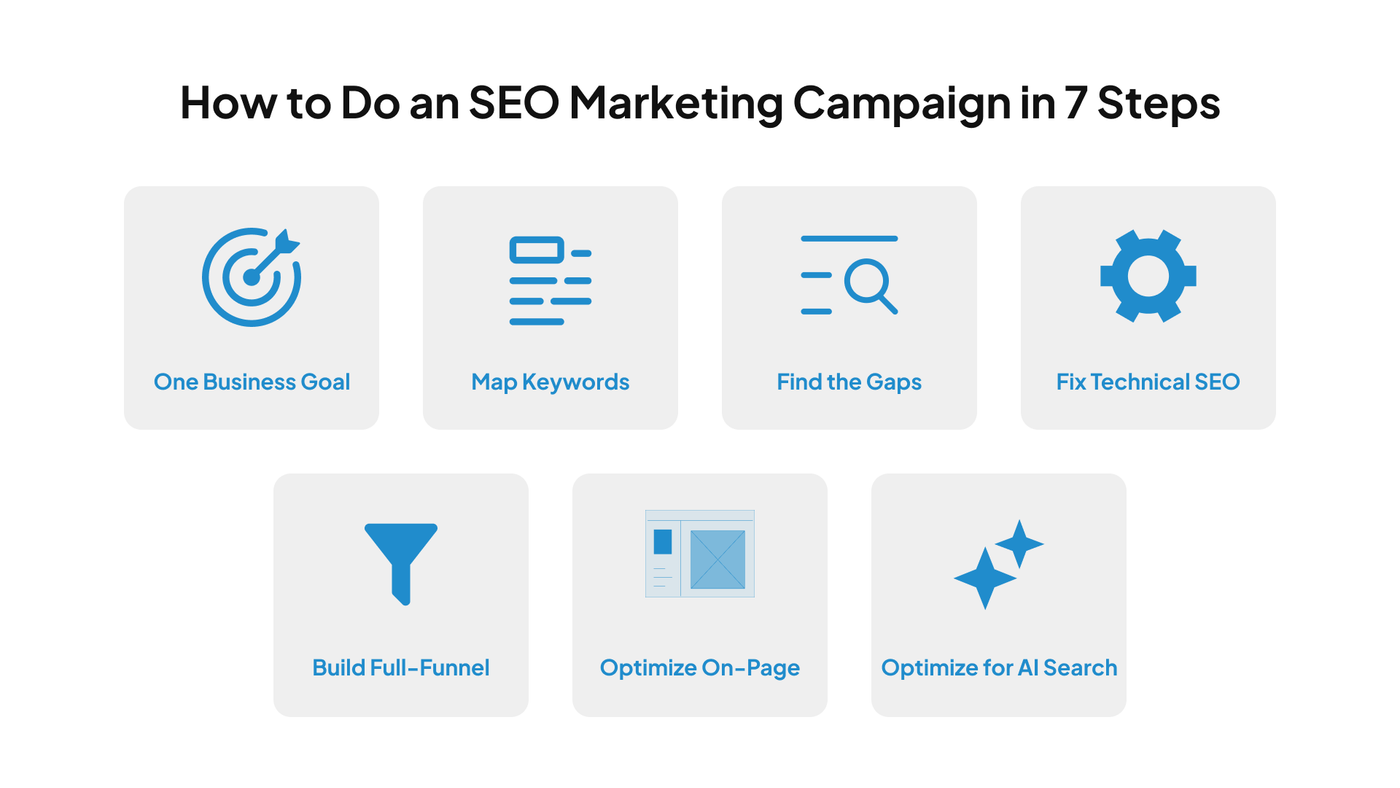
Order matters more than people assume. Publishing content before fixing a crawl problem is how you end up with forty articles Google never indexed.
Step 1: Set One Business Goal and Baseline Your Site
Every SEO campaign should have exactly one primary goal, defined as a business outcome rather than a ranking position.
One goal. Not four. The moment a campaign chases blog traffic and service page rankings and local visibility, resources split three ways and nothing moves far enough to matter.
Good campaign goals sound like: increase organic demo requests from 12 to 25 per month, or generate 30 qualified leads monthly from the services section. Bad ones sound like "improve organic SEO."
Baselining is the part people skip and regret at the 90-day review, because they have nothing to compare against. Before work starts, record:
-
Organic traffic and conversions in GA4, segmented to the pages in scope, for the previous three months
-
Impressions, clicks, average position, and query coverage in Google Search Console
-
Starting rank positions for target keywords in Ahrefs or Semrush
-
Technical health: crawl errors, indexed page count, Core Web Vitals status
-
Referring domains to the pages in scope
Export all of it. The Search Console only holds 16 months of data.
Step 2: Map Keywords to Search Intent
Search intent determines what type of page you build, not just which keyword goes in the title tag.
-
Informational. "What is technical SEO?" I need guides. Converts poorly, builds topical authority.
-
Commercial. "Best SEO agency," "SEO pricing." Needs comparisons and pricing transparency. Most B2B revenue originates here.
-
Transactional. "Hire an SEO agency." Needs a service page with proof and a low-friction contact path.
Here's where intent mapping changes the build. Two keywords can look nearly identical and need completely different pages. "SEO campaign cost" wants a pricing breakdown with real numbers. "SEO campaign services" wants a service page with process and a CTA. Put both on one page and you satisfy neither.
Practical method: search each target keyword in incognito and look at what's ranking. If the top ten are all blog posts, a service page won't break in no matter how well optimized. Google has already told you the format.
Check for cannibalization before writing anything. Run site:yourdomain.com "keyword". If three of your own pages appear, consolidate first.
Step 3: Find the Gaps Your Competitors Left Open
You're not copying competitors. You're finding what they didn't cover.
Competitive gap analysis means identifying keywords, content angles, backlinks, and SERP features your competitors have captured that you haven't plus the ones nobody has captured.
-
Content gaps. Keyword Gap in Semrush or Content Gap in Ahrefs. Enter your domain plus three competitors, filter for terms where they all rank and you don't. Then read the top three pages end to end and note what they leave unanswered. There's usually an obvious hole: pricing, timelines, a real example.
-
Backlink gaps. Backlink Gap or Link Intersect. Sites already linking to two or three competitors are your warmest outreach targets.
-
SERP feature gaps. Featured snippet, People Also Ask, AI Overview. If a competitor owns the snippet, write a tighter answer paragraph. Snippets flip more easily than rankings.
Worth flagging: don't benchmark against the biggest brand in your space. Semrush ranks for everything because it's Semrush. Benchmark against sites with a similar authority profile.
Step 4: Fix Technical SEO Foundations
Technical SEO fixes must come before content production, because Google cannot rank pages it cannot crawl, render, or index.
Skip this and everything after gets weaker. You'll publish good content into a section Google barely crawls and earn backlinks pointing at pages with a stray noindex tag.
-
Indexation. Compare indexed pages in the Search Console Pages report against your sitemap count. A big gap usually means a noindex, a bad canonical, or thin content Google chose not to keep.
-
Crawlability. Run Screaming Frog. Look for 4xx errors, redirect chains longer than one hop, orphan pages, blocked resources.
-
Canonicals. Self-referencing on unique pages, correct cross-page on duplicates. Misconfigured canonicals silently kill more campaigns than almost anything else.
-
Core Web Vitals. Use the Search Console report, not just PageSpeed Insights, because it uses real field data. Target LCP under 2.5s and INP under 200ms.
-
Mobile rendering. Everything is mobile-first indexed. If content breaks on mobile, that's the version Google evaluates.
Priority order: indexing and canonicals first, crawl errors second, speed third. A fast page that isn't indexed is worth nothing.
Step 5: Build Full-Funnel Content
A full-funnel content plan produces pages for awareness, consideration, and decision stages instead of chasing high-volume keywords alone.
The failure here is predictable. Teams pick the biggest volume terms, write ten informational posts, get traffic, generate zero leads.
-
Top of funnel. Guides, explainers, statistics roundups. Builds authority and earns links. Converts at low single digits, and that's fine.
-
Middle of funnel. Comparisons, alternatives pages, buyer's guides, case studies. Chronically underbuilt on most sites, and where the highest-value queries live.
-
Bottom of funnel. If you're building these around search rather than paid traffic, our guide to organic SEO covers how service pages should be structured.
Sequencing matters. Don't publish twenty pieces in month one. A workable pace for a small team:
-
Weeks 1–4: Build or rebuild the bottom-of-funnel money page first. It converts, and it's usually the neglected one.
-
Weeks 5–8: Publish two or three middle-of-funnel pieces that link into it.
-
Weeks 9–12: Add top-of-funnel content that supports the cluster and gives outreach something linkable.
That order means conversions start in month one rather than month five.
Step 6: Optimize On-Page and Internal Links
On-page SEO aligns each page's title tag, headings, URL, and content structure with the search intent behind its target keyword.
-
Title tags. Primary keyword near the front, 50–60 characters, written to earn a click. Google rewrites roughly a third of titles anyway, so make yours worth keeping.
-
Meta descriptions. Around 150 characters. Not a ranking factor, definitely a click factor.
-
URLs. Short, lowercase, no dates. /blog/seo-marketing-campaign/ beats /2026/03/how-to-do-an-seo-marketing-campaign-guide/.
-
Headings. One H1. H2s that answer real questions. Headings are how both readers and language models parse a page.
Internal linking deserves more attention than it gets, and it's the cheapest lever in the campaign. You already own the pages and the links.
-
Every supporting article in the cluster links to the money page, using varied descriptive anchor text.
-
The money page links back out to two or three of the strongest supporting pieces, no more.
-
Supporting articles link to each other where genuinely relevant, not systematically.
-
Never use "click here." Use the topic.
One specific tactic: sort your existing pages by URL Rating in Ahrefs and add a contextual link from the strongest ones to your campaign target page. Takes an hour, often the highest-ROI action in the whole campaign.
Step 7: Optimize for AI Search (AEO + GEO)
AEO (Answer Engine Optimization) is the practice of formatting content so it can be extracted as a direct answer by AI systems; GEO (Generative Engine Optimization) is the broader practice of making a brand discoverable, understandable, and citable by generative search engines.
Five years ago this step didn't exist, because the destination was always a blue link. Now a meaningful share of searches end inside an AI Overview, a ChatGPT reply, or a Perplexity answer, and the brand cited there captures attention regardless of organic position.
-
Write extractable answer sentences. Open each section with one complete sentence that answers its question without depending on context. No pronouns pointing backward. If a model lifts it alone, it should still be correct.
-
Deploy structured data. FAQPage, HowTo, Article, and Organization schema. Validate in Google's Rich Results Test before shipping.
-
Use question phrasing in headings. "How much does an SEO campaign cost" outperforms "Pricing considerations."
-
Strengthen E-E-A-T signals. Named authors with linked profiles, published and updated dates, cited sources. AI systems weigh source credibility heavily.
-
Build brand mentions, not just backlinks. Unlinked mentions still shape how models associate your brand with a topic. Podcasts, expert quotes, industry roundups, digital PR.
One honest caveat: nobody can guarantee AI citations. The systems are opaque and change often. What you can control is being the easiest correct answer to extract.
Your 90-Day SEO Campaign Timeline
A realistic SEO campaign timeline runs in three 30-day phases: foundation and research, build and optimize, then amplify and measure.
Ninety days isn't arbitrary. Long enough for fixes and new content to be crawled, indexed, and start ranking. Short enough that you'll notice if it isn't working.
Days 1–30: Foundation
-
Lock the single goal and record every baseline metric
-
Run the technical audit and fix indexing, canonical, and crawl errors
-
Complete keyword research and intent mapping for the cluster
-
Finish competitor gap analysis and build the outreach target list
-
Publish or rebuild the primary money page
Expect no ranking movement this month. That's normal, not failure.
Days 31–60: Build
-
Publish two to four middle-of-funnel pieces
-
Roll out on-page optimization across pages in scope
-
Deploy the internal linking structure
-
Add Article, FAQPage, and Organization schema
-
Begin outreach to the targets identified in week three
The first movement usually appears here. Long-tail terms start ranking, and impressions climb in Search Console before clicks do.
Days 61–90: Amplify and Measure
-
Publish supporting top-of-funnel content
-
Continue outreach and digital PR
-
Refresh anything stuck on page two, usually a depth or intent-match problem
-
Run the full review against baseline and build next quarter's roadmap
Fair expectation at day 90: measurable ranking improvement, rising impressions and clicks, early conversion signal. Full compounding takes six to twelve months. Anyone promising page one in 90 days for a competitive commercial term is selling something.
How Much Does an SEO Campaign Cost?
SEO campaign costs are driven by competition level, the site's current technical condition, content volume, and how much link acquisition is required.
A campaign for a local service business and one for a SaaS company competing against Semrush are not the same product. The ranges below reflect commonly reported market pricing rather than any single agency's rate card.
What pushes cost up: competitive verticals like legal and insurance, significant technical debt, large page counts needing template-level fixes, and campaigns where links are the bottleneck. What brings it down: a technically healthy site, an existing in-house writer, and narrow geographic focus.
Be cautious below roughly $500 a month. At that rate the math doesn't support real technical work, original content, and genuine outreach
How to Measure SEO Campaign Success
SEO campaign success should be measured across three layers: visibility metrics, engagement metrics, and business outcomes with business outcomes carrying the most weight.
Rankings alone are a vanity metric. Position four for a keyword nobody buys from is worse than position eleven for one that converts.
-
Impressions and query coverage (Search Console). Impressions rise before clicks, making them the earliest reliable signal. Query coverage tells you whether topical authority is expanding.
-
Clicks and CTR (Search Console). Rising impressions with flat CTR is a title tag problem, not a ranking problem.
-
Organic sessions and engagement (GA4). Segment to campaign pages. Site-wide numbers hide everything that matters.
-
Rankings (Ahrefs, Semrush, or a dedicated tracker). Track the cluster, not a random keyword list. Watch group movement.
-
Branded search volume (Search Console, filtered to brand queries). Rising branded search means real awareness, and it's one of the better proxies for AI-search visibility right now.
-
Conversions and pipeline (GA4 plus your CRM). Organic leads, qualified leads, closed revenue. This decides renewal.
-
Referring domains (Ahrefs). Growth in unique linking domains, not raw link count.
Set up UTM tracking on campaign-driven placements so attribution doesn't collapse into "direct." Review monthly, not weekly. SEO data is noisy at short intervals and weekly reviews produce reactive decisions.
5 Mistakes That Kill SEO Campaigns
The most common SEO campaign failures come from sequencing errors and misaligned measurement rather than bad tactics.
1. Publishing content before fixing indexation. Content feels like progress; technical work feels invisible. Teams publish twelve articles, then discover months later that a stray noindex meant half were never indexed.
2. Targeting keywords the site can't realistically rank for. A domain with forty referring domains chasing a term where the top ten average four hundred isn't a strategy. This happens because tools display volume prominently and difficulty in a score people ignore.
3. Building content with no internal link path to a money page. Common blogs run separately from the main site. The content ranks, gets traffic, sends nobody anywhere.
4. Changing the approach at week six. Pressure to "try something else" peaks right when the original plan is about to work. It's a stakeholder expectation problem, not an SEO problem. Set the timeline in writing before the campaign starts.
5. Reporting rankings instead of revenue. Rankings improve while leads stay flat, and nobody notices for two quarters because the report never showed leads.
Should You Run It In-House or Hire an Agency?
Running SEO in-house makes sense when there's dedicated headcount and product complexity outsiders can't easily learn; hiring an SEO agency makes sense when the work spans specialisms no single hire can cover.
In-house works better when:
-
You have a full-time person whose only job is SEO, not a generalist doing it in the gaps
-
Your product or industry is genuinely technical and context takes months to build
-
You publish at high volume and need editorial control
-
You already have developer resource for technical fixes
An agency works better when:
-
The work needs a technical SEO, a content strategist, and an outreach specialist hiring all three costs far more than a retainer
-
You need to start now rather than after a three-month hiring cycle
-
You want an outside opinion free of internal politics about what "should" be working
-
Your need is project-shaped: a migration, a recovery, a one-time audit
The hybrid usually beats both. An in-house marketer owning strategy, context, and approvals, paired with external specialists for technical work or link acquisition. You keep institutional knowledge and buy the specialisms.
The real question isn't in-house versus agency. It's whether anyone owns the outcome. SEO that's nobody's specific job fails regardless of who's doing it. Frequently Asked Questions
How long does an SEO campaign take to show results?
Most SEO campaigns show measurable movement in impressions and long-tail rankings within 60 to 90 days, with meaningful traffic and conversion gains typically appearing between four and six months. Competitive verticals such as legal, finance, and insurance often take nine to twelve months to produce significant commercial results.
What's the difference between an SEO campaign and an SEO strategy?
An SEO strategy is the long-term plan defining which topics, pages, and audiences a business will own in search, and it has no fixed end date. An SEO campaign is a time-boxed execution of one part of that strategy, usually running 30 to 180 days with a single measurable goal attached.
How much does an SEO marketing campaign cost?
SEO campaign costs commonly range from around $750 per month for local single-location businesses to $12,000 or more per month for enterprise and highly competitive campaigns. Pricing is driven by competition level, the site's existing technical condition, content volume, and how much link acquisition is required.
How many keywords should one SEO campaign target?
A focused SEO campaign should target one primary keyword cluster of roughly 10 to 30 related terms rather than a long list of unrelated keywords. Clustering by shared search intent lets a small number of pages rank for many variations, while spreading a campaign across unrelated clusters splits resources and slows results.
How do you optimize an SEO campaign for AI Overviews?
To optimize for AI Overviews, open each section with a complete, self-contained answer sentence that needs no surrounding context, use real question phrasing in headings, and deploy valid FAQPage, HowTo, and Article schema. Strong E-E-A-T signals such as named expert authors, cited sources, and visible update dates increase the likelihood of being used as a source, though no method guarantees an AI citation.
Should I run an SEO campaign in-house or hire an agency?
Run SEO in-house when you have dedicated full-time headcount and a product complex enough that external context-building would be slow. Hire an SEO agency when the campaign needs technical SEO, content, and outreach specialisms that would cost far more to staff internally, or when execution needs to start immediately rather than after a hiring cycle.