



Generative Engine Optimization (GEO) is the practice of structuring your content, entities, and technical signals so generative AI systems ChatGPT, Perplexity, Google AI Overviews, Gemini retrieve your pages, cite them, and name your brand inside the answers they generate. You're optimizing to be quoted, not just to be ranked.
The reason this matters right now is narrow and specific: Google rolled AI Overviews out across the majority of US queries through 2024 and 2025, which means a synthesized answer now sits above the organic results your team spent years earning. If your page is the source of that answer, you get the mention. If a competitor's page is, you get nothing.
I've spent two years testing what actually changes citation rates versus what just sounds good in a strategy deck. This guide covers how retrieval works, where each engine differs, the technical setup that matters, and the metrics worth reporting.
What Is Generative Engine Optimization (GEO)?
GEO is the discipline of making content retrievable, quotable, and attributable by large language models that generate answers instead of listing links.
The term comes from a 2023 research paper by teams at Princeton, Georgia Tech, the Allen Institute for AI, and IIT Delhi, which tested which content changes improved visibility inside generated responses. Their finding: adding citations, statistics, and quotations to source content measurably improved how often that source appeared in AI answers. The vocabulary stuck because practitioners needed a word for work that traditional SEO frameworks didn't cover.
Is it just SEO with a new label? No, and the difference is mechanical. Classic SEO optimizes a document to win a position in a ranked list. GEO optimizes a passage to survive being chunked, embedded, retrieved, and rewritten by a model that will paraphrase you and decide whether to name you. Same site, different unit of optimization.
GEO vs. Traditional SEO: Key Differences
Traditional SEO competes for a link position on a results page; GEO competes for inclusion inside a generated answer where there may be no results page at all.
The practical implication: your page can rank #3 and never get cited, because the model pulled a cleaner, more quotable passage from a #9 result. GEO and SEO overlap on crawlability and authority, then diverge sharply on how content is written and structured at the paragraph level.
How AI Search Engines & LLMs Actually Retrieve and Cite Content
Most AI search products run on retrieval-augmented generation: the system searches a live index, pulls a handful of documents, feeds selected passages to the model as context, and generates an answer grounded in that context.
The chain runs in four steps. Indexing: a crawler (or a licensed third-party index) stores your content. Retrieval: your query gets converted into search calls, and the system returns candidate documents ranked by relevance. Synthesis: the model reads the retrieved passages, not your whole site, and writes an answer. Citation: the system attributes claims back to source URLs, usually the documents whose passages contributed most directly.
What's confirmed: these products use live search retrieval rather than answering purely from training data, and Google has stated AI Overviews are generated from its regular web index. What's inferred: how passages get scored against each other, how heavily brand authority weighs in, and why one source gets named while an equally relevant one doesn't. Anyone claiming precise knowledge of those weights is guessing.
Why GEO Matters Now
Search behavior has shifted from "get a list of links" to "get an answer," and answers don't always come with a click.
The zero-click trend predates AI. Featured snippets and knowledge panels have been eating informational clicks since 2016. Generative answers accelerate it, because a synthesized paragraph resolves multi-part questions that used to require visiting two or three pages. I'd treat the widely circulated percentages with suspicion measurement methodologies vary enormously and vendors have incentives but the direction is not in dispute.
The business impact isn't only lost traffic. When someone asks ChatGPT to recommend an agency and your brand appears in the shortlist, you've been considered without a session ever hitting analytics. Influence now happens upstream of your traffic reports, which is why AI search optimization needs its own measurement.
GEO Across Different AI Engines: ChatGPT vs. Perplexity vs. Google AI Overviews vs. Gemini
Each engine retrieves from a different index and displays citations differently, so a single GEO approach won't perform equally across all four.
ChatGPT rewards content that reads like an explanation rather than a keyword-optimized page. It'll paraphrase heavily and cite a smaller set of sources.
Perplexity is the friendliest surface for smaller sites. Because it attributes almost line by line, a page with clear statistics and specific claims can be cited alongside far bigger domains.
AI Overviews are the least separable from traditional SEO. If you don't rank in Google's index, you generally aren't in the Overview. Ranking is necessary but not sufficient.
Gemini leans on Google's understanding of you as an entity. Inconsistent business names, missing Organization data, or a thin Knowledge Graph presence hurt more here than elsewhere.
Core Pillars of GEO-Ready Content
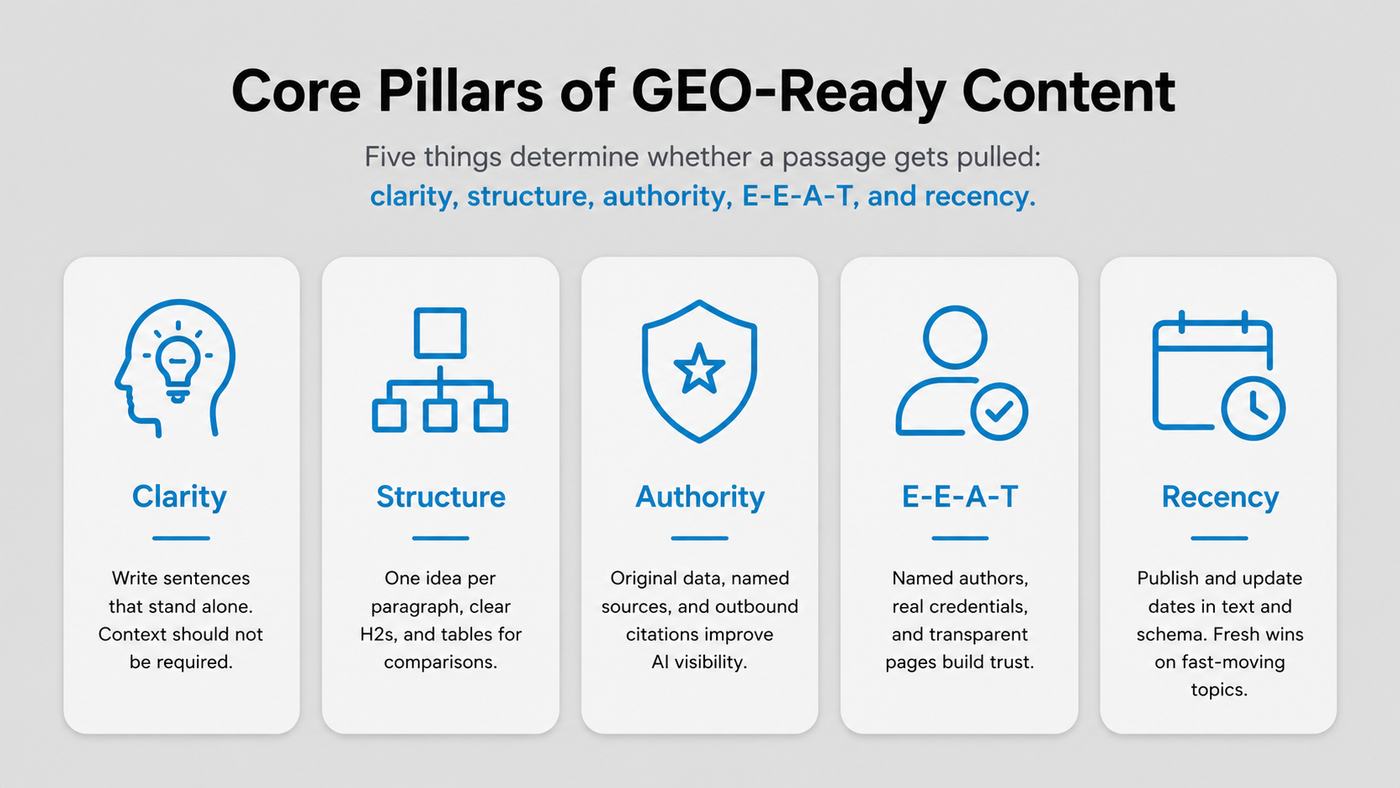
Five things determine whether a passage gets pulled: clarity, structure, authority, E-E-A-T, and recency.
-
Clarity: Write sentences that stand alone. "This approach cuts crawl waste" is useless out of context; "Consolidating faceted URLs reduces crawl waste on ecommerce sites" survives extraction.
-
Structure One idea per paragraph, question-shaped H2s, tables for comparisons. Models chunk documents. Long undifferentiated blocks get chunked badly.
-
Authority Original data, named sources, and outbound citations. The Princeton-led GEO study found adding cited statistics and quotations improved visibility in generated answers by a meaningful margin.
-
E-E-A-T Named authors with real credentials, dated content, transparent About and contact pages. AI systems reference the same trust surface Google does.
-
Recency Publish and update dates in visible text and schema. On fast-moving topics, engines skew hard toward recently updated pages.
Optimizing Content by User Intent
Intent still decides format, but in GEO the format has to work when it's read by a machine and rewritten before a human sees it.
For informational queries, lead every section with a 40 to 80 word answer that fully resolves the heading. That block is what gets lifted. Everything after it is deep for the reader who clicks.
For navigational and brand queries, consistency is the job. Your company description, founding details, service list, and positioning should be read identically on your site, your LinkedIn page, your Crunchbase profile, and any directory listing. Models corroborate across sources, and contradictions cause them to hedge or omit you.
For transactional queries, structure the comparison for them. Pricing ranges, deliverables, and who a service is not for, in table form. Answer engine optimization (AEO) work rewards specificity "starting at $2,500/month for 20 pages" gets quoted, "competitive pricing" never does.
Technical GEO: Schema Markup, Crawlability, llms.txt
Three technical levers control whether AI systems can access and interpret your content: structured data, AI crawler permissions, and the emerging llms.txt convention.
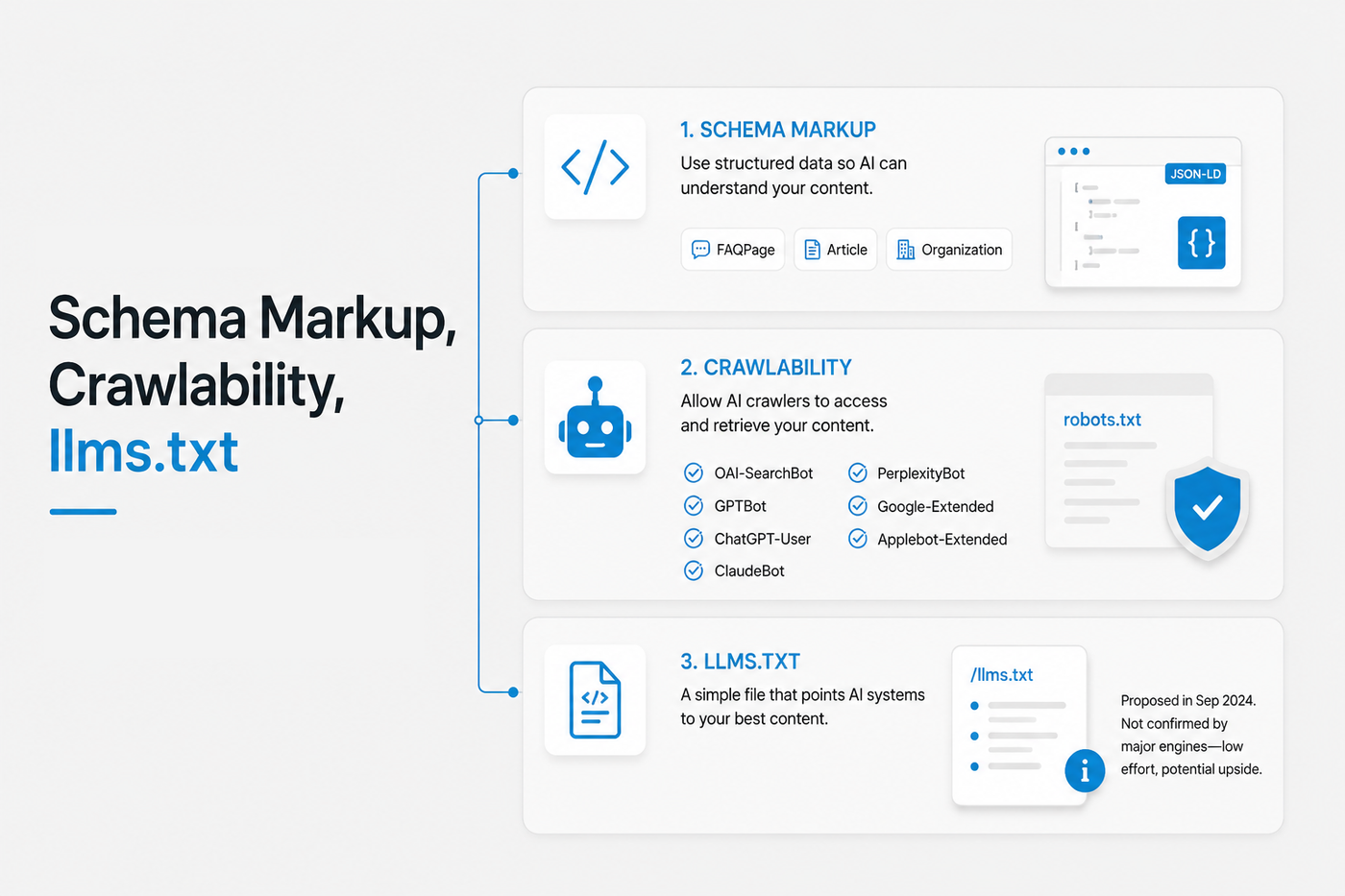
Schema. FAQPage, Article, and Organization markup do the most work. Article establishes authorship and dates. Organization ties your brand to a consistent entity with sameAs links to your verified profiles. FAQPage still helps machines parse Q&A structure even after Google reduced its rich-result eligibility.
Crawlability. Check your robots.txt right now for these user agents: OAI-SearchBot, GPTBot, ChatGPT-User, ClaudeBot, PerplexityBot, Google-Extended, and Applebot-Extended. I've audited sites where a security plugin blanket-blocked every non-Google bot and nobody noticed for eight months. One note that trips people up: Google-Extended controls Gemini and Vertex grounding, not AI Overviews. Overviews run off the standard index, so blocking Googlebot is the only way out and you don't want that.
llms.txt. Proposed in September 2024 by Jeremy Howard, it's a markdown file at your root that points AI systems to your most useful content. Be honest about its status: no major engine has confirmed using it as a ranking or retrieval input. It costs an hour to ship and might matter later.
# Example Company
> B2B software company providing inventory management tools
> for mid-market ecommerce and wholesale distributors.
## Products
- [Inventory Platform](https://example.com/platform/): Real-time stock sync across warehouses and sales channels.
- [Forecasting Module](https://example.com/forecasting/): Demand planning built on historical order data.
## Documentation
- [API Reference](https://example.com/docs/api/): Endpoints, authentication, and rate limits.
- [Integration Guides](https://example.com/docs/integrations/): Setup steps for major ecommerce platforms.
## Resources
- [Pricing](https://example.com/pricing/): Plan tiers, limits, and what each includes.
- [Contact](https://example.com/contact/)
Winning Featured Snippets & AI Overviews
Snippet and AI Overview placement goes to the page that answers the question fastest in the cleanest format, not the page with the most comprehensive coverage.
Three formatting habits do most of the lifting:
-
Direct-answer blocks. 40 to 80 words, immediately under the heading, no windup. Start with the subject, not "There are several factors to consider."
-
Question-based headers. Match how people phrase the query. "How long does GEO take?" outperforms "GEO Timelines."
-
Lists and tables for comparative or sequential content. Steps become numbered lists. Comparisons become tables. Both extract cleanly; a paragraph describing a comparison does not.
One thing I'd push back on: chasing snippet position for high-volume informational keywords with no commercial intent. You'll win the snippet and lose the click. Prioritize questions where the answer naturally leads to a service.
GEO Tools & Platforms
The GEO tooling market is young, most of it is repackaged rank tracking, and you can get 80% of the value for free.
Free and DIY:
-
Manual prompt testing. Run 20 to 30 real buyer questions through ChatGPT, Perplexity, and Google monthly. Log which brands and URLs get cited. Boring, unglamorous, and the most reliable signal I've found.
-
Google Search Console. Still your baseline for impressions and query-level shifts.
-
Schema Markup Validator + Google Rich Results Test. Free, definitive for structured data errors.
-
Server logs. Filter for GPTBot, PerplexityBot, and ClaudeBot to confirm AI crawlers are actually reaching you.
-
GA4 referral segments. Isolate traffic from chatgpt.com, perplexity.ai, and similar sources.
Paid options worth evaluating: Profound, Peec AI, Otterly.AI, and the AI visibility modules now inside Semrush and Ahrefs. Useful for scale and reporting. None of them see inside the models.
Metrics & KPIs That Actually Matter for GEO
Track five things: brand citations, AI Overview inclusion, AI referral traffic, branded search lift, and assisted conversions.
-
Brand mentions and citations Run a fixed prompt set monthly and record citation rate as a percentage. Consistency of the prompt set matters more than its size.
-
AI Overview inclusion Sample your priority keywords manually, or use a rank tracker with SERP-feature detection. Note whether you're cited, not just whether an Overview appeared.
-
AI referral traffic GA4 segment by source. Volume will look small. Look at conversion rate instead it's usually well above organic average, because the user arrived pre-qualified.
-
Branded search lifts GSC impressions on brand terms. This is where AI visibility shows up when clicks don't.
-
Assisted conversions AI referrals frequently sit mid-path. Last-click reporting will hide them entirely.
Real-World Examples / Mini Case Studies
These are illustrative scenarios based on common patterns, not verified client results.
Ecommerce. A specialty coffee retailer ranks well for product pages but never appears when someone asks an AI which grinder suits a beginner. The fix is comparison content structured as tables with named models, price bands, and explicit use cases. Plausible outcome: citations on recommendation-style prompts where product pages alone never qualified.
SaaS. A project management tool is absent from "best alternatives to X" answers. They publish honest comparison pages that state where they lose, add Organization schema with consistent sameAs profiles, and get their positioning aligned across G2 and their own site. Plausible outcome: inclusion in shortlists, because models favor corroborated, non-promotional framing.
Local business. A dental practice gets no mention in "best dentist near me" style AI queries. They fix NAP consistency across directories, add LocalBusiness schema, and rewrite service pages to answer specific procedure questions. Plausible outcome: appearance in local recommendation answers alongside map results.
Common GEO Mistakes to Avoid
-
Treating GEO as SEO plus schema. Structured data helps machines parse content. It doesn't make weak content quotable. This happens because schema is the easiest thing to check off.
-
Blocking AI crawlers by accident. Security plugins, CDN bot rules, and inherited robots.txt files are the usual culprits. Nobody audits robots.txt until traffic drops.
-
Over-indexing on markup while ignoring content quality. Perfect schema on a thin page gets you nothing. Markup is measurable; content quality isn't, so teams optimize what they can see.
-
Judging visibility from one prompt. Generative outputs vary run to run. Testing once and declaring victory or defeat is noise, not data.
-
Ignoring entity consistency. Different company descriptions across your site, LinkedIn, and directories make models hedge. It happens because nobody owns off-site brand data.
-
Buying tools before fixing fundamentals. A dashboard showing zero citations doesn't fix the reason you have zero citations.

FAQs
Is GEO replacing SEO?
No. GEO depends on the same crawlability, indexation, and authority foundations that SEO builds, and Google AI Overviews are generated from the standard web index. GEO extends SEO into generated answers rather than replacing it.
How long does GEO take to show results?
Expect 2 to 4 months for AI citation changes on existing indexed pages, and longer for new content that must first be crawled and gain authority. Technical fixes like unblocking AI crawlers can show effects within weeks.
Do I need new content or can I optimize existing pages?
Start with existing pages. Restructuring current content with direct-answer openings, question-based headings, and comparison tables typically produces faster citation gains than publishing new articles, because those pages already have authority signals.
What's the difference between GEO and AEO?
Answer engine optimization (AEO) focuses on winning direct answers, including featured snippets and voice results. GEO focuses specifically on being retrieved and cited inside AI-generated responses. They overlap heavily, and most practitioners use the terms interchangeably.
Can small businesses realistically do GEO without an agency?
Yes, for the fundamentals. Fixing robots.txt, adding Organization and Article schema, restructuring pages with direct answers, and running monthly prompt tests are all doable in-house. Agencies add value at scale, on competitive entity work, and on ongoing measurement.