


You're spending on AI. Your team talks about it in every meeting. There's probably a line item in your 2026 budget labelled "AI tools and platforms."
But here's the question nobody wants to answer honestly: what has it actually produced?
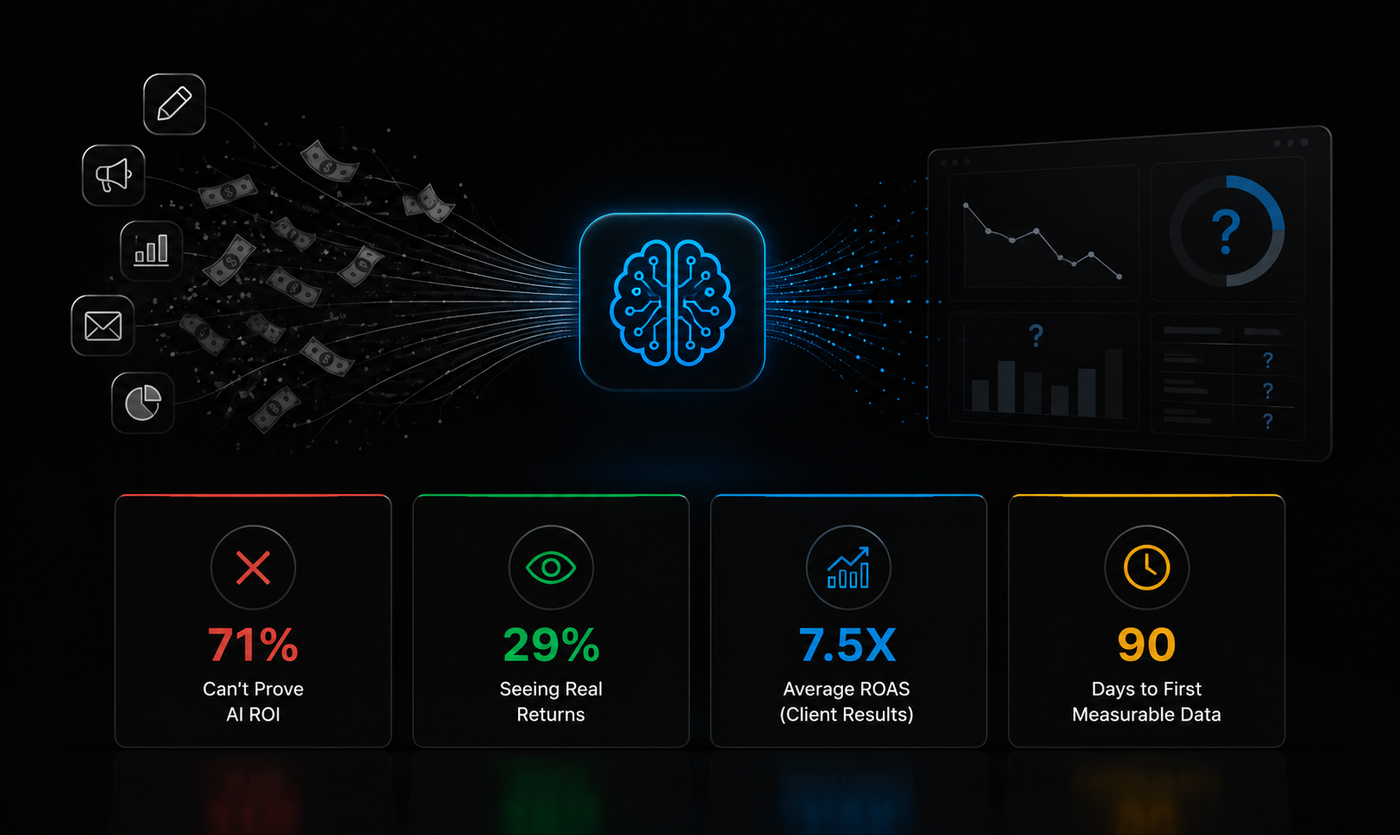
Not in theory. Not in potential. In actual, measurable revenue impact. If you can't answer that question with a specific number in under 10 seconds, you're not alone. 71% of enterprise marketing leaders say they cannot clearly demonstrate ROI from their AI investments. They're spending, they're adopting, they're talking about it in board presentations. But they can't prove it's working.
And the uncomfortable truth? The way most marketing teams measure AI performance right now is fundamentally broken.
The Measurement Problem Nobody Talks About
Here's where the measurement falls apart for most enterprises.
Traditional marketing ROI is straightforward. You spend X on a campaign, it generates Y in revenue, and you calculate the return. Clean. Simple. Boardroom-ready.
AI doesn't fit that model. And that's where things get messy.
AI tools touch multiple parts of your marketing operation simultaneously. Your AI writing assistant speeds up content production. Your AI bidding algorithm adjusts thousands of ad placements per hour. Your AI analytics tool surfaces insights that inform strategy across every channel. How do you isolate the revenue contribution of each?
Most CMOs try to measure AI the same way they measure a Google Ads campaign. Direct attribution. Last-touch. "This tool generated this many leads." And when the numbers don't add up cleanly (they never do), they either abandon measurement altogether or fall back on soft metrics like "time saved" and "team satisfaction."
Neither approach works. The first gives you incomplete data. The second gives your CFO nothing to approve next year's budget with.
We've worked with 138+ brands on AI-powered marketing strategies, and the pattern is always the same. The brands that can't measure AI ROI aren't using the wrong tools. They're using the wrong measurement framework entirely.
Why Traditional Marketing Metrics Fail for AI Let's get specific about what breaks.
Problem 1: AI creates compound value, not linear value.
When your AI tool optimises ad bidding, the improvement compounds over time. Month one, it's learning. Month two, it's slightly better than your human buyer. Month six, it has enough data to make optimisation decisions no human could replicate. Measuring AI after 30 days is like judging a marathon runner at the starting line.
We ran the numbers across our own client base. AI-driven campaign optimisation averaged 2.1X ROAS in month one. By month six, the same campaigns were hitting 5.8X. By month twelve, the top performers were above 7.5X. If you measured at month one and called it a failure, you'd have killed a strategy that was about to 4X your returns.
Problem 2: AI value shows up in places you're not measuring
Your AI content tool didn't just "save your writer 3 hours." It allowed your content team to produce enough material to cover 40 more long-tail keywords. Those keywords now drive 15% of your organic traffic. But your measurement system credits the writer's output, not the AI that made the volume possible.
Your AI analytics tool didn't just "create a nice dashboard." It flagged a conversion rate drop on mobile at 2 AM that would have taken your team three days to notice. By then, you'd have lost $30K in revenue. But there's no line item for "revenue saved by early detection."
Problem 3: You're measuring inputs instead of outcomes
The most common AI metrics we see in enterprise marketing reports are number of AI tools adopted, hours saved per week, content pieces generated, and reports automated. These are input metrics. They tell you what AI is doing, not what it's producing. Your board doesn't care that you automated 12 reports. They care whether those automated reports led to faster decisions that generated more revenue.
The AI Marketing ROI Framework That Actually Works
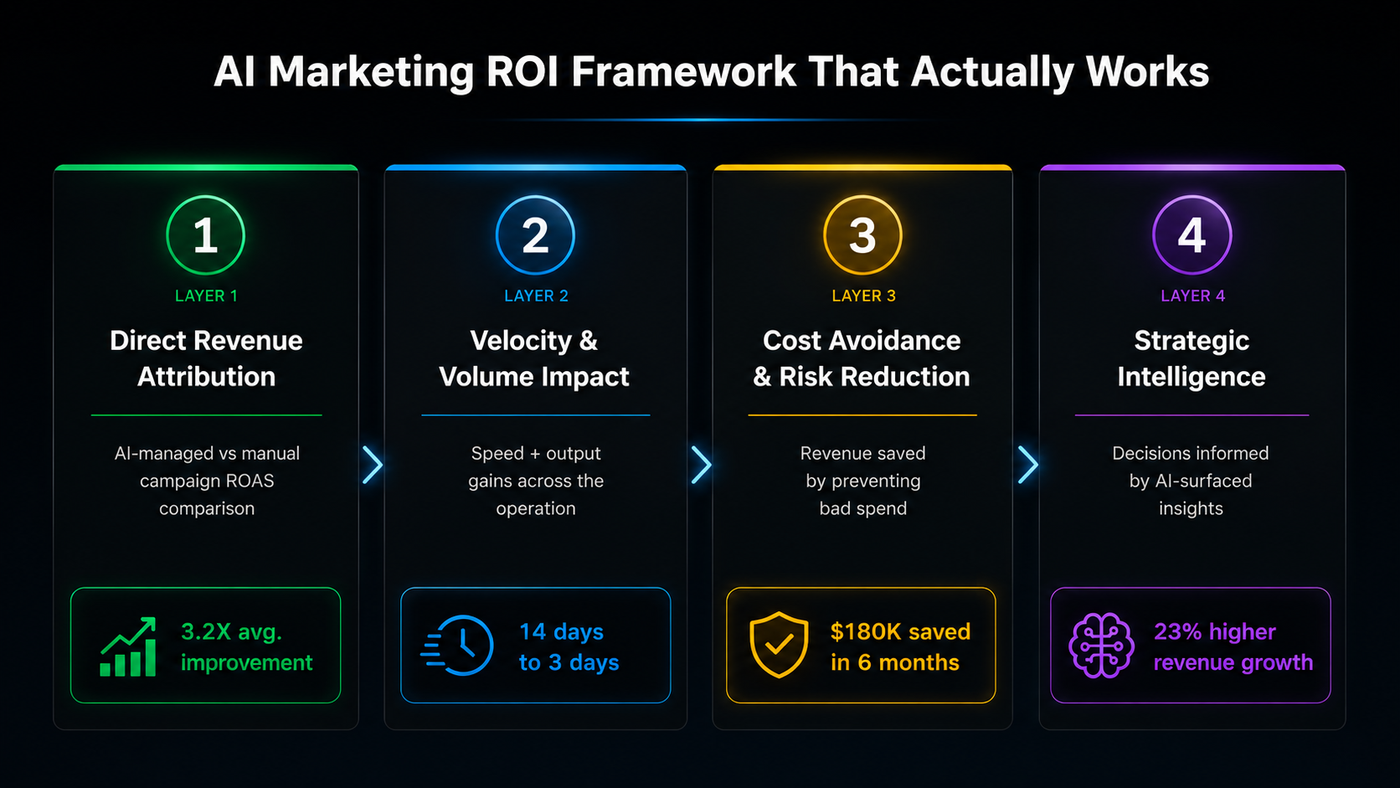
After running 2,578+ campaigns across 27+ industries, we've developed a measurement framework that captures the full picture of AI's impact on marketing performance. It works across any AI tool, any channel, and any business model.
The framework has four layers. Each one captures a different type of value that AI creates.
Layer 1: Direct Revenue Attribution
For any AI tool that directly touches campaign performance (bid management, audience targeting, creative optimization), measure the revenue generated by AI-managed campaigns versus human-managed campaigns over the same period, with the same budget allocation.
The key here is the control. You need a baseline. Run parallel tests. Keep one campaign set on manual management while the AI handles the other. After 90 days (not 30, the compound effect matters), compare ROAS, CPA, and revenue per dollar spent.
When we run this test for clients, the AI-managed campaigns outperform manual ones by an average of 3.2X in ROAS after the 90-day learning period. That's a number your CFO can work with.
Layer 2: Velocity and Volume Impact
AI doesn't just improve results. It accelerates them. This layer measures how much faster and how much more your marketing operation produces with AI.
Track these metrics before and after AI integration: content output per team member per month, campaign launch time from brief to live, number of creative variants tested per campaign cycle, time from data collection to actionable insight, and speed of response to performance anomalies.
For one enterprise client, AI integration reduced their campaign launch cycle from 14 days to 3 days. They captured market share during a competitor's product recall because they could launch a targeted campaign within 48 hours. The revenue from that single rapid response covered their entire AI investment for the year.
Layer 3: Cost Avoidance and Risk Reduction
This is the layer most CMOs miss completely. And it's often the most valuable one.
AI prevents expensive mistakes. Wasted ad spend on poorly performing audiences. Content published with conflicting messaging. Budget allocation stuck in underperforming channels.
One brand we work with calculated that their AI monitoring tools prevented roughly $180K in wasted spend over six months. Not by finding new revenue. By stopping bad spend before it happened. That's pure margin protection.
Layer 4: Strategic Intelligence Value
AI surfaces patterns humans miss. Audience segments that convert 3X higher than your current targeting. Content topics that drive high-intent traffic but aren't on your editorial calendar. Competitor movements in adjacent markets.
The value of strategic intelligence is measured by the outcomes of the decisions it informs. Strategic decisions informed by AI analytics have driven an average of 23% higher revenue growth for brands that act on the insights versus those that don't.
The Five Metrics Your Board Actually Cares About
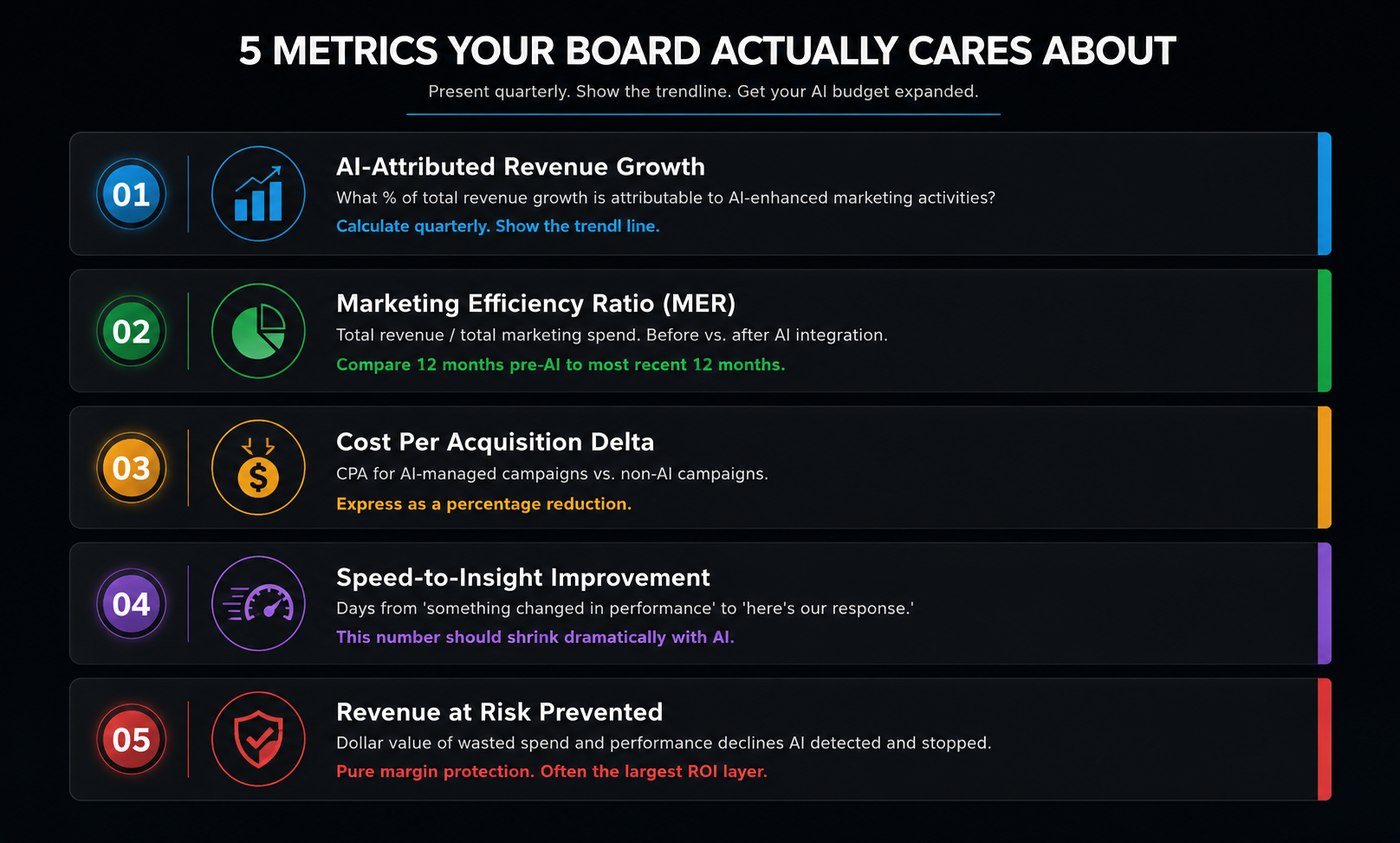
Your CFO doesn't want a 47-slide deck on AI capabilities. They want five numbers.
1. AI-Attributed Revenue Growth: What percentage of total revenue growth can be directly or indirectly attributed to AI-enhanced marketing activities? Calculate this quarterly.
2. Marketing Efficiency Ratio (MER) Before vs. After AI: Total revenue divided by total marketing spend. Compare the 12 months before AI to the most recent 12 months.
3. Cost Per Acquisition Delta: What is your CPA for AI-managed campaigns versus non-AI campaigns? Express it as a percentage reduction.
4. Speed-to-Insight Improvement: How many days from "something changed" to "here's what we're doing about it"?
5. Revenue at Risk Prevented: Dollar value of wasted spend, missed opportunities, or performance declines that AI detected and stopped.
Present these five metrics quarterly. Show the trendline over 12 months. That's what gets AI budgets approved and expanded.
The Implementation Roadmap: First 90 Days
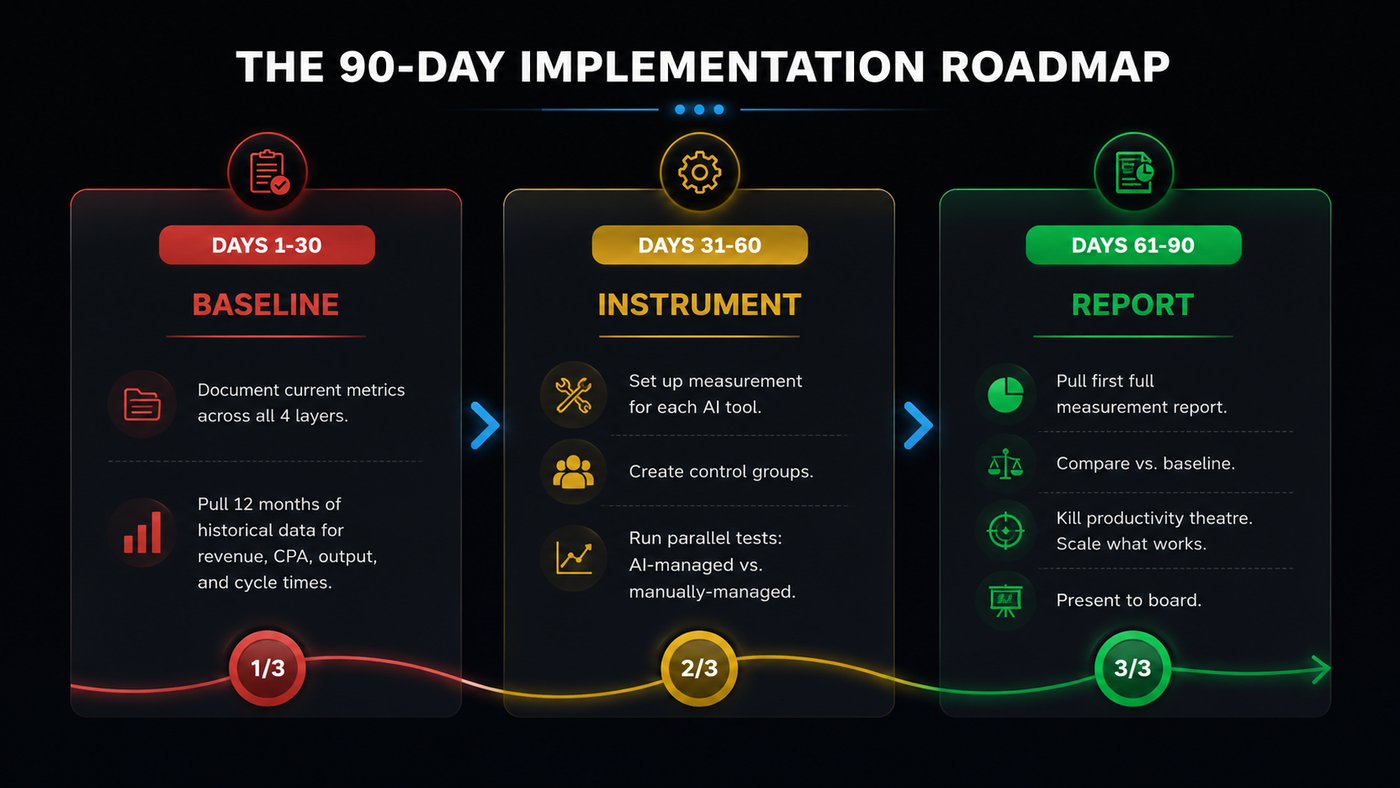
Days 1 to 30: Establish Your Baseline
Document your current metrics across all four framework layers. You can't measure improvement without knowing where you started. Pull 12 months of historical data for revenue, CPA, content output, campaign cycle times, and any performance anomalies your team caught.
Days 31 to 60: Instrument and Test
Set up measurement infrastructure for each AI tool. Create control groups where possible. Define the specific metrics you'll track for each of the four layers. Start running parallel tests between AI-managed and manually-managed campaigns.
Days 61 to 90: First Report and Calibrate
Pull your first full measurement report. Compare against the baseline. Identify which AI tools are delivering measurable value and which are "productivity theatre." Double down on the winners. Kill or restructure the losers.
After 90 days, you'll have enough data to present a credible AI ROI story to your board. Not based on vendor promises or industry averages, but on your own performance data.
The Real Risk: Not Measuring at All
Here's the Status Quo Bias trap most CMOs fall into.
They know their AI measurement is inadequate. But measuring properly feels hard, and the current approach "works well enough." So they keep running without real data, making gut-feel decisions about which AI tools to keep and which to cut.
When budget season arrives and the CFO asks for proof that AI spending is justified, the CMO has nothing concrete. The budget gets questioned. Sometimes cut. And the brand loses ground to competitors who measured, proved value, and doubled down.
The brands we work with that implement proper AI measurement frameworks don't just keep their budgets. They get them expanded. Because when you can show that every dollar invested in AI-enhanced marketing returns $7.50 in revenue (our average across 138+ brands), the budget conversation changes entirely.
It stops being "should we spend on AI?" and becomes "how fast can we scale this?"
Want to build your AI measurement framework? We'll walk you through the setup for your specific marketing stack. No pitch. Just a clear plan for measuring what your AI tools actually deliver.
Book a free strategy session. 30 minutes. Actionable framework. Zero obligation.
NFlow Technologies is a Google Partner and AI-SEO pioneer that has generated £473M+ in revenue for 138+ brands across 27+ industries.