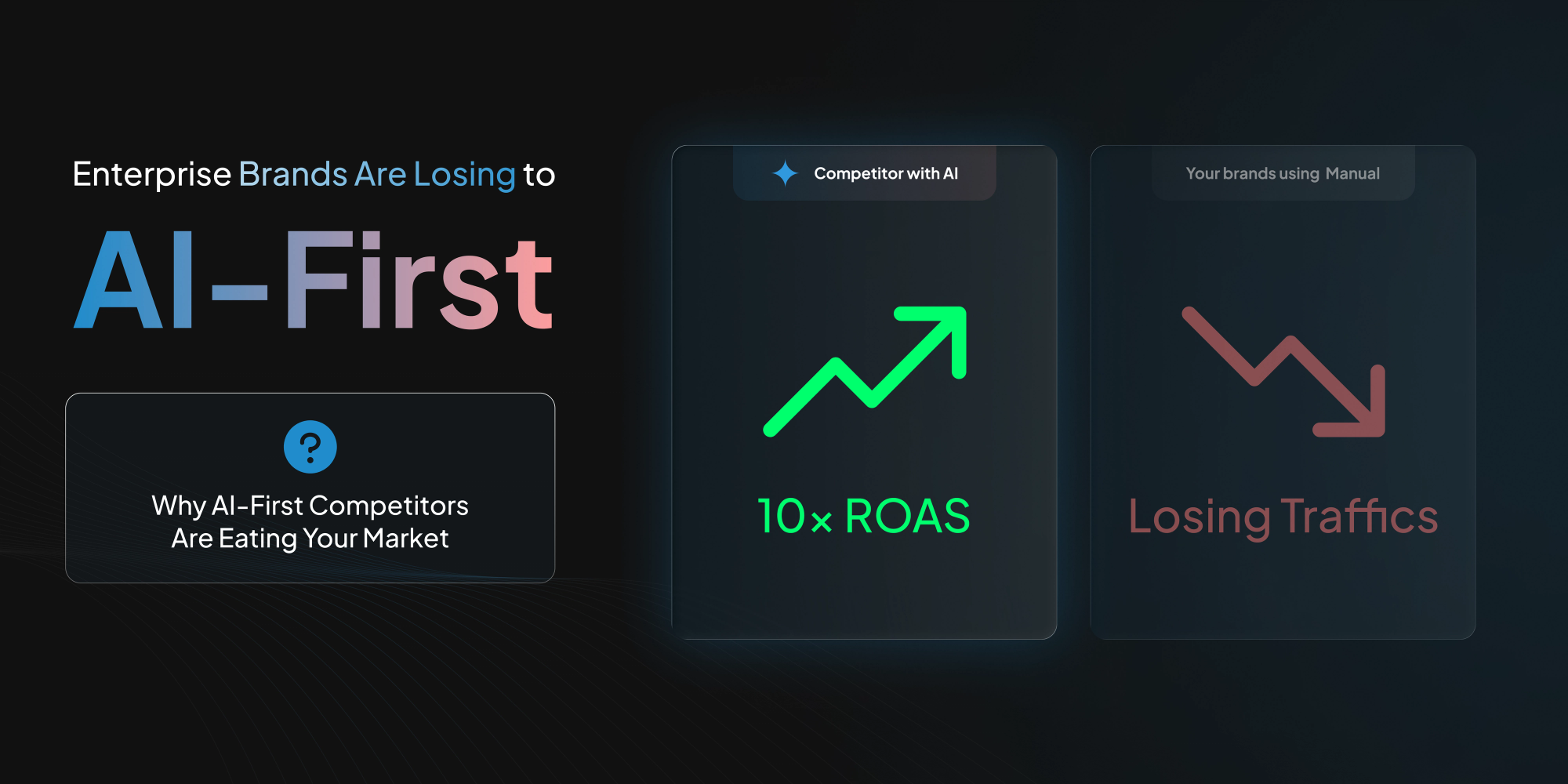



You spent years building your brand's search presence. Years earning those page-one rankings. Years investing in content, backlinks, and technical SEO. And now, quietly, the rules changed underneath you.
Google's AI Overviews, ChatGPT search, Perplexity, Gemini. These aren't experimental curiosities anymore. They're where your buyers go to make decisions. And if your brand isn't showing up inside those AI-generated answers, you're not just losing rankings. You're losing relevance.
The scary part? Most brands don't even know it's happening. They're still watching traditional keyword positions and celebrating page-one rankings while an entirely new search layer siphons off their highest-intent traffic.
The Quiet Shift That Changed Everything
Let's put some numbers on this so it doesn't feel abstract.
AI Overviews now appear on more than 30% of commercial search queries on Google. That number has been climbing steadily since late 2024, and Google has made it clear: this is the future of search, not a test feature they might roll back.
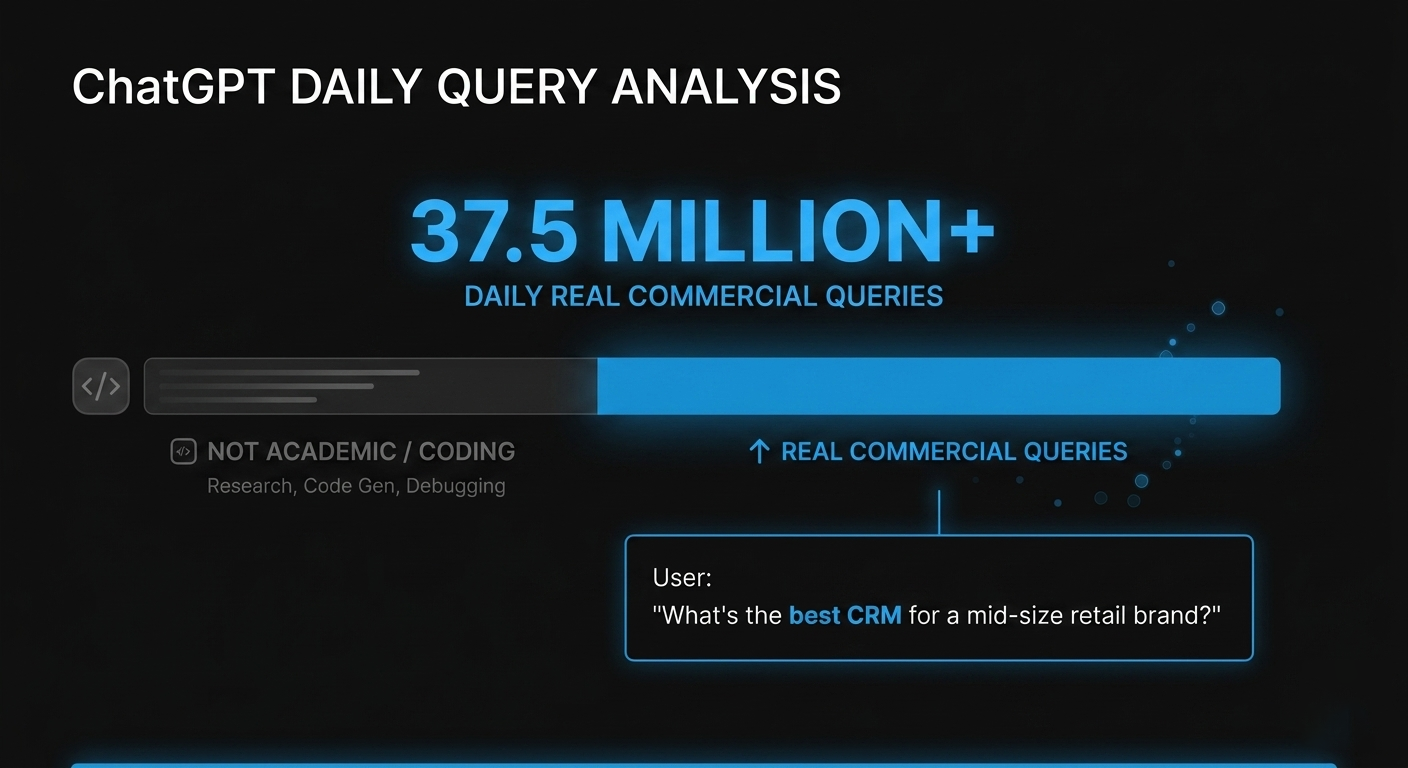
ChatGPT processes over 37.5 million queries daily. Not research questions. Not coding problems. Real commercial queries where people ask "What's the best CRM for a mid-size retail brand?" or "Which agency specialises in e-commerce SEO?" If your brand isn't in that answer, your competitor is.
Perplexity hit 15 million monthly active users earlier this year. Gemini is integrated directly into Android and Google Workspace. These platforms don't show ten blue links. They show one answer. Maybe two. And they cite the sources they trust most.
This is the shift. Search is moving from "which page ranks highest" to "which brand gets cited in the answer." And the strategies that earned you traditional rankings don't automatically earn you AI citations.
Why Your Current SEO Strategy Isn't Enough
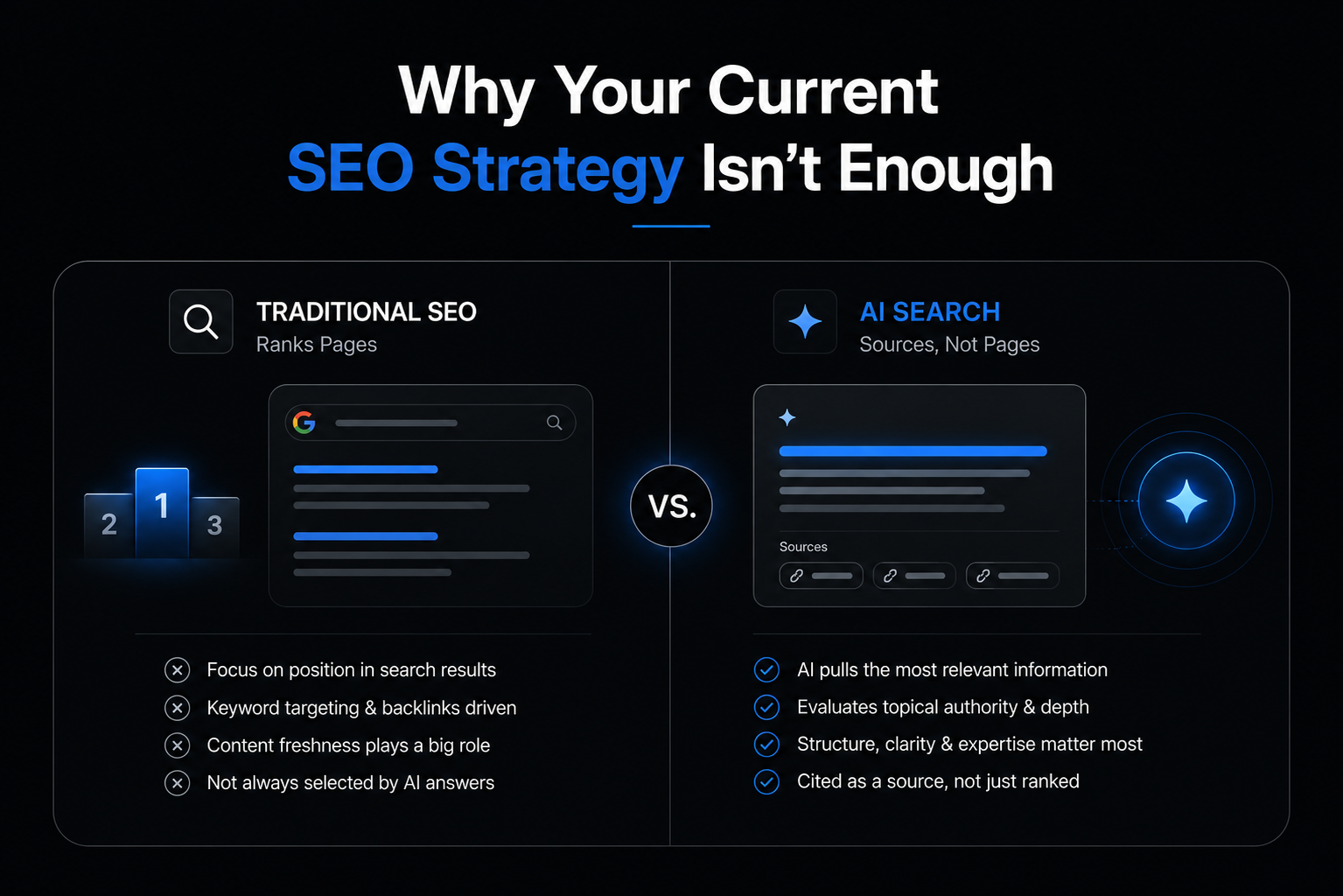
Here's where things get uncomfortable for brands that have invested heavily in traditional SEO.
The content that ranks well in classic search results and the content that gets cited in AI answers are not always the same thing. Google's traditional algorithm rewards a combination of backlinks, keyword targeting, technical health, and content freshness. AI systems evaluate content differently. They're looking for comprehensive topical authority, factual depth, structured information that's easy to parse, and genuine expertise signals.
That blog post you published last year that ranks third for your target keyword? The AI Overview for that same query might pull from a completely different source. One that has more depth, better structure, or stronger authority signals in the specific sub-topic the AI determined was most relevant to the searcher's intent.
We've seen this play out across dozens of client accounts at NFlow. Brands ranking in the top three for valuable keywords, yet completely absent from the AI Overview on the same search. That's traffic walking out the back door while you're counting visitors at the front.
The brands that understand this shift are already adapting. The ones that don't are watching their visibility erode in ways that traditional rank tracking tools won't even flag.
The Three Pillars of AI Search Visibility
After optimising 138+ brands for AI-driven search over the past 18 months, we've identified three pillars that determine whether AI systems cite your brand or skip over it entirely.
1. Topical Authority at Depth
AI search engines don't trust one good article on a topic. They trust brands that demonstrate comprehensive, interconnected expertise across an entire subject area.
This means content clusters built around core topics with real depth. Not 20 thin posts targeting keyword variations. Instead, you need three to five deep, authoritative pieces per topic cluster, each one covering a different angle, supported by original data or genuine experience, and linked together in a way that signals "this brand owns this topic."
Here's the practical test. If someone asked an AI "Who is the definitive source on [your core topic]?" would your brand be the answer? If you're not sure, you probably know the answer already.
When we rebuilt Avita Jewellery's content architecture around intent-mapped clusters, 70% of their target keywords hit the top five within nine months. More importantly, their content started appearing in AI-generated answers for buying-intent queries. That second result is where the real value sits now.
2. Structured Data and Entity Recognition
AI systems parse content differently than traditional search crawlers. They're building knowledge graphs, mapping entities and relationships, and deciding which sources are authoritative for specific factual claims.
If your content isn't structured in a way that AI can easily parse, you're invisible to these systems regardless of how well-written it is.
What does this look like in practice? Schema markup that goes beyond basic page-level tags. Clear, hierarchical content structures with logical H2 and H3 relationships. Factual claims supported by citations. Named entities (people, companies, products, locations) used consistently across your content. FAQ sections that match the natural language patterns people use when querying AI assistants.
This isn't glamorous work. It's the structural foundation that makes your content machine-readable. And most brands skip it because it doesn't feel like "real marketing."
3. E-E-A-T Signals That AI Systems Can Verify
Google's E-E-A-T framework (Experience, Expertise, Authoritativeness, Trustworthiness) matters more for AI search than it ever did for traditional rankings. Here's why.
When an AI system decides which source to cite in its answer, it's making a trust decision. Not a relevance ranking. It's asking: "Which source can I confidently cite without giving the user bad information?"
That means author credentials matter. Named, real authors with verifiable expertise in the subject area. It means your About page, author bios, and company credentials aren't just brand exercises. They're trust signals that AI systems actually evaluate.
It means original research, proprietary data, and first-hand case studies carry disproportionate weight. AI systems can't generate original data. They can only cite it. If your content contains data nobody else has, you become uncitable-around.
This is something we emphasise with every brand we work with at NFlow. Your case studies, your client results, your campaign data. That's not just sales collateral. That's your AI search moat.
What AI Search Visibility Actually Looks Like in Practice
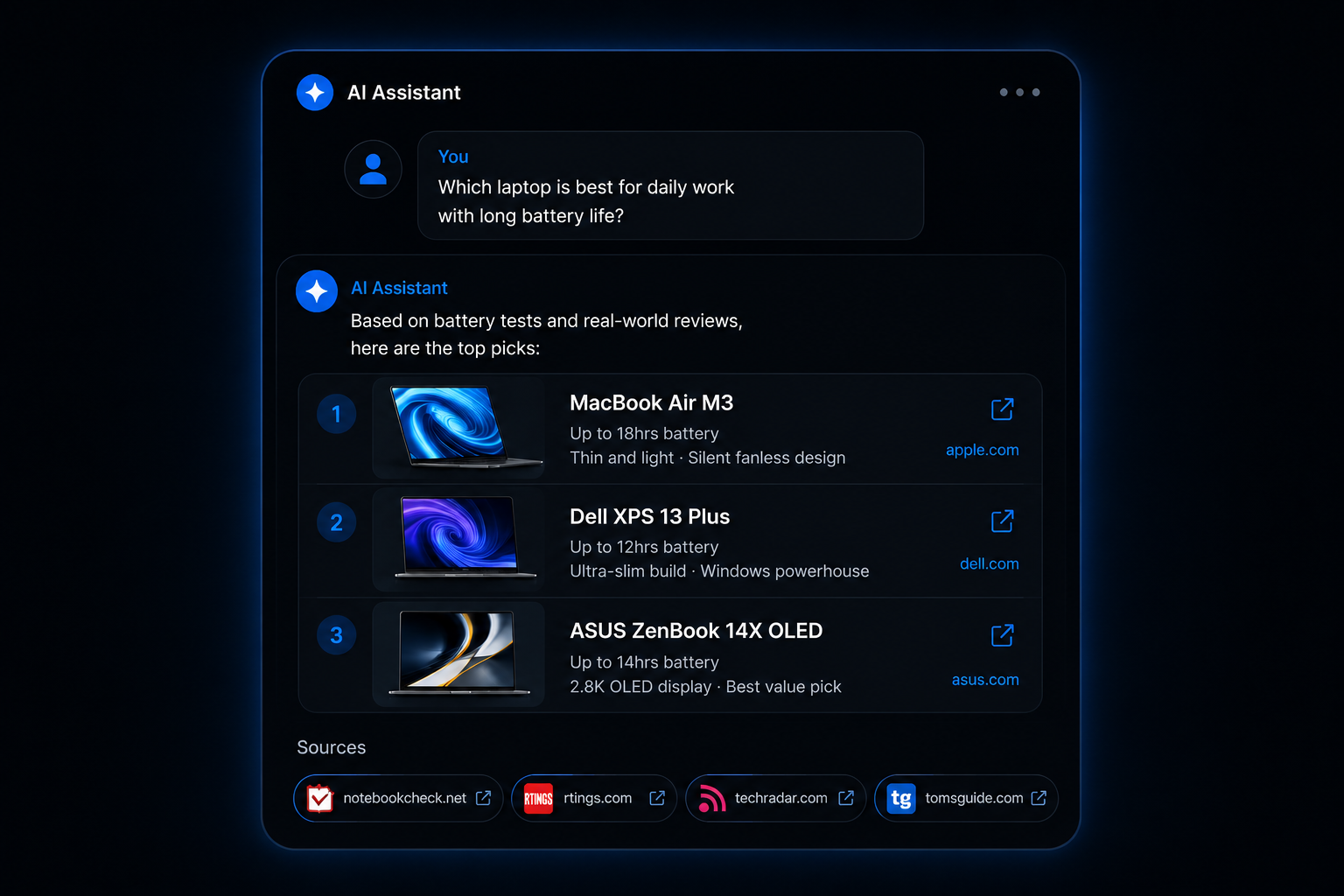
Traditional SEO approach: You target "best CRM for retail." You write a 2,000 word comparison post. You build backlinks. You rank on page one. Someone searches that phrase, sees your result among ten others, and maybe clicks through. Maybe.
AI search-optimised approach: You create a comprehensive content cluster around retail technology decisions. Your CRM comparison post is supported by an original survey of 200 retail operators, a case study showing how a specific CRM integration improved one retailer's operations, and a technical guide to CRM data migration. When someone asks ChatGPT or Google's AI Overview "What CRM should a mid-size retailer use?" your brand is cited as the source. Not one of ten results. The source.
The difference in click-through rates and trust transfer between those two scenarios is massive. Traditional organic results average 2-3% CTR for mid-page positions. AI citation sources see dramatically higher engagement because the AI has already pre-qualified the source as trustworthy.
The Five Steps to Make Your Brand AI-Search Ready
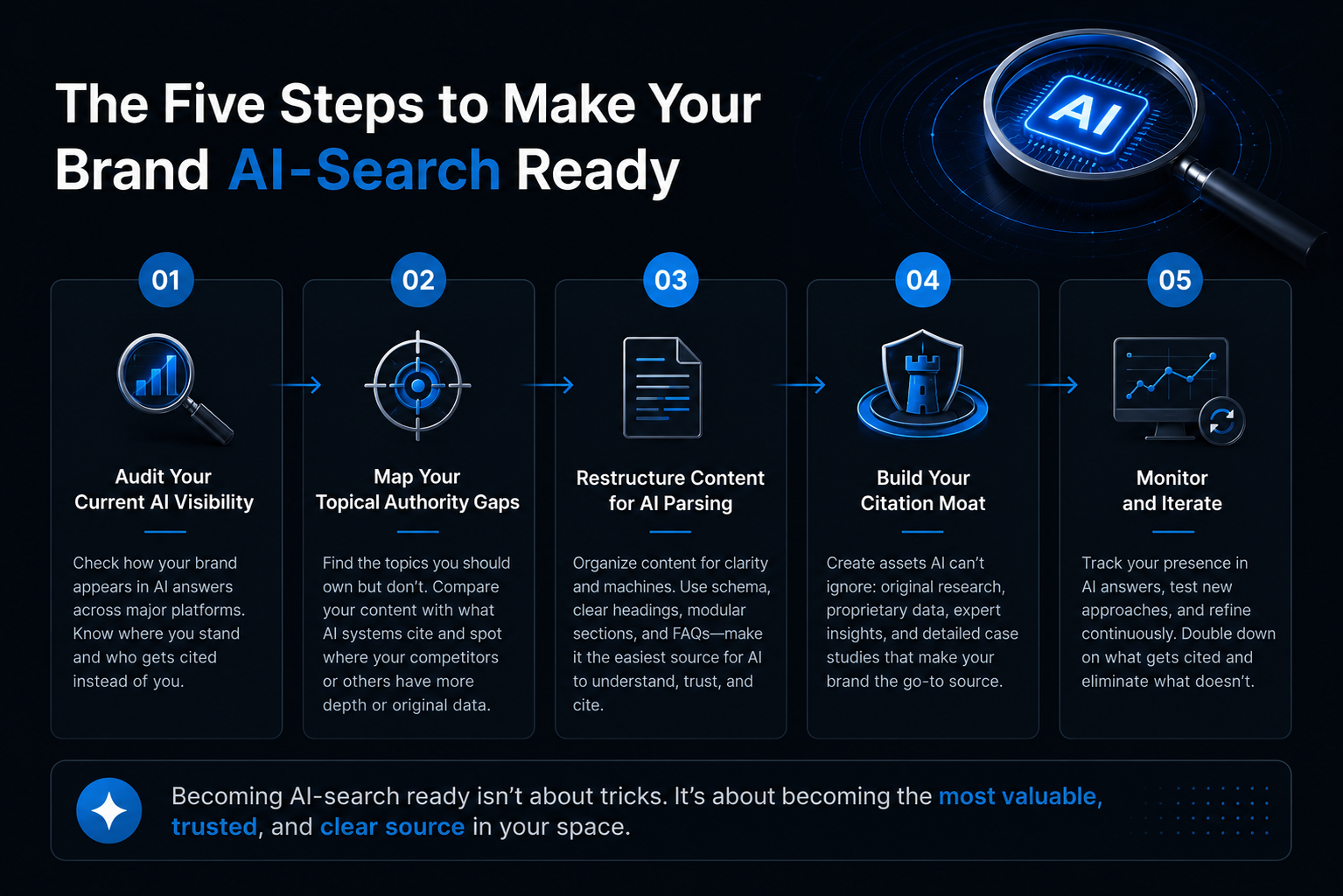
Step 1: Audit Your Current AI Visibility
Before you change anything, understand where you stand. Search your core topics on ChatGPT, Perplexity, and Google (with AI Overviews enabled). Is your brand mentioned? Are your competitors? Are sources in your industry being cited that you've never heard of?
Step 2: Map Your Topical Authority Gaps
Identify the topics where you should be the definitive source but aren't. Compare your content depth against the sources AI systems currently cite. Where are you thinner than them? Where do they have original data that you don't?
Step 3: Restructure Content for AI Parsing
Take your existing high-value content and restructure it. Add schema markup. Improve heading hierarchies. Break complex topics into clearly defined sections. Add FAQ sections with natural language patterns. Make your content the easiest source for an AI system to understand, trust, and cite.
Step 4: Build Your Citation Moat
Create content assets that AI systems can't ignore. Original research. Proprietary data from your industry. Expert interviews with named authorities. Detailed case studies with specific metrics. These are the pieces that make your brand the primary citation source because nobody else has this information.
Step 5: Monitor and Iterate
AI search is not static. The algorithms that determine which sources get cited are evolving monthly. Set up monitoring to track your brand's appearance in AI-generated answers across platforms. Test new content formats. Double down on what gets cited. Cut what doesn't.
The Cost of Ignoring This Shift
If your competitors start optimising for AI search visibility today and you wait 12 months, you're not just 12 months behind. You're behind by 12 months of compounding authority signals, citation history, and AI trust-building that you can't fast-track.
AI systems learn which sources are reliable over time. The brands they cite consistently build a "citation reputation" that reinforces itself. Getting into that trusted source set early matters enormously. Getting in late means competing against established citation patterns that the AI has already learned.
The brands that own AI search visibility will own the next decade of organic growth. The ones that wait will spend the next decade trying to catch up.
NFlow Technologies is a Google Partner and AI-SEO pioneer that has generated £473M+ in revenue for 138+ brands across 27+ industries.