

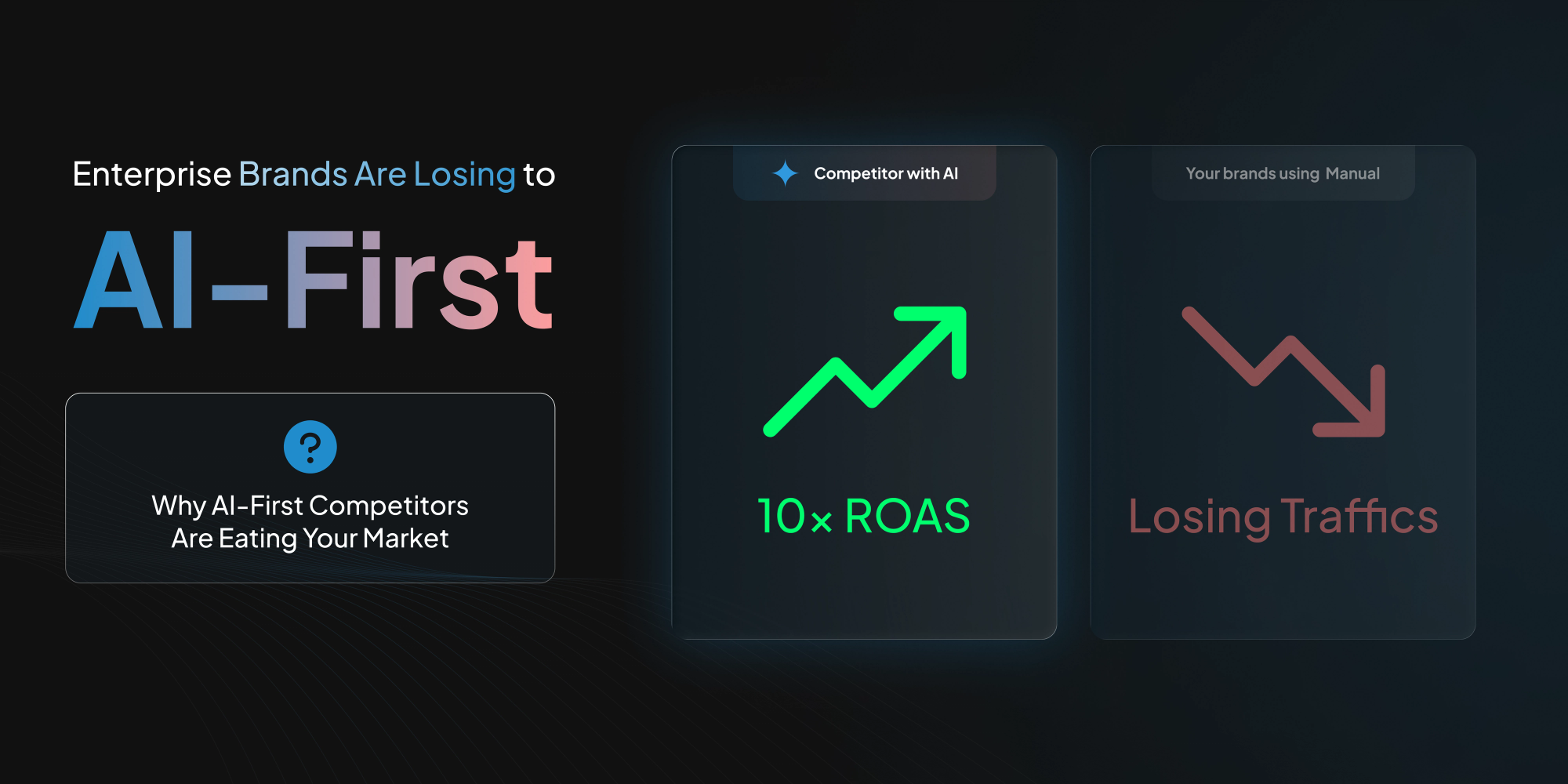
Your competitors didn't outspend you. They didn't hire a bigger team. They didn't stumble onto some secret channel you haven't discovered yet.
They adopted AI before you did. Simple as that.
While your marketing team sat in meetings debating which tools to pilot, theirs was already running autonomous campaigns, generating personalised content at scale, and optimising ad spend in real time. With a fraction of your headcount.
That's the uncomfortable reality of enterprise marketing in 2026. The brands winning right now aren't the ones with the fattest budgets. They're the ones that restructured their entire marketing operation around AI. And they did it 18 months ago.
The Data Is Already Damning
Here's where the gap becomes impossible to ignore.
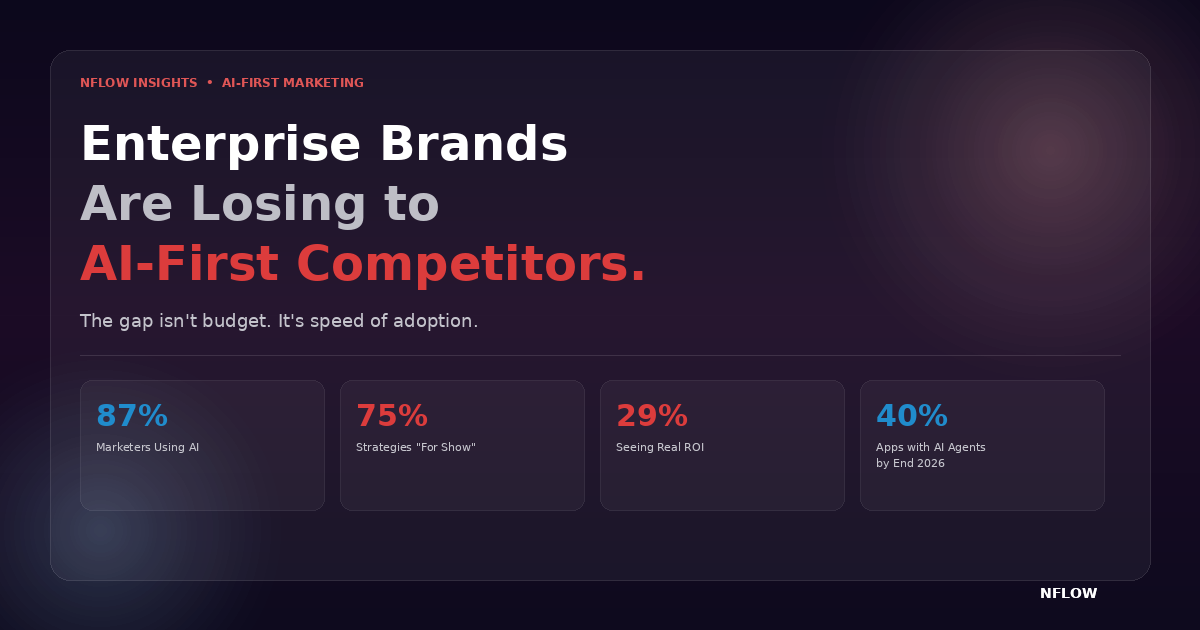
87% of marketers now use generative AI in at least one recurring workflow. At enterprise level, that number climbs to 94%. On paper, it looks like everyone's on board. But look one layer deeper and the picture falls apart.
75% of enterprise executives admit their company's AI strategy is "more for show" than actual internal guidance. 39% have no formal plan to drive revenue from AI tools. And only 29% of companies are seeing significant ROI from their AI investments. That last number should make every CMO deeply uncomfortable.
Roughly 7 in 10 enterprise brands are spending on AI, talking about AI, maybe even hiring for AI, but aren't generating measurable returns from it. Meanwhile, AI-first competitors (the brands that built their operations around these tools from day one) are compounding their advantage every single quarter.
This isn't a technology problem. It's a strategy problem. And the window to fix it is closing faster than most boardrooms realise.
What “AI-First” Actually Means (And Why Most Enterprises Get It Wrong)
Let's be precise about what separates AI-first brands from enterprises that merely use AI tools.
An AI-first marketing operation doesn't bolt AI onto existing workflows. It redesigns the workflow around what AI makes possible. The difference is structural, not cosmetic. And it shows up in everything from how content gets produced to how ad budgets get allocated.
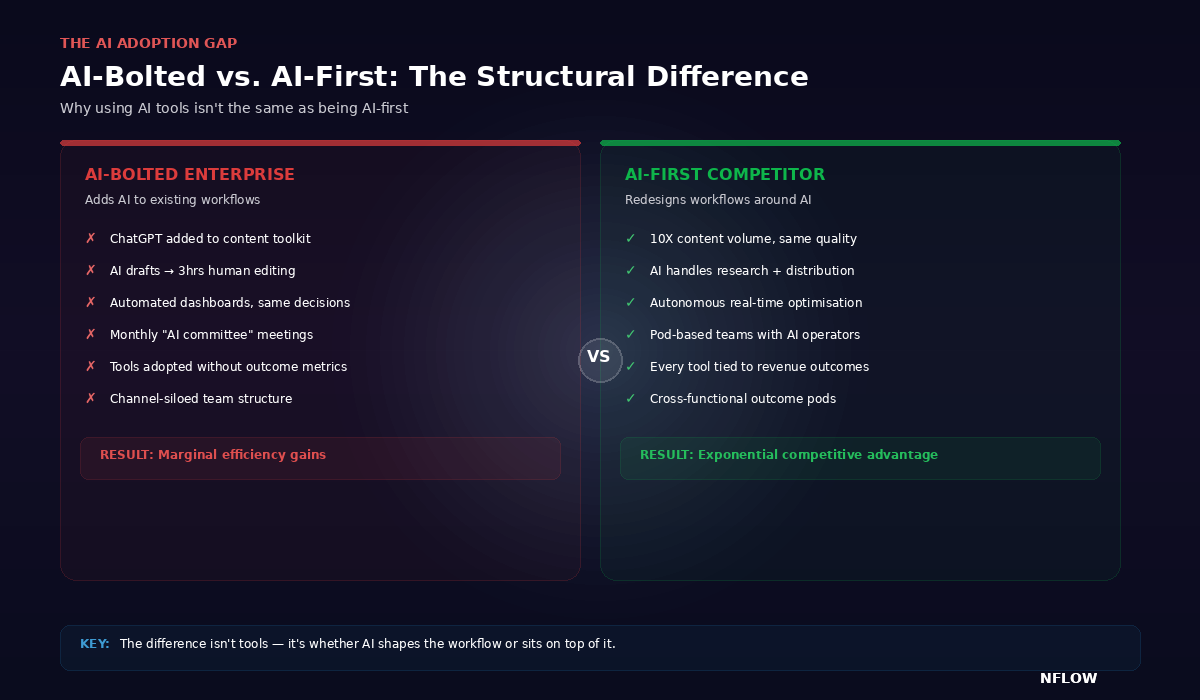
AI-bolted enterprises add ChatGPT to their content team's toolkit and call it transformation. They use AI to write first drafts that humans then spend three hours editing back into brand voice. They automate reporting dashboards but still make decisions the same way they did in 2022. They have an "AI committee" that meets monthly and produces slide decks about potential use cases. Sound familiar?
AI-first competitors operate differently at every level. Their content teams use AI to produce 10X the volume at the same quality. Not by replacing writers, but by eliminating research bottlenecks, automating distribution, and running multivariate tests on messaging at a pace no human team could match. Their paid media runs on autonomous agents that adjust bids, creative, and targeting in real time based on conversion data. Their SEO strategy is built for AI search, not just traditional rankings but visibility inside AI Overviews, ChatGPT responses, and Perplexity citations.
The enterprise that bolts AI onto a 2020 marketing playbook gets marginal efficiency gains. The competitor that builds an AI-native playbook from scratch gets exponential competitive advantage. That's not hyperbole. That's what the data shows.
Gartner predicts that by end of 2026, 40% of enterprise applications will have embedded AI agents. Up from less than 5% in 2025. The brands that embedded AI agents into their marketing stack in early 2025 now have 18 months of compounding optimisation data. No late adopter can replicate that quickly.
The Five Warning Signs Your Brand Is Falling Behind
Most enterprise leaders don't realise they're losing ground until revenue declines make it obvious. By then, the AI-first competitor has already captured your most valuable customer segments.
Here are the warning signs that show up 12 to 18 months before the revenue impact hits.
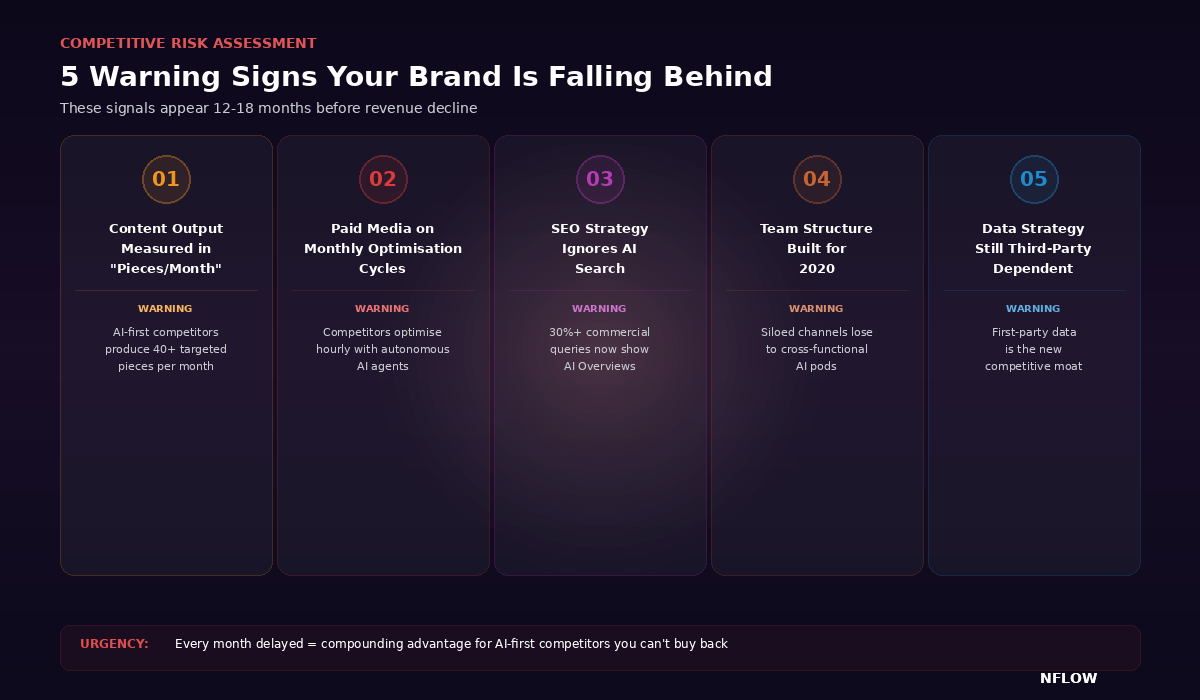
1. Your Content Output Is Measured in “Pieces Per Month”
AI-first competitors don't think about content in units. They think in coverage: how much of their target audience's search journey do they own? While your team publishes 8 to 12 blog posts a month and calls it productive, your AI-first competitor is producing 40+ pieces across blog, social, email, and video. Each one personalised to a specific audience segment and intent stage.
This isn't about quality versus quantity. That's a false binary. AI-first brands produce more AND better because their human talent is focused on strategy, insight, and creative direction (the parts humans do best) while AI handles research, first-draft generation, distribution formatting, and performance analysis.
2. Your Paid Media Still Runs on Monthly Optimisation Cycles
If your media buyers are reviewing campaigns weekly or monthly, you're already behind. AI-first competitors run autonomous campaign management where AI agents adjust bids every hour, swap creative variants based on real-time engagement data, and reallocate budget across channels automatically when performance shifts.
Meta has announced its goal to fully automate ad creation with AI by end of 2026. Advertisers will upload a product image, set an objective and budget, and AI handles creative variations, targeting, and delivery. The brands already running this way have 18 months of learning data that will make Meta's native tools even more powerful for them. And less useful for late adopters who don't have the historical performance data to train on.
3. Your SEO Strategy Doesn't Account for AI Search
If your SEO team is still optimising primarily for traditional Google rankings, you're optimising for a search experience that's shrinking. AI Overviews now appear on over 30% of commercial search queries. ChatGPT search, Perplexity, and Gemini are capturing an increasing share of information-seeking queries that used to go to Google.
Enterprise brand visibility now depends on whether AI systems recognise your brand as a credible, citable source. That requires a fundamentally different content architecture. One built around comprehensive topical authority, structured data, and content that AI can parse, cite, and recommend. Brands that don't invest in AI search optimisation risk watching decades of earned brand authority quietly transfer to competitors who built their content strategy for the AI-powered search ecosystem.
4. Your Team Structure Is Built for 2020
AI-first brands don't have traditional marketing departments with siloed teams for content, paid media, SEO, and social. They operate in cross-functional "AI pods." Small, outcome-focused groups where a strategist, a creative, and an AI operator work together on specific business objectives.
If your org chart still has a "Content Team" that throws briefs over the wall to a "Design Team" that hands assets to a "Demand Gen Team," you're running a relay race while your competitor is running as a single unit. The structural overhead alone costs you 30 to 40% of your potential output velocity.
5. Your Data Strategy Is Still Third-Party Dependent
The death of third-party cookies isn't coming. It's here. AI-first brands have already built their marketing infrastructure around first-party and zero-party data. Email lists, community engagement, direct customer interactions, and owned audience platforms.
If your targeting strategy still relies on third-party data brokers or lookalike audiences built from diminishing cookie pools, your ad performance will deteriorate steadily through 2026 and 2027. AI-first competitors are using their first-party data to train custom AI models that personalise messaging at the individual level. No amount of third-party data can replicate that capability.
The AI-First Marketing Framework: How Enterprise Brands Fight Back
The good news: it's not too late. The bad news: "not too late" has an expiry date. And it's closer than you think.
Here's the framework we use at NFlow to transition established brands from AI-bolted to AI-first.
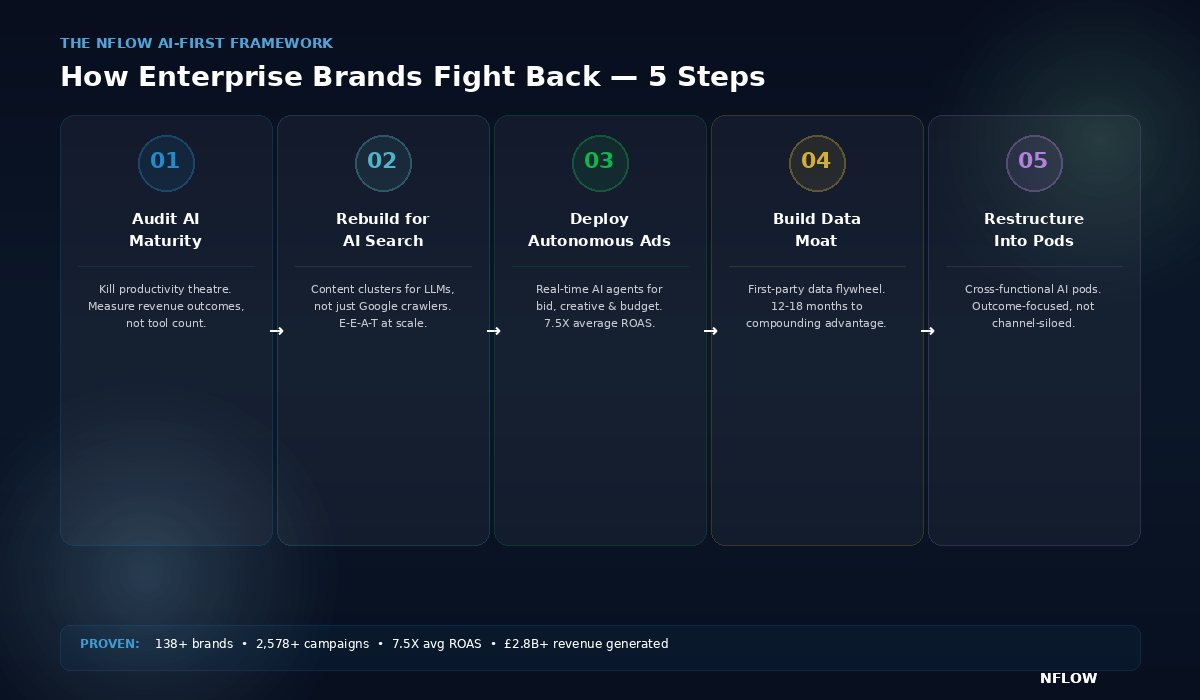
Step 1: Audit Your AI Maturity Honestly
Stop counting tools. Start measuring outcomes.
For every AI tool your team uses, answer three questions. What specific revenue outcome does this tool drive? How much human time does it actually save (measured, not estimated)? And what would happen to output quality and volume if you removed it tomorrow?
Most enterprises discover that 60% of their AI tools are productivity theatre. They make the team feel modern but don't measurably improve results. Kill those. Double down on the 40% that actually drive outcomes.
Step 2: Rebuild Your Content Engine for AI Search
This is the step most agencies skip because they don't understand AI search architecture. Traditional SEO built content for Google's crawler. AI-first SEO builds content for large language models. That's a fundamentally different game.
It means content clusters with genuine depth. Not 500-word keyword-targeted pages, but comprehensive, experience-rich resources that demonstrate real expertise. Google's E-E-A-T signals matter more than ever because AI systems use the same quality signals to determine which sources to cite.
We've done this for 138+ brands across 27+ industries. When we rebuilt Avita Jewellery's content architecture around intent-mapped clusters, 70% of their target keywords hit the top 5 within 9 months. And the content now appears in AI-generated answers, not just traditional search results.
Step 3: Deploy Autonomous Campaign Management
Move from human-driven optimisation cycles to AI-agent-driven continuous optimisation. This doesn't mean removing humans from the loop. It means changing what humans do.
Your media strategists should set objectives, guardrails, and creative direction. AI agents should handle bid management, audience targeting, creative testing, and budget allocation in real time.
The brands running this model with us are seeing 7.5X average ROAS. Not because AI is magic, but because real-time optimisation at machine speed compounds into dramatically better performance over time.
Step 4: Build Your First-Party Data Moat
Every interaction with your brand should generate data you own. Website visits, email engagement, content consumption patterns, purchase history, support interactions. All of it feeds your AI models. The more data you own, the better your AI-driven personalisation becomes, which drives better engagement, which generates more data.
This is the AI-first flywheel that late adopters can't replicate quickly. It takes 12 to 18 months of consistent data collection and model training to reach the point where your personalisation meaningfully outperforms generic campaigns. Start now or accept that your competitor's flywheel will be 18 months ahead of yours. Permanently.
Step 5: Restructure Your Team Around Outcomes, Not Channels
Kill the channel silos. Build cross-functional pods organised around business outcomes. "Increase qualified leads by 40%," not "Run the SEO programme." Each pod gets a strategist, a creative, an AI operator, and a data analyst. They own the full funnel for their objective and have the authority to deploy AI tools without committee approval.
This structure lets your team move at AI speed. The enterprise that still requires three meetings and a slide deck to test a new AI tool will always lose to the competitor whose pod tested it, measured it, and either scaled it or killed it in the same week.
The Cost of Waiting
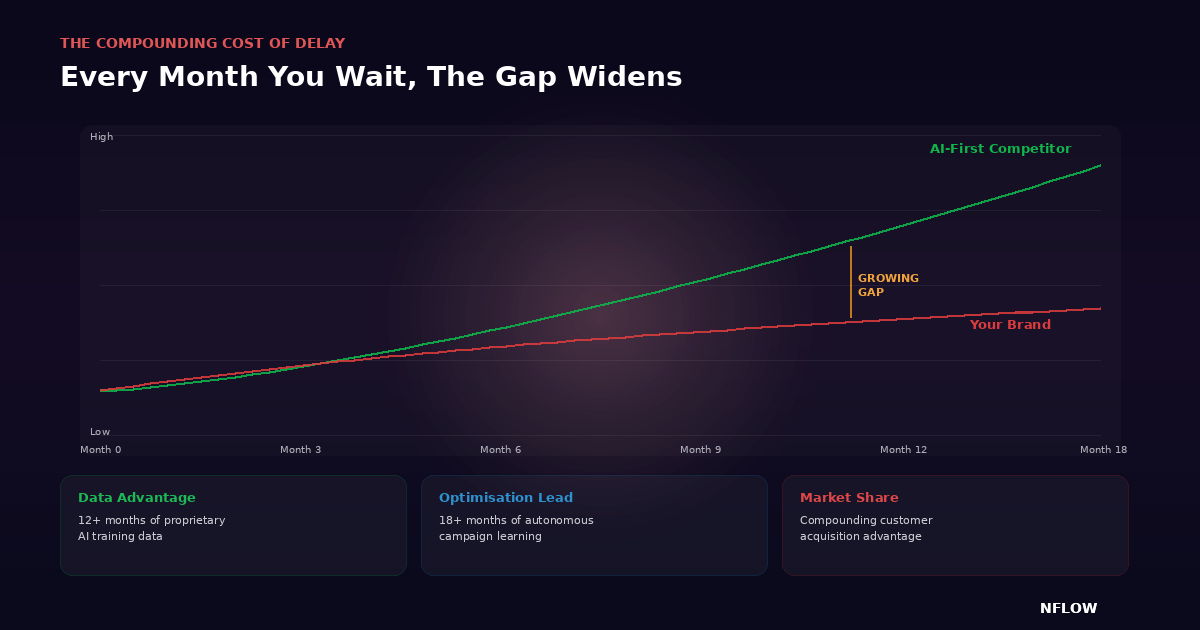
Here's the calculation most enterprise leaders don't make. The cost of delaying AI-first transformation isn't zero. It's the compounding value of the data, optimisation, and market share your competitor gains during every month you wait.
If your competitor started their AI-first transition 12 months ago, they now have a year of proprietary data training their models, a year of autonomous campaign optimisation refining their targeting, and a year of AI-optimised content building their search authority. You can't buy that back. You can only start building your own.
79% of enterprises face significant challenges in AI adoption. That means 4 in 5 brands in your industry are struggling with the same transition. The brands that figure this out first don't just gain an advantage. They gain an advantage that compounds monthly and becomes increasingly difficult to close.
The question isn't whether AI will reshape your competitive landscape. It already has. The question is whether your brand will be the one doing the reshaping or the one being reshaped.
Ready to assess where your brand stands? We'll run a complimentary AI-readiness audit of your marketing operation. No pitch, just a clear-eyed assessment of your current maturity level and the specific gaps your competitors are exploiting.