

A luxury jewellery brand came to us with a problem nobody talks about in the industry: they were invisible online. Beautiful products. Real craftsmanship. A physical showroom that converted well. But when their ideal customer searched for what they sold, they found competitors instead.
Within 12 months, that brand Avita Jewellery generated £90K+ in direct online revenue and £370K+ in offline sales influenced by organic search. Over £460K in total revenue, from a brand that wasn’t even ranking for its own name when we started.
This isn’t a story about keywords and backlinks. It’s a blueprint for how established luxury brands can own their digital presence without cheapening their positioning.
The Problem Most Luxury Brands Share (But Won’t Admit)
Here’s the uncomfortable truth about luxury jewellery in 2026: your product quality is no longer your competitive advantage online. It’s table stakes.
Pandora, Tiffany, Cartier they’ve spent millions building digital ecosystems. Their SEO teams are 40+ people deep. They rank for everything. And they’re not just capturing search demand. They’re shaping it.
If you’re a luxury brand doing £1M–£10M+ and your digital presence is still an afterthought a nice website, a few social posts, maybe some seasonal Google Ads you’re bleeding market share every single day. Not because your product is worse. Because your customer finds someone else first.
Why Traditional SEO Fails Luxury Brands
Most SEO agencies approach luxury jewellery the same way they approach plumbing or SaaS. Target high-volume keywords. Write blog posts stuffed with keyword variations. Build backlinks from directories nobody visits. Send monthly reports showing traffic going up while revenue stays flat.
Reason 1: The buyer journey is fundamentally different. A customer spending £2,000+ on a piece of jewellery doesn’t search “buy gold necklace online” and click the first result. They research materials, compare craftsmanship, read about brand heritage, visit the showroom, then come back online to purchase or call. Google’s information retrieval patents account for this their systems score resources on how well a page satisfies the full depth of a user’s information need.
Reason 2: Generic content destroys brand equity. When a luxury brand publishes “10 Tips for Choosing a Gold Ring,” they’re competing with Amazon listicles and mass-market retailers. They’re positioning themselves alongside brands three tiers below.
Reason 3: Traffic without intent is vanity. Getting 50,000 monthly visitors means nothing if none of them are in-market for £2,000+ jewellery. Enterprise SEO for luxury brands optimises for qualified intent the searches made by people who are ready to spend, not browse.
The NFlow Approach: What We Actually Did for Avita
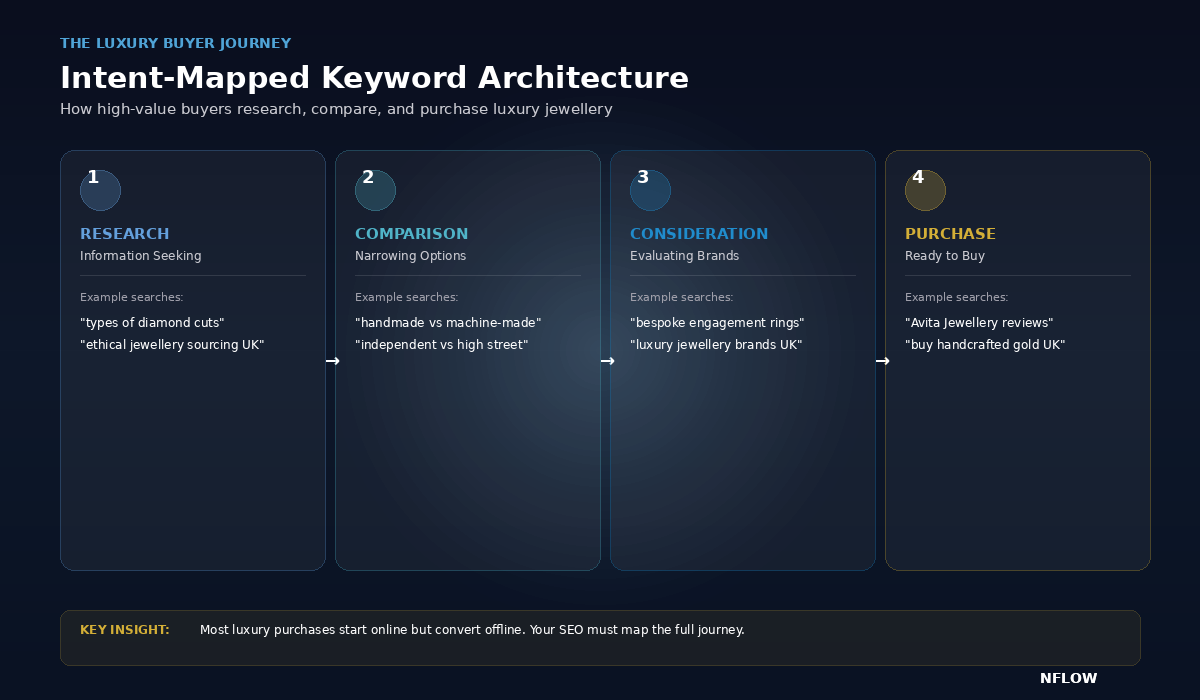
Step 1: Intent-Mapped Keyword Architecture
We didn’t start with “what keywords have the highest volume.” We started with “what does Avita’s ideal customer search at each stage of their decision?” We mapped the full buyer journey into four search intent layers: Research intent, Comparison intent, Consideration intent, and Purchase intent. We built content for every layer not thin keyword-targeted pages, but authoritative, experience-rich content that demonstrated genuine expertise.
Step 2: Content Clusters, Not Random Blog Posts
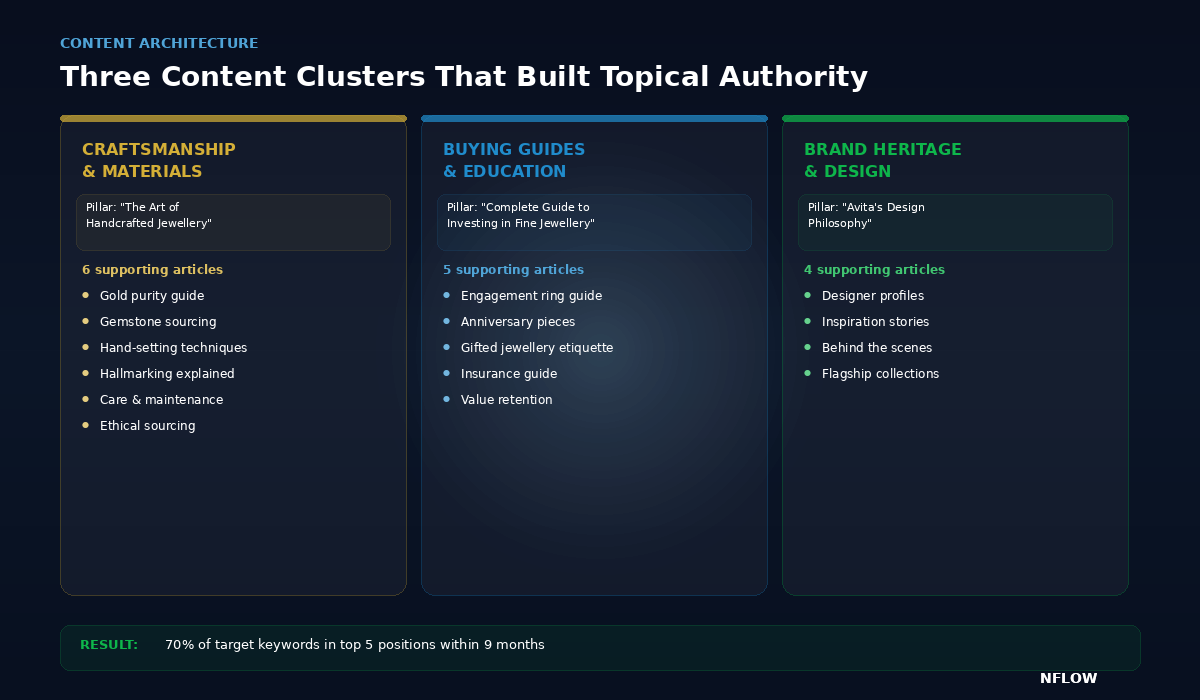
We built three content clusters for Avita: Craftsmanship & Materials (1 pillar + 6 articles), Buying Guides & Education (1 pillar + 5 articles), and Brand Heritage & Design (1 pillar + 4 articles). Every article linked to the pillar. The pillar linked to relevant product collections. This cluster architecture meant Google found a deeply interconnected web of expertise, not a random collection of pages.
The result: 70% of Avita’s target keywords landed in the top 5 positions within 9 months.
Step 3: Experience-First Product Pages
For Avita, we rebuilt every product page around the buyer’s experience: the story behind the piece, material deep-dives linked to craftsmanship articles, styling context, and genuine social proof. These pages didn’t just convert better. They ranked better. Google’s quality rater guidelines explicitly reward pages that demonstrate first-hand experience.
Step 4: Strategic Internal Linking
Every content piece had a purpose beyond ranking. Blog articles on craftsmanship linked naturally to Avita’s bespoke design service. Buying guides linked to their consultation booking page. We maintained 3–4 contextual internal links to blog content and 1–2 internal links to service pages per article.
Step 5: Offline Attribution
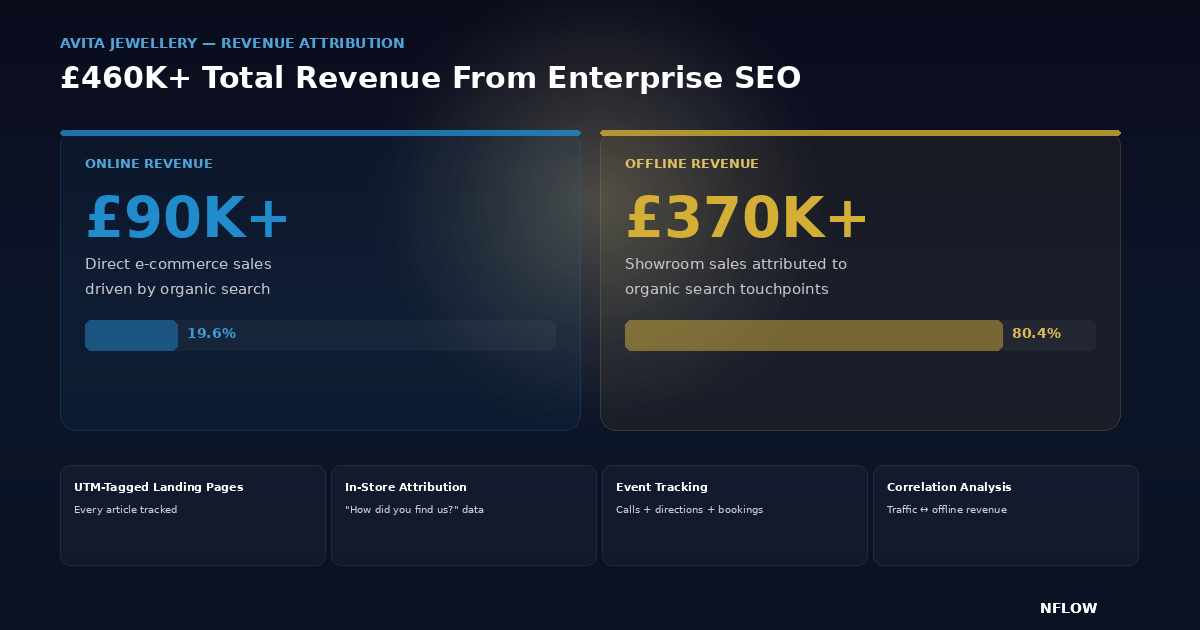
We built a simple attribution framework: UTM-tagged landing pages, in-store “How did you hear about us?” data, Google Analytics event tracking on directions and calls, and monthly correlation analysis. The data was clear: £90K+ in online sales. £370K+ in offline sales directly attributed to organic search. £460K+ total revenue.
The Enterprise SEO Framework for Luxury Brands
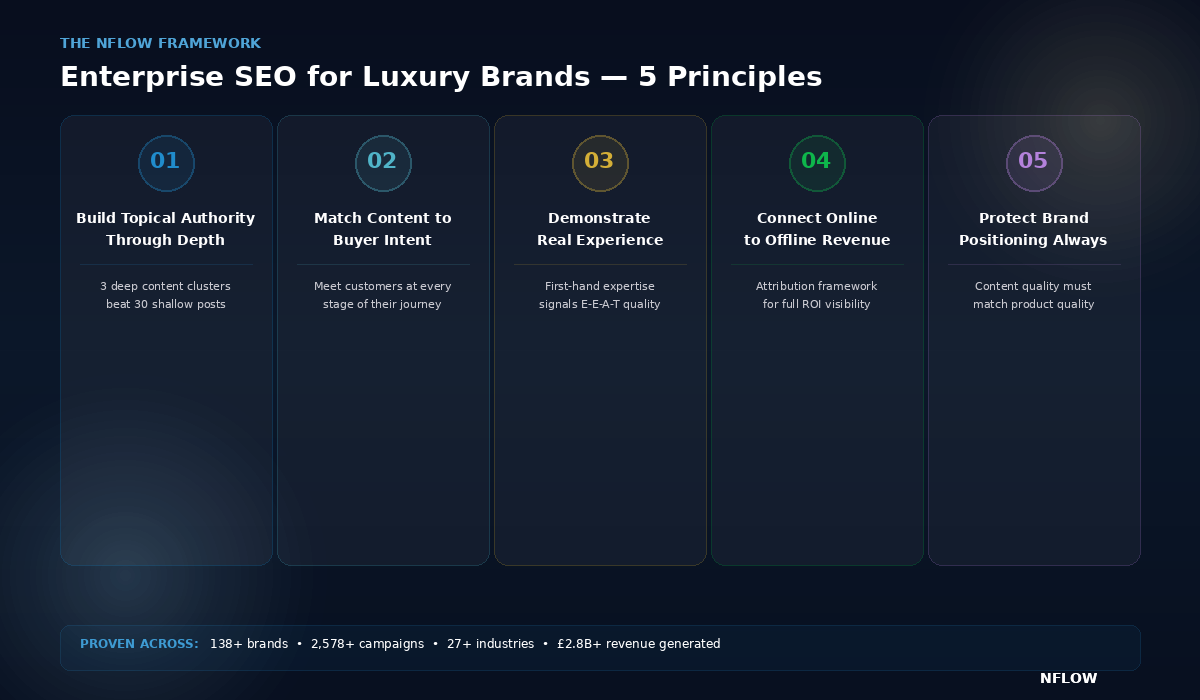
1. Build topical authority through depth, not breadth. Google’s content scoring patents reward pages that demonstrate comprehensive knowledge. Three deep content clusters beat thirty shallow blog posts.
2. Match content to buyer intent at every stage. Luxury buyers research extensively. Your content ecosystem should meet them at every stage.
3. Demonstrate real experience. E-E-A-T isn’t a checklist. Content from people who’ve handled the products and met the customers signals experience that Google recognises.
4. Connect online authority to offline revenue. If your luxury brand generates significant offline revenue, your SEO strategy must include offline attribution.
5. Protect your brand positioning in every piece. Every page you publish is a brand impression. The quality of your content should match the quality of your product.
Want to see what this framework could do for your brand? We’ll audit your current organic presence, identify the gaps your competitors are exploiting, and show you the specific revenue opportunity you’re leaving on the table.