

Your traffic dropped last week and you have no idea why.
You didn’t change anything. Didn’t touch your site. Didn’t update a single page. But sometime between March 27 and April 8, Google quietly rewired the way it ranks content. And if you’re running a small or mid-sized business that depends on organic search for leads, you probably felt it.
The March 2026 core update is done rolling out. Twelve days. That’s all it took for Google to reshuffle the deck on millions of businesses.
Some of you reading this saw a nice bump. More impressions. Better click-through rates. Pages that had been stuck on page two suddenly showing up in the top five. If that’s you, don’t skip this article. What Google gave you this month, it can take away next month if you don’t understand why you moved up.
And if your traffic fell off a cliff? Keep reading. Because here’s the thing most SEO blogs won’t tell you: the businesses that got hit the hardest in this update share a very specific pattern. Once you see it, you can’t unsee it. And fixing it is not as complicated as the SEO industry wants you to believe.
What Google Actually Changed This Time
Google’s official statement was predictably vague. They called it “a regular update designed to better surface relevant, satisfying content for searchers from all types of sites.”
Helpful. Thanks, Google.
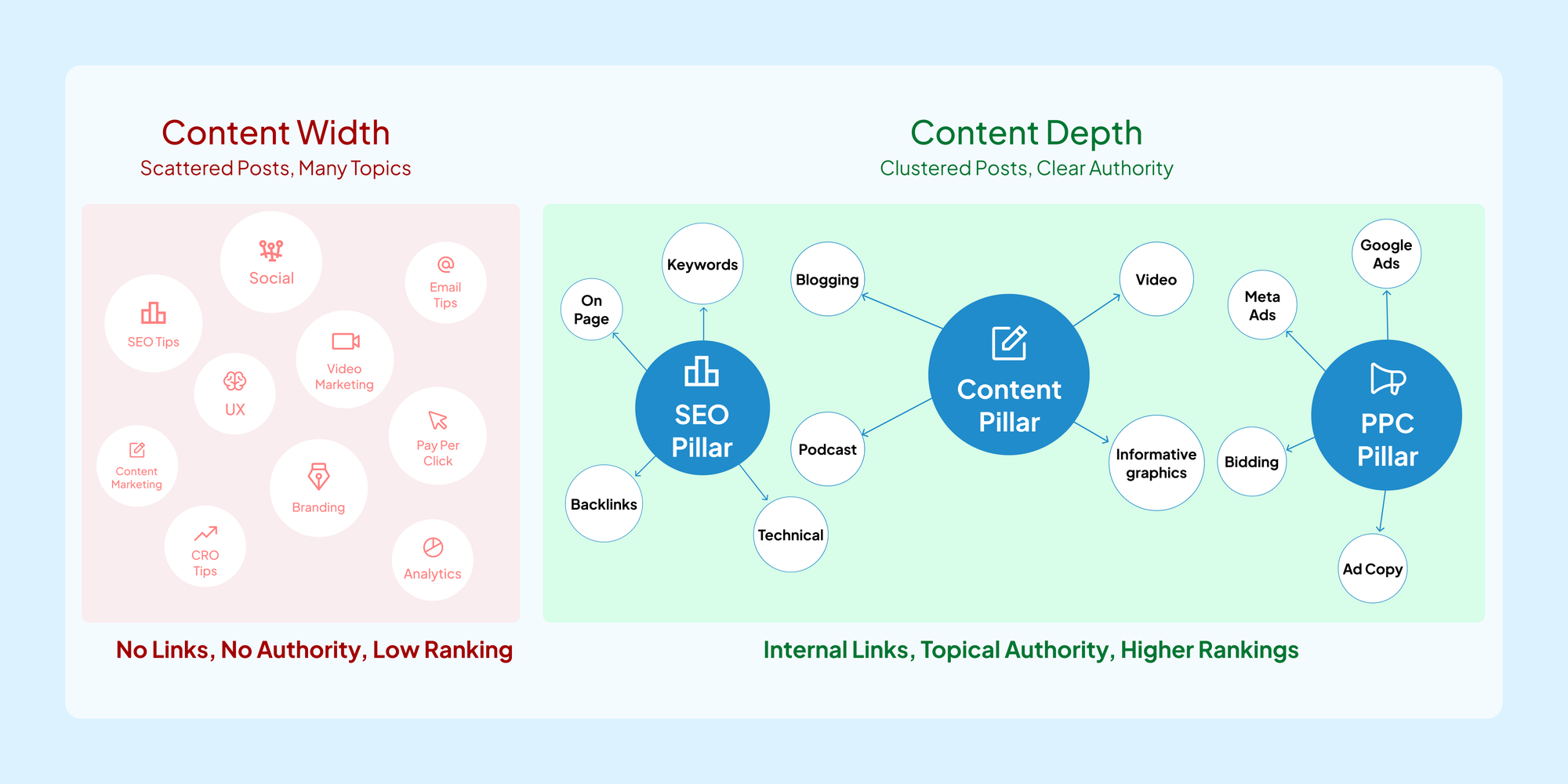
But when you dig into what actually moved across thousands of queries, the pattern is clear. This update was about one thing above everything else: content depth versus content width.
Let me explain.
For years, the standard SEO playbook for small businesses went something like this. Find a bunch of keywords. Write a 1,000 word blog post for each one. Sprinkle in some headers, add an image, hit publish, move on to the next keyword. Repeat fifty times. Hope for the best.
That playbook worked. Past tense.
What Google is now rewarding, and this has been building for the last eighteen months but this update made it unavoidable, is topical authority. Not “we published one article about this subject” authority. Real, demonstrated, go-deep-on-a-topic authority.
The businesses that gained rankings in this update tend to have clusters of content around specific subjects. They don’t just have a page about “kitchen remodeling costs.” They have that page, plus a page on financing options, plus a page on material comparisons, plus a case study, plus an FAQ page that answers the seventeen questions homeowners actually ask during a remodel.
The businesses that lost? They had a page about everything. And depth about nothing.
The Quiet Pattern Nobody Is Talking About
Here’s where it gets interesting. And this is the part I haven’t seen any other agency or SEO blog cover yet.
We manage campaigns across 27 different industries at NFlow. Jewellery brands. E-commerce stores. Marine construction companies. Toy companies. Health and safety businesses. When the update rolled out, we had a front row seat to how it hit across wildly different verticals.
And the quiet pattern is this: the update disproportionately punished businesses that rely on AI-generated content without human editorial layers.
Not all AI content. That’s an important distinction. If you’re using AI tools to help you draft outlines, speed up research, or generate first drafts that a human then rewrites, edits, and adds genuine expertise to? You’re fine. In fact, some of those sites gained traffic.
But if you spent the last six months pumping out dozens of blog posts where the AI did 90% of the work and a human maybe changed the title and hit publish? This update found you.
Google didn’t release a statement saying “we’re targeting AI content.” They don’t need to. Their systems are now sophisticated enough to detect content that lacks original insight, first-hand experience, and genuine expertise. Whether a human or a machine wrote it doesn’t matter as much as whether the content adds something new to the conversation.
This is a massive deal for SMBs. Because a lot of small businesses jumped on the AI content train in 2024 and 2025, thinking they’d found a cheat code. Fifty blog posts a month for the cost of a single ChatGPT subscription. And for a while, it worked. Rankings went up. Traffic increased.
Until this update.
Five Things to Do This Week If Your Traffic Dropped
If you opened Google Search Console last week and saw a downward trend starting around March 27, here’s what to do. Not next month. This week. The faster you respond to a core update, the faster Google recrawls and reassesses your pages.
1. Audit Your Thin Content (and Be Honest About It)
Open a spreadsheet. Pull every page on your site that gets organic traffic. Sort by sessions, lowest first. Now look at the bottom 30% of that list.
How many of those pages are genuinely useful to someone who lands on them? Not “technically answers the question in 300 words” useful. Actually, sit-down-and-read-the-whole-thing useful.
If you have pages that exist only because someone told you “you need more content,” those pages might now be hurting you. Google’s helpful content signals work at the site level, not just the page level. A bunch of weak pages can drag down the rankings of your strong ones.
What to do: Don’t delete them yet. First, check if they have backlinks (use Ahrefs, Semrush, or even Google Search Console’s links report). If they don’t have links and don’t drive traffic, either improve them dramatically or noindex them. If they have backlinks, rewrite them into something genuinely comprehensive.
2. Build Content Clusters, Not Content Graveyards
Remember the depth versus width point from earlier? Here’s how to apply it.
Pick the three topics that matter most to your business. Not thirty. Three. For a jewellery brand, that might be engagement rings, custom designs, and gemstone education. For a plumber, that might be emergency repairs, bathroom renovations, and water heater installation.
Now build a content cluster around each one. A pillar page that covers the topic comprehensively. Five to eight supporting pages that go deep on subtopics. Internal links connecting them together.
We did exactly this for Breezy Permits, a marine construction company. The result? 70% of their target keywords ended up in the top five positions. Not because we published more content than their competitors. Because we published deeper content in a tighter cluster.
This is the structure Google now rewards. Connected expertise, not scattered keyword chasing.
3. Add First-Hand Experience to Every Page That Matters
Google’s E-E-A-T framework (Experience, Expertise, Authoritativeness, Trustworthiness) added that first “E” for Experience in late 2022. For a while, it felt like a nice-to-have. After this update, it’s a requirement.
What does “experience” look like in practice? It’s specific. It’s detailed. It’s the kind of thing you can only write if you’ve actually done the work.
Bad: “Google Ads can be an effective way to generate leads for small businesses.”
Good: “We ran a Google Ads campaign for KindtoKidz, an Australian toy brand, starting with a $3,000 monthly budget. After restructuring their campaign into single-theme ad groups and rewriting their landing pages for mobile-first conversions, their ROAS hit 23.34. That’s $23 back for every $1 spent. And the total conversion value crossed AUD 151K in the first quarter.”
See the difference? The first sentence could have been written by anyone. Or anything. The second sentence could only come from someone who actually managed that campaign.
Go through your top twenty pages. Add specific examples. Client stories (with permission). Numbers from your actual work. Opinions based on your real experience. This is what separates content that survives algorithm updates from content that gets swept away every three months.
4. Fix Your Internal Linking (It Takes Thirty Minutes and It Matters More Than You Think)
Internal linking is one of those SEO fundamentals that everyone knows about and almost nobody does well. Especially small businesses.
Here’s the quick version: Google uses internal links to understand which pages on your site are the most important and how they relate to each other. If your most valuable service page has two internal links pointing to it, and your “About Our Team” page has fifteen, you’re telling Google that your team page is more important than your money page.
Spend thirty minutes this week doing this:
First, identify your five most important pages. The ones that directly drive revenue. Service pages, product categories, key landing pages.
Second, go through your recent blog posts and look for natural opportunities to link to those five pages. Not forced, “click here” style links. Natural, contextual links within sentences where you’re already talking about the relevant topic.
Third, make sure your content cluster pages link to each other. If you have a pillar page on “kitchen remodeling” and a supporting page on “countertop materials,” those pages should link to each other. It sounds obvious, but you’d be shocked how often this gets missed.
5. Check Your Page Speed (Google Got Pickier About This Again)
Core Web Vitals have been a ranking factor for a while now. But the March 2026 update appears to have tightened the thresholds for what Google considers “good” performance.
Run your top pages through PageSpeed Insights. If your Largest Contentful Paint (LCP) is above 2.5 seconds, that’s now a problem. If your Cumulative Layout Shift (CLS) is above 0.1, that’s a problem. If your Interaction to Next Paint (INP) is above 200ms, that’s a problem.
For most SMB websites, the biggest speed killers are oversized images, too many third-party scripts (looking at you, Facebook Pixel and Google Tag Manager containers with forty tags), and cheap hosting.
Quick wins: Compress all images to WebP format. Defer non-critical JavaScript. If you’re on shared hosting and your LCP is consistently above 3 seconds, it might be time to move to a managed WordPress host or a CDN-backed setup. The investment is usually $30 to $100 per month. The traffic you recover is worth multiples of that.
What This Means for the Rest of 2026
This update isn’t an isolated event. It’s a signal.
Google is moving, faster than most businesses realize, toward a search experience where AI Overviews handle the simple questions and traditional organic results get reserved for content that offers genuine depth, real expertise, and original perspective.
If your SEO strategy is still built on publishing blog posts that summarize what’s already on the first page of Google, that strategy has an expiration date. And it might have already expired.
The businesses that will win in organic search for the rest of 2026 and beyond are the ones that treat content as a product, not a checkbox. That means fewer, better pages. Deeper expertise on the topics that actually matter to your customers. And a willingness to share real data, real experience, and real opinions instead of safe, generic advice.
At NFlow, this is exactly why we built our Organic Opportunity Lab. When we worked with Avita Jewellery, the goal was never “rank for more keywords.” It was “become the most trusted jewellery resource in your market.” The result was £90K+ in online sales and £370K+ in offline revenue. Because when people trust your content, they trust your brand. And when they trust your brand, they buy.
Your Next Move
If your traffic took a hit from this update, you have a window right now, while Google is still recrawling after the update, where strategic changes can make a fast difference. The five steps above are where to start. Every one of them can be done this week, most of them in a single afternoon.
And if you’re looking at this list thinking “I need help figuring out which of these applies to my site,” that’s what our free consultations are for. We’ll pull up your Search Console data, show you exactly where the update hit, and build a recovery plan tailored to your business. No pitch. Just the data and a clear set of next steps.