

A website can get thousands of visitors a month and still leave the phone silent. That gap between traffic and leads is where most businesses get frustrated with search marketing, and it's usually a targeting and follow-through problem rather than a traffic problem. This guide explains how a good SEO agency closes that gap, what the work involves, what it costs and how long it takes. It's written for owners and marketing managers who want customers, not just numbers on a dashboard, and are deciding whether outside help is worth it.
How Does an SEO Agency Turn Search Traffic Into Qualified Leads?
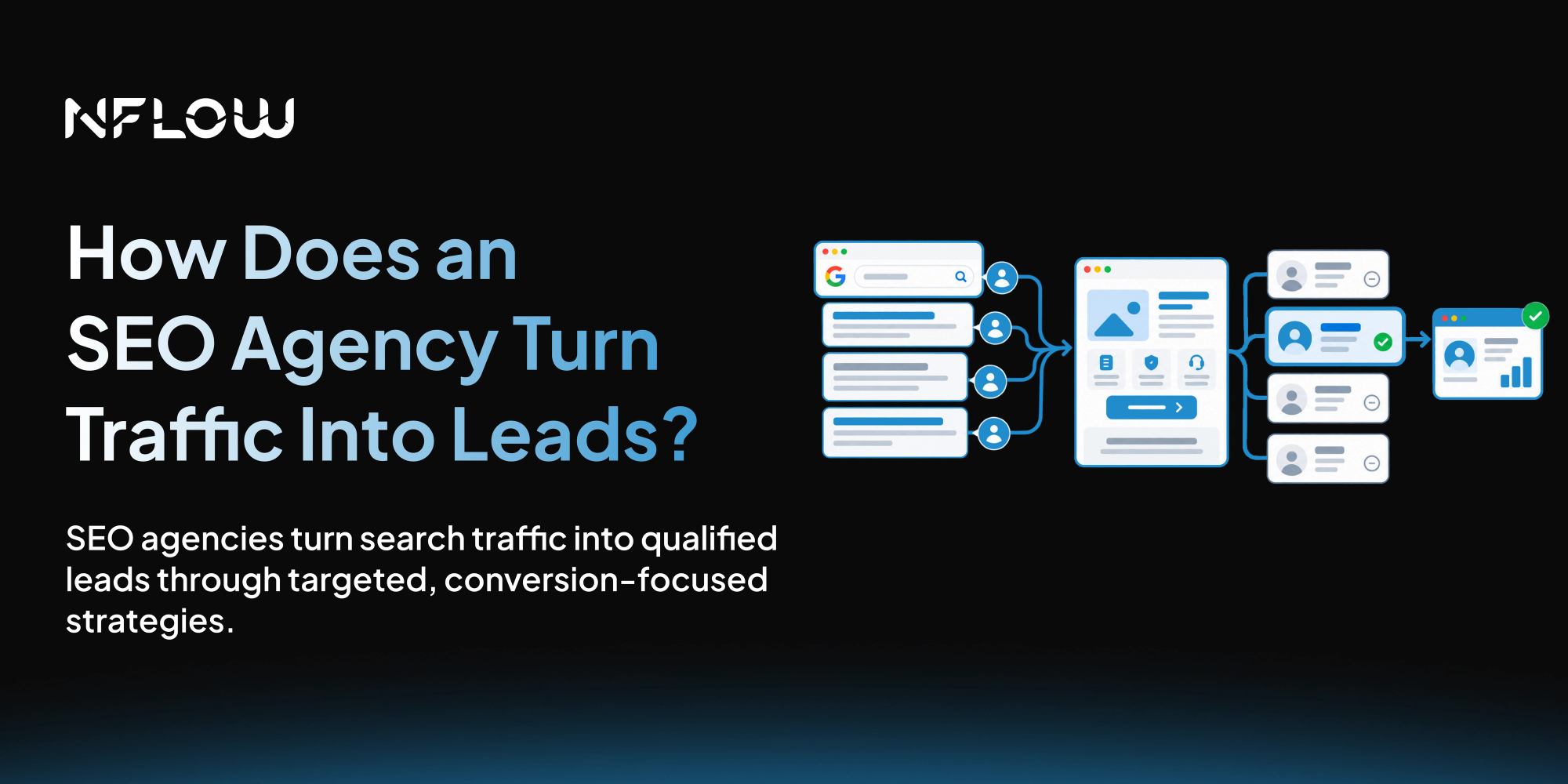
An SEO agency turns search traffic into qualified leads by getting your business in front of people who are already searching for what you sell, then making it easy for those people to contact you. The first half is visibility. The second half is conversion, and agencies that only do the first half are the ones that produce reports full of traffic and no customers.
SEO lead generation is the use of search engine optimization to bring in inquiries, calls and bookings instead of just visits. A qualified lead is someone who fits your service area, budget and needs closely enough that a sales conversation makes sense. A specialist organic SEO agency focuses on exactly this: earning those inquiries from unpaid search results rather than buying clicks.
Search traffic moves through three stages. Early on, people are learning about a problem ("why is my roof leaking"). Then they compare options ("roof repair vs. replacement cost"). Finally, they're ready to act ("roofer near me free estimate"). An agency builds pages for each stage, but puts the most effort into the last two, because that's where inquiries come from.
Think of organic traffic as people walking past your shop window. Qualified leads are the ones who walk in already wanting what you sell. A busy street is nice, but only the second group pays your rent.
What SEO Services Help Generate Qualified Leads?
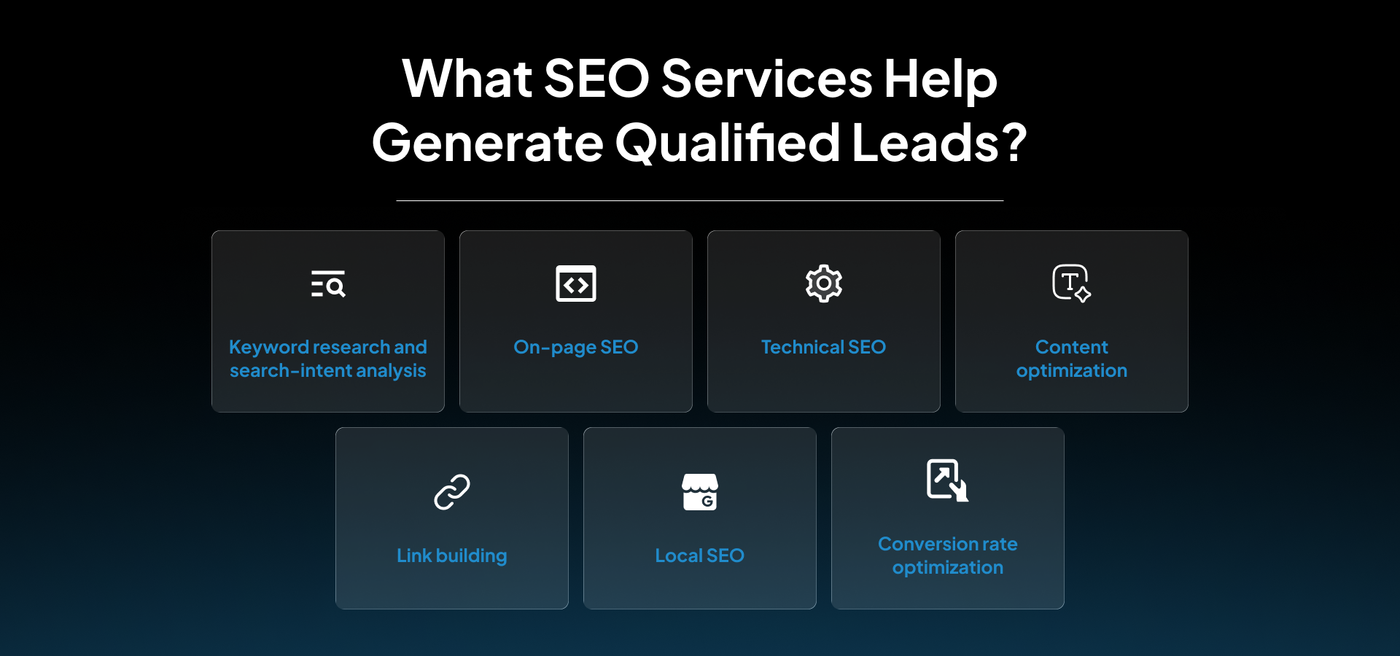
The SEO services that generate qualified leads are the ones that connect what people search for with a page built to answer them and a clear way to get in touch. Most engagements combine several of these:
-
Keyword research and search intent analysis: Finds the exact phrases your buyers type, and works out what they want when they type them (to learn, compare or buy).
-
On-page SEO: Adjusts titles, headings and page copy so search engines understand what each page offers and visitors see what they came for.
-
Technical SEO: Fixes the behind-the-scenes problems, such as slow loading, broken links and pages Google can't read, that stop good content from ranking.
-
Content SEO: Creates guides, comparisons and answers that reach people while they're still deciding.
-
Local SEO: Improves how you appear in map results and "near me" searches, including your Google Business Profile.
-
Link building: Earns mentions from other reputable sites, which signals to Google that you can be trusted.
-
Conversion rate optimization (CRO): Improves the site itself so a larger share of visitors call, book or fill in a form.
How Does an SEO Company Attract High-Intent Search Traffic?
An SEO company attracts high-intent traffic by researching which searches come from people actively comparing options or ready to buy, then building pages that target those searches first. Search intent simply means the reason behind a search. A high-intent keyword is a phrase that signals someone is close to a decision.
Compare two searches. Someone typing "what is a dentist" wants a definition and will never book an appointment because of your page. Someone typing "emergency dentist near me open now" has a toothache and a phone in their hand. Both count as traffic in your analytics, but only one is worth paying to reach.
To find the second kind, an agency looks at commercial phrases (words like "cost," "near me," "best," "quote," "emergency" and "vs."), studies what already ranks, and checks tools such as Google Search Console, Semrush or Ahrefs to see which terms competitors win and which they miss. Then it decides where your budget goes. Usually that means fewer, more specific pages aimed at buyers, rather than broad articles aimed at everyone.
How Can SEO Services Convert Website Traffic Into Leads?
SEO services convert traffic into leads by matching each search to a page that answers it and then pointing the visitor to one obvious next step. Ranking gets people to the door. What's on the page decides whether they step through.
The pieces work together like this:
-
Relevant content: A visitor searching "kitchen remodel cost" should land on a page that discusses typical costs and what affects them, not a generic homepage.
-
Service pages: Each core service gets its own page covering who it's for, what's included, how it works and what it costs, so the reader can decide without hunting.
-
Landing pages: For high-value searches, a focused page with a single goal, such as booking a free consultation, tends to outperform a page that tries to do everything.
-
Calls to action (CTAs): A CTA is the button or prompt that tells someone what to do next. "Get a free quote" beats "Submit."
-
Clear user journeys: Someone should reach a contact option within a click or two from any page, on a phone as easily as on a desktop.
None of this is exotic. It's mostly the discipline of asking, on every page, what a visitor wants and what we want them to do next.
What Does an SEO Agency Do to Improve Conversion Rates?
An SEO agency improves conversion rates by studying how visitors behave on your pages and removing whatever stops them from contacting you. Your conversion rate is the percentage of visitors who take the action you want, such as calling or submitting a form. If 1,000 people visit and 20 inquire, that's 2%. Small gains here can matter as much as ranking higher, because they multiply the value of the traffic you already have.
Typical fixes are unglamorous and specific. A vague button gets rewritten to say "Book a free 15-minute call." A page that takes six seconds to load on mobile gets compressed and cleaned up, since many visitors leave before it finishes. A contact form with nine fields gets trimmed to name, phone and a short message. Trust signals, meaning things that reassure a stranger, get placed near the CTA: real reviews, licenses, certifications, photos of actual work and clear pricing guidance.
Agencies find these problems with tools like Google Analytics 4 (GA4), heatmaps from Hotjar or Microsoft Clarity, and session recordings. Then they test changes one at a time so they know what worked.
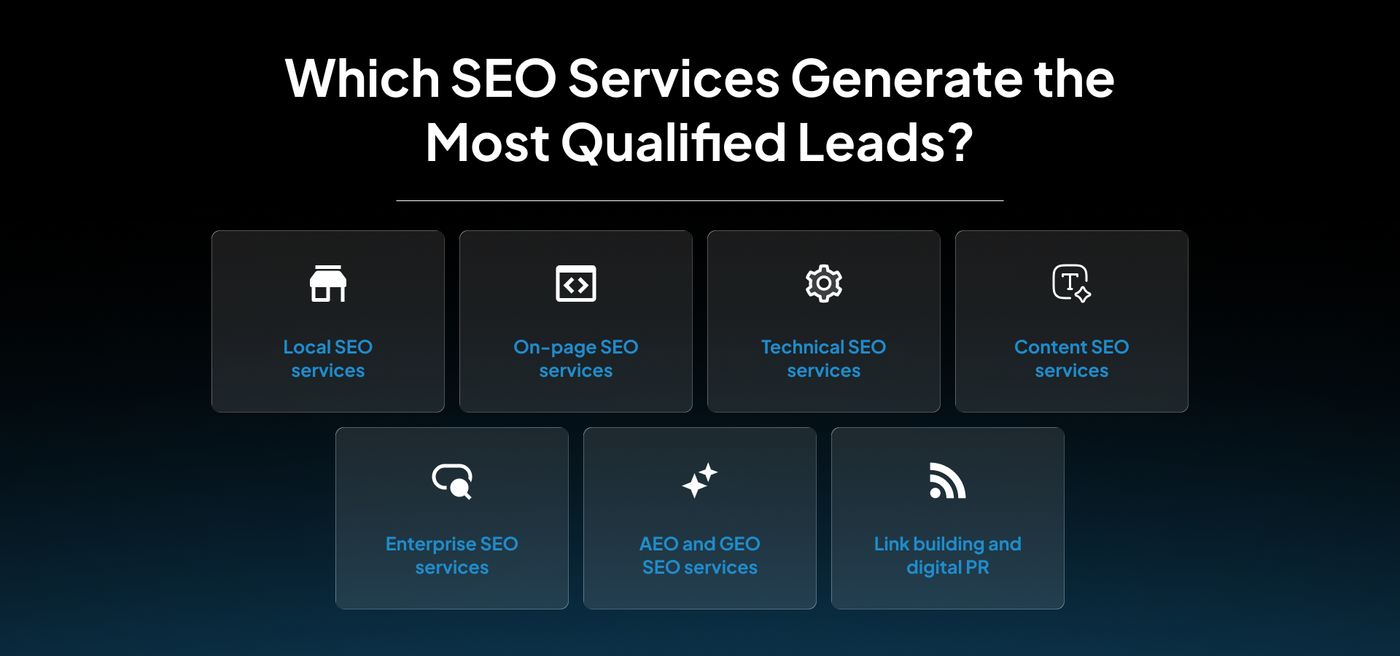
Which SEO Services Generate the Most Qualified Leads?
The SEO services that generate the most qualified leads are usually local SEO, commercial keyword optimization and strong service pages, because they target people closest to a buying decision. Here's when each tends to work best:
-
Local SEO: Best for businesses serving a specific area, such as dentists, plumbers, law firms and clinics. A dedicated local SEO agency handles the map listings, reviews and location pages that decide who shows up in "near me" results.
-
Commercial keyword optimization: Best when your buyers search with words like "pricing," "best" or "hire," which show they're comparing providers.
-
Service and landing page SEO: Best for any business with distinct offers, since each page can match one specific need.
-
Content marketing and topical authority: Topical authority means Google sees your site as a go-to source on a subject because you've covered it thoroughly. It works best in considered purchases, like B2B software or legal services, where buyers research for weeks.
-
Technical SEO: Best for large or older sites where crawling problems, duplicate pages or slow speed are holding everything back.
-
AEO and GEO: Answer engine optimization (AEO) structures content so AI assistants and Google's answer boxes can quote it. Generative engine optimization (GEO) is the broader effort to get your brand cited in AI-written answers. Both suit businesses whose customers now ask ChatGPT or Google's AI Overviews for recommendations.
-
Link building and digital PR: Best in competitive markets where several sites have similar content and authority decides who ranks first.
The best mix depends on your business, your market and how much competition you face. Anyone offering the same package to everyone isn't looking closely enough.
How Does an SEO Company Measure Lead Generation?
An SEO company measures lead generation by tracking how many inquiries come from organic search, what they cost and how many turn into paying customers. Traffic alone doesn't count. Here's what to expect in reporting:
-
Organic leads: Total inquiries from unpaid search, tracked in GA4 with events set up for form submissions and calls.
-
Conversion rate: Visitors who inquire divided by total visitors, tracked in GA4 by page and by traffic source.
-
Calls: Call tracking software such as CallRail assigns numbers to organic visitors so you can see which searches drove which calls.
-
Form submissions: Tracked in GA4, ideally matched to the search terms visible in Google Search Console, which shows which queries brought people to your site.
-
Cost per lead: Your monthly SEO spend divided by the leads it produced. It's a rough measure, since SEO effects build over time.
-
ROI: Revenue from SEO-sourced customers compared with what you paid. This needs your CRM (customer relationship management software, such as HubSpot or Salesforce) or even a simple spreadsheet, because analytics can't see who actually bought.
How Much Do SEO Services Cost?
SEO services typically cost between a few hundred and several thousand dollars a month, depending on your competition, the size of your site, the scope of work and your location. Pricing rises when you're chasing competitive phrases (personal injury law costs far more to compete in than a local florist), when your site has hundreds of pages, when you want content and link building on top of the basics, and when you're in a major city rather than a small town. Agency location matters too, since rates in India, the UK and the US differ considerably.
Why Hire an SEO Agency for Lead Generation?
You should hire an SEO agency for lead generation when search is a meaningful source of customers for your market and you don't have the time or expertise to run it well in-house. The clearest signs are competitors outranking you on searches that clearly matter, a site with traffic but few inquiries, or a marketing team already stretched thin.
What you're paying for beyond traffic growth is a working system. That means a strategy built around your services and market, people who can execute it (writers, developers, outreach specialists), tracking that ties search activity to real inquiries, and someone accountable when the numbers don't move. Few small teams have all four. If you also want search coordinated with paid ads, email and social, a full-service digital marketing agency can run those channels from one plan.
To be fair, it isn't always necessary. If you run a small local business in a low-competition area, a motivated owner can handle the basics: a well-maintained Google Business Profile, solid service pages and steady reviews. An agency earns its fee when the competition, the complexity or the stakes outgrow that.
How Do You Choose the Right SEO Services Company?
You choose the right SEO services company by checking whether it can show relevant results, explain its plan in plain language and tie its reporting to leads rather than rankings. Look at these areas:
-
Experience: Ask if they've worked in your industry or a similar one, and what they learned.
-
Case studies: Look for results described in terms of leads and revenue, with enough detail to be believable. Ask to speak with a past client.
-
Strategy: They should explain why they'd start where they propose, using your actual market, not a template.
-
Reporting: Ask to see a sample report. It should show leads and conversions, not only rankings and traffic.
-
Communication: Find out who your contact is, how often you'll talk and how quickly questions get answered.
-
Deliverables: You should know what gets done each month, in writing.
-
Transparency: A good agency tells you what it's doing and lets you own your accounts and content.
-
Lead-generation capability: Ask directly how they'll improve conversions, not just rankings.
Red flags include guaranteed rankings or leads (nobody controls Google), vague reporting, long lock-in contracts with no exit, and refusing to explain their methods.
What Should You Check Before You Hire an SEO Agency?
Before you hire an SEO agency, check that it can carry out the seven parts of this lead generation checklist, since each one shows whether the work will lead to inquiries or only to traffic.
-
Target high-intent keywords: Ask how they'll find searches from people ready to buy, and to see a sample list for your business.
-
Match content with search intent: Ask how they decide whether a keyword needs a guide, a service page or a comparison.
-
Optimize service pages: Confirm each of your core services will get its own page that's clear about who it's for and what to do next.
-
Improve technical SEO: Ask for an audit covering speed, mobile usability, crawl errors and indexing before any content is written.
-
Create clear conversion paths: Ask how visitors will move from a search result to a call, form or booking with as little friction as possible.
-
Track leads and conversions: Confirm they'll set up GA4, call tracking and form tracking in accounts you own.
-
Measure SEO ROI: Ask how they'll connect leads to closed sales, and how often they'll report on it.
If an agency hesitates on more than one of these, keep looking.
How Long Does SEO Take to Generate Qualified Leads?
SEO usually takes three to six months to show early signs of lead growth and six to twelve months or longer to produce meaningful, steady results. That's a typical range, not a promise. In the first two or three months you'd expect fixes to be completed and rankings to start moving on lower-competition phrases. Calls and form fills usually begin trickling in around months three to five. Consistent lead flow tends to take longer.
Timelines vary for practical reasons:
-
Competition: A crowded market with established players takes longer than a niche one.
-
Website authority: A domain with years of history and quality links starts ahead of a brand-new one.
-
Content: Sites that publish useful, well-targeted pages regularly progress faster.
-
Technical SEO: Serious problems can suppress everything else until they're fixed.
-
Target keywords: Specific, lower-volume phrases rank sooner than broad, contested ones.
-
Location: A small town is quicker than a major city.
If someone promises page-one results in 30 days, they're guessing or selling something else.
How Can an SEO Agency Improve Lead Quality Over Time?
An SEO agency improves lead quality over time by using conversion data to find which searches, pages and visitors produce real customers, then shifting effort toward them and away from the rest. The first few months set a baseline. After that, the useful work is refinement, and it's the stage where you improve organic SEO results based on evidence instead of guesses.
Agencies compare keyword performance in Google Search Console against inquiries in GA4 and your CRM, check which landing pages convert and which don't, and watch user behavior for signs of confusion. Then they adjust.
Here's a realistic example. A home-renovation company ranks well for "kitchen design ideas" and gets lots of visitors, but almost none inquire, because those people are browsing photos. Meanwhile, "kitchen remodeler near me" brings fewer visitors and a steady stream of calls. A good agency stops investing in the first phrase, moves that effort to the second and improves the page it lands on. Traffic may dip slightly while revenue rises, and that's the trade you want.
Conclusion
An SEO agency turns search traffic into qualified leads by reaching people who are ready to buy and making it easy for them to contact you. The traffic number matters far less than how many of those visitors call, book or fill in a form.
Results still depend on your competition, your budget and the quality of your website, and nobody can honestly guarantee rankings or leads. Expect early signs in three to six months and steadier lead flow after six to twelve.

FAQs
How does an SEO agency generate leads?
An SEO agency generates leads by getting your site to rank for searches from people ready to buy, then improving your pages so those visitors call, book or fill in a form.
Can SEO services generate qualified leads?
Yes, SEO services can generate qualified leads when they target high-intent searches and convert visitors well, though results depend on your competition, budget and website quality.
What does an SEO company do?
An SEO company researches what your customers search for, fixes technical problems, creates and optimizes content, builds links, and tracks whether search traffic turns into inquiries.
How much do SEO services cost?
SEO services commonly run from about $500 to $1,500 a month for small businesses and $1,500 to $5,000 for mid-sized ones, with enterprise work often costing much more.
How long does SEO take to generate leads?
Most businesses see early signs within three to six months and steadier lead flow after six to twelve months, though competitive markets can take longer.
How do I hire an SEO agency?
List your goals and budget, shortlist agencies with relevant case studies, ask for a sample report and a written scope of work, and confirm you'll own your analytics accounts and content.
How do I choose an SEO services company?
Choose an SEO services company that explains its strategy in plain language, reports on leads instead of only rankings, shows believable past results and doesn't guarantee rankings.
Which SEO services are best for lead generation?
Local SEO, commercial keyword optimization and well-built service pages usually produce the most qualified leads, but the right mix depends on your business and market.