

If you've wondered why every agency is suddenly selling AI SEO services, look at how fast search has changed. ChatGPT launched in late 2022 and, according to OpenAI, passed 900 million weekly users by February 2026. Google rolled out AI Overviews in the US in 2024, and at I/O 2026 Google reported that AI Overviews had over 2.5 billion monthly active users, while AI Mode passed 1 billion in its first year.
Clicking habits are shifting too. A Pew Research Center study found Google users clicked a regular result on 8% of visits when an AI summary appeared, versus 15% when none did.
So what is AI SEO, really? Some say it means using ChatGPT to write blog posts; others say traditional SEO is dead. Neither is right. This guide explains what it actually is, how to check where you stand today, what you can fix yourself, what it costs, and how to tell if it's worth paying for.
What Is AI SEO and How Is It Changing the Way People Search?
AI SEO is the work of making your business easy for AI search tools like ChatGPT, Perplexity and Google's AI Overviews to find, understand and recommend, while still ranking in normal Google results.
For twenty years, search worked like a phone book: you typed a few words, Google showed ten links, and you picked one. Now a lot of searches end with an AI tool reading several pages and writing one answer, often naming a couple of businesses along the way. Your website isn't only trying to get clicked anymore. It's trying to get mentioned.
Here's a simple example. Say someone asks ChatGPT, "Which accountant in Dallas is good for small online stores?" The AI won't show ten links. It'll name a few firms and explain why. If your firm isn't one of them, that person may never visit Google at all. (Our ChatGPT SEO guide explains how ChatGPT picks which businesses to name.)
That's the big difference from the SEO you already know. Normal SEO is about earning a spot in the list of results through useful pages, a healthy website and links from other sites. AI SEO keeps all of that and adds one more goal: making your information so clear and trustworthy that an AI tool repeats it correctly when someone asks about your industry.
It's also not just about using AI to write content, which is the most common mix up we hear. Pumping out AI articles is a shortcut, not a plan, and pages that sound like everyone else's rarely get picked. Real AI SEO is about what search engines and AI tools see when they look at your business.
Beyond official numbers like Google's, many stats online come from companies with something to sell, so take them with a pinch of salt. The direction is clear, though: more people start their research in AI tools, and AI Overviews keep showing up on more searches.
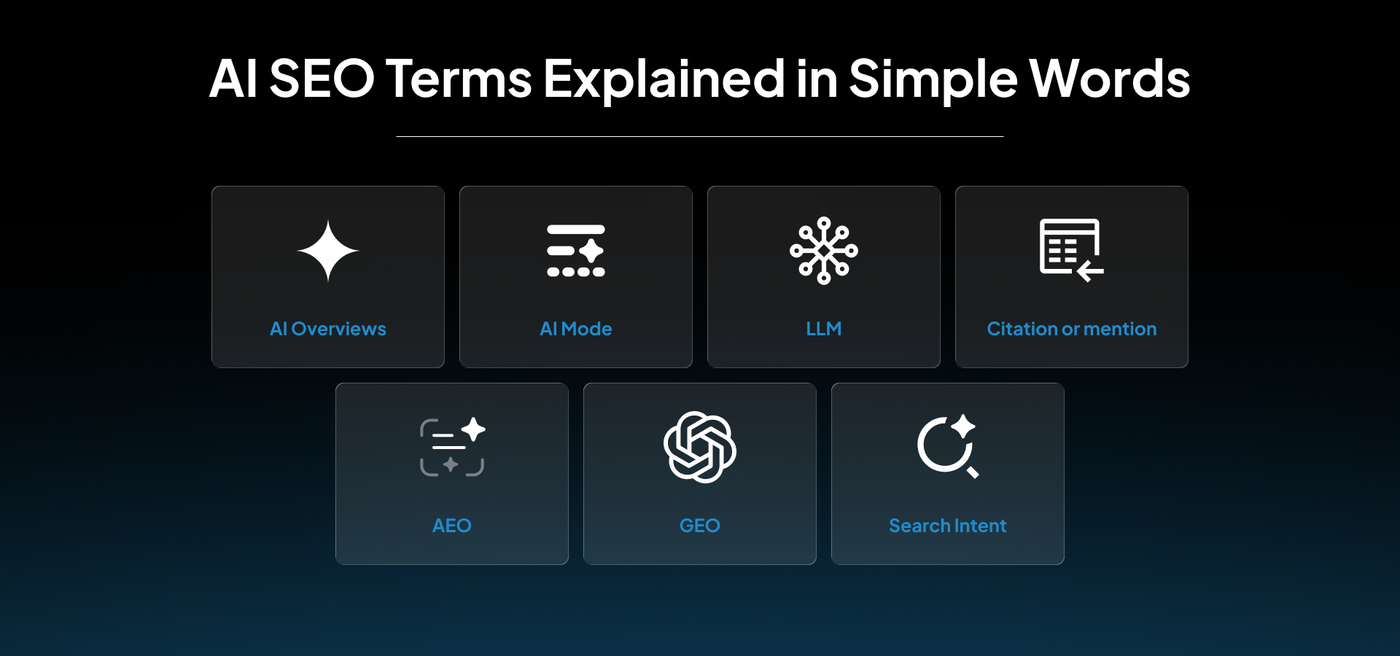
AI SEO Terms Explained in Simple Words
You don't need to learn a whole new language to understand AI SEO, but knowing a handful of terms will help you follow any conversation with an agency.
-
AI Overviews: The short AI written summary Google shows at the top of many search results, with links to the pages it used.
-
AI Mode: A chat style search inside Google where you can ask follow up questions, a lot like talking to ChatGPT.
-
LLM (large language model): The technology behind tools like ChatGPT and Gemini. It reads huge amounts of text and writes answers in plain language.
-
Citation or mention: When an AI answer names your business or links to your page as a source. This is the AI version of ranking.
-
AEO (Answer Engine Optimization): Shaping your content so it gives clear, direct answers that search engines and AI tools can pick up easily.
-
GEO (Generative Engine Optimization): Building your brand's presence across the web so AI tools understand who you are and feel safe recommending you. Our generative engine optimization guide covers it step by step.
-
Search intent: The reason behind a search. Is the person just learning, comparing options, or ready to buy?
AI SEO Services by the Numbers: What Do the Stats Say?
AI search is growing fast and changing how people click, but many numbers are still settling, so be careful with anyone who quotes exact figures with total confidence.
Here's what the evidence honestly supports right now:
-
AI search use: Many people now ask AI chat tools the questions they used to type into Google. Normal search is still much bigger, so this is a change in habits, not a replacement.
-
Fewer clicks on some searches: As the Pew data shows, AI summaries can reduce clicks to regular results, especially on simple questions the summary fully answers. Searches where the person is ready to buy still tend to send visitors to websites.
-
Businesses using AI in SEO: Industry surveys show AI tools are now a normal part of SEO work. Far fewer businesses are working on purpose to show up inside AI answers, and that gap is your opening.
-
Better quality visitors: Some early reports suggest visitors from AI tools buy at a higher rate, likely because they've already compared options before they click. The numbers are still small for most sites, so treat this as a good sign, not a proven fact.
What does that mean for you? You don't need to rebuild your marketing around AI tomorrow. You do need to know whether AI tools mention you when customers ask about your field, because if they don't, someone else gets that recommendation.
Why Should You Invest in AI SEO Services Right Now?
AI tools recommend businesses based on what's already written about them online, and that kind of reputation takes time to build, so starting early gives you a head start that's hard to buy later.
A good AI SEO agency can help you get found faster by fixing the obvious problems first, like unclear service pages and technical errors that stop search engines reading your site. It won't make you famous overnight, but it can stop you wasting months on the wrong work.
It also helps you reach customers wherever they search. Your customers aren't choosing between Google and ChatGPT; plenty use both for the same purchase. AI search optimization makes sure the same correct story about your business shows up wherever they ask.
And if you ignore AI search? Nothing dramatic happens tomorrow, and your rankings won't disappear because you skipped a trend. The risk is slower: more customers will get their shortlist from an AI answer, and if you're not on it, you never get the chance to compete.
How Can You Check If AI Tools Mention Your Business?
You can run a simple check yourself in about an hour by asking AI tools the same questions your customers ask and noting whether your business shows up.
-
Write down 5 to 10 real customer questions. Use the words your customers actually use, like "best roofing company in Phoenix for flat roofs" or "affordable payroll software for a 10 person team."
-
Ask them for several tools. Try ChatGPT, Gemini, Perplexity, and Google itself, looking at the AI Overview and AI Mode answers.
-
Note who gets named. Are you mentioned? Which competitors are? Is the information about you correct, including your services, location and prices?
-
Look at the sources. Check which websites the AI links to or quotes. Those are the places where being mentioned matters most in your industry.
-
Repeat every month. AI answers change often, so save screenshots and compare them over time.
On the Google side, Google's own documentation says that traffic from AI Overviews and AI Mode is counted inside your normal Search Console data, so you won't see it as a separate channel there. That's another reason this hands on check is useful. If you want to go further than a monthly spot check, our guide to brand visibility in AI search engines shows how to track and improve how AI tools talk about you.
What Will an AI SEO Agency Actually Do for Your Business?
A good AI SEO provider studies how your customers search, improves your website so Google and AI tools understand it, works to get you mentioned in AI answers, and keeps an eye on your competitors.
In practice, the work usually covers:
-
Keyword and search intent research: Finding the questions your customers actually ask, including the longer, chat style ones people type into AI tools, and matching each to the right page on your site.
-
Improving your existing content: Most businesses already have pages that are close to good but hide the answer or contradict each other. Putting clear answers near the top and fixing old information is often the quickest win.
-
Visibility in ChatGPT, Google AI Overviews and other AI results: AI tools tend to use pages that answer questions directly and businesses that are mentioned often on trusted sites like industry publications and review platforms. So the work covers your reputation beyond your own website too, although nobody can promise a mention in any particular answer.
-
Competitor tracking: Learning which competitors show up in AI answers and Google results for your most valuable searches, and why. That shows you the real gaps worth closing.
What Can You Do Yourself Before Hiring Anyone?
Most of the basics that help with AI search are the same good habits that help with normal SEO, and you can start on many of them this week without any special tools.
That's not just our opinion. Google's guide on AI features says plainly that normal SEO best practices still apply to AI Overviews and AI Mode, and that there are no extra requirements or special tricks needed to appear in them. Here are simple steps worth doing:
-
Answer the main question first. At the top of each service page, explain in one or two plain sentences what you do, who it's for and where you work.
-
Add a short FAQ section. Use real questions customers ask you on calls and in emails, and answer each one clearly in a few lines.
-
Keep your details the same everywhere. Your business name, address, phone number and hours should match on your website, Google Business Profile and directories. Google's own list of best practices includes checking that your Business Profile information is up to date.
-
Ask happy customers for reviews. Reviews on Google and trusted industry sites help both people and AI tools judge whether you're reliable.
-
Show the real people behind your business. A proper About page, team names and real experience make your content more trustworthy than faceless pages.
-
Link your related pages together. If a blog post talks about a service you offer, link to that service page so visitors and search engines can find it.
-
Make sure Google can see your pages. Use the free Google Search Console tool to check that your important pages are indexed, meaning Google has saved them and can show them in results.
None of this guarantees an AI mention, but it gives AI tools clear, correct information to work with. If you get stuck, or you don't have the time, that's usually when an agency starts to make sense.
How Much Do AI SEO Services Cost?
Most businesses pay somewhere between a few hundred and several thousand dollars a month for AI SEO services, depending on how much work their website needs and how tough their competition is.
AI SEO cost works like any other professional service: you're paying for skilled time and the tools behind it. The ranges below are general guidance based on typical US market pricing, not fixed rates. If you'd like to compare them with traditional SEO pricing, our breakdown of how much SEO services cost goes into more detail.
For most small and midsize businesses, a solid monthly plan lands in the low to mid thousands. Much less than that usually means a lot of automation or a very small scope.
Monthly plans are the most common because SEO is ongoing work that builds over time. Hourly consulting and one time projects, like an audit, suit businesses that already have their own team and just need expert direction.
What you get grows with the price. At the lower end, expect technical fixes, some content and basic reporting. Higher budgets add more content, active work on mentions and links, deeper AI visibility tracking and more time with senior experts.
There's no reliable single average for what businesses spend, because published surveys mix tiny local shops with huge brands and define "AI SEO" differently. A better guide is what similar businesses in your industry and area pay, which a few honest quotes will tell you quickly.
Why Do AI SEO Company Prices Vary So Much?
AI SEO company prices vary because every website starts from a different place, and the amount of skilled work needed to move it forward changes a lot from one business to the next.
The main factors are:
-
Website size: A 15 page service site and a 5,000 product store are very different jobs. The bigger one takes more hours to check and maintain, which pushes AI SEO cost up.
-
Competition: A small town plumber competes with a handful of rivals, while a big city law firm faces well funded firms that have invested in SEO for years. More competition means more work.
-
Content and technical needs: Technical SEO is the behind the scenes health of your site, such as loading speed and whether search engines can read every page. A site that needs big repairs plus lots of new content costs more than one that only needs small tweaks.
-
How much human work is involved: Cheaper providers lean on automation with little review. More human oversight usually costs more, but it brings judgment that tools can't match, like spotting when a tool's advice is simply wrong.
Are AI SEO Services Worth the Money?
AI SEO services are usually worth it for businesses that win customers through online research and can commit to at least six months, but they're a poor fit if you need leads next week.
As general guidance, most businesses see early movement in three to six months, with stronger results building over six to twelve months. Technical fixes show up faster, while earning trust from AI tools and other websites takes longer.
To tell if it's working, watch your rankings and website visits from search, but also check whether AI tools mention you when you ask them your customers' questions. The number that matters most is leads and sales from search, because visitors who never buy don't pay the bills.
ROI, or return on investment, simply compares what you earn from the work with what you spend on it. To measure it, set up tracking so calls, form fills and sales can be traced back to where the customer came from.
Independent ROI data for AI SEO is still thin, because the field is new and most published numbers come from agencies or tool companies. The wider evidence does show organic search as one of the better value marketing channels over time, and AI search optimization builds on those same foundations.
Can AI SEO Services Replace Traditional SEO?
No. AI SEO doesn't replace traditional SEO; it's built on top of it, because an AI tool can't confidently recommend a business whose website search engines can't properly read or trust.
AI tools are really good at the repetitive parts of SEO: sorting thousands of keywords, finding broken links, drafting page descriptions and summarizing competitor pages. That saves hours of boring manual work.
But AI doesn't know your customers, your profit margins or which services you want more of. It also gets things wrong while sounding completely sure, so someone experienced needs to check facts, set priorities and write content that shows real expertise. That human touch is what search engines and AI tools look for when deciding which sources to trust.
The best results come from using AI for speed and people for judgment, so you get more done without lowering quality. Think of AI as better tools for a skilled team, not a replacement for the team. That's why many businesses pair AI search work with an experienced organic SEO agency that handles the fundamentals AI visibility depends on.
How Do You Choose an AI SEO Agency Without Wasting Your Budget?
Pick a provider that explains its process in plain language, shows you exactly how it measures results, and refuses to promise rankings or AI mentions it can't control.
At minimum, a solid AI SEO package should include a technical check of your site, keyword and intent research, regular content improvements, work on mentions beyond your own site, and reports that cover AI visibility as well as Google rankings. If any of those are missing, ask why.
Questions to ask an AI SEO company before signing:
-
How will you check whether my business shows up in AI answers?
-
Who actually does the work, and how much of it is automated?
-
What will you focus on in the first 90 days, and why?
-
Can I see a sample report?
-
What happens to the content and accounts if we stop working together?
Red flags to watch for:
-
Guaranteed rankings or guaranteed spots in ChatGPT or AI Overviews. Nobody outside those companies controls them.
-
Selling a "secret code" or special file that supposedly gets you into AI Overviews. Google's own guidance says no special tricks are needed.
-
Vague reports that list activity, like "20 articles published," without linking it to leads.
-
Long contracts with no clear way out.
-
Piles of unedited AI written content, which creates pages nobody wants to quote.
Final Thoughts
AI SEO isn't magic, and it isn't a passing trend either. It's the next chapter of the job SEO has always done: making sure the right people find you, wherever they happen to look. Start with the simple checks and fixes above, stay wary of anyone selling shortcuts, and you'll be in a strong position as search keeps changing.
FAQs
Is AI SEO a good fit for small businesses?
Yes, AI SEO can be a good fit for small businesses, especially local and specialist ones, because AI tools often recommend smaller businesses that answer questions clearly and keep their details consistent online. Starting with a small, focused plan keeps it affordable.
How much should a small business budget for AI SEO?
Most small businesses budget between $500 and $2,500 a month for AI SEO, depending on their competition and how much work their website needs. A one time audit is a good starting point if a monthly plan isn't realistic yet.
How long does AI SEO take to show results?
AI SEO usually shows early movement within three to six months, with stronger results building over six to twelve months, depending on your website's starting point and how tough your competition is.
Can AI SEO improve visibility in ChatGPT and other AI search engines?
Yes, AI SEO can improve the chances that ChatGPT, Google AI Overviews and similar tools mention your business by making your information clear and well supported across the web. No one can guarantee a mention, because each AI platform chooses its own sources.
Do I need special code to appear in Google AI Overviews?
No, Google says there are no extra requirements or special code needed to appear in AI Overviews or AI Mode. Your page needs to be indexed and eligible to show in normal Google Search, so standard SEO best practices are what count.