

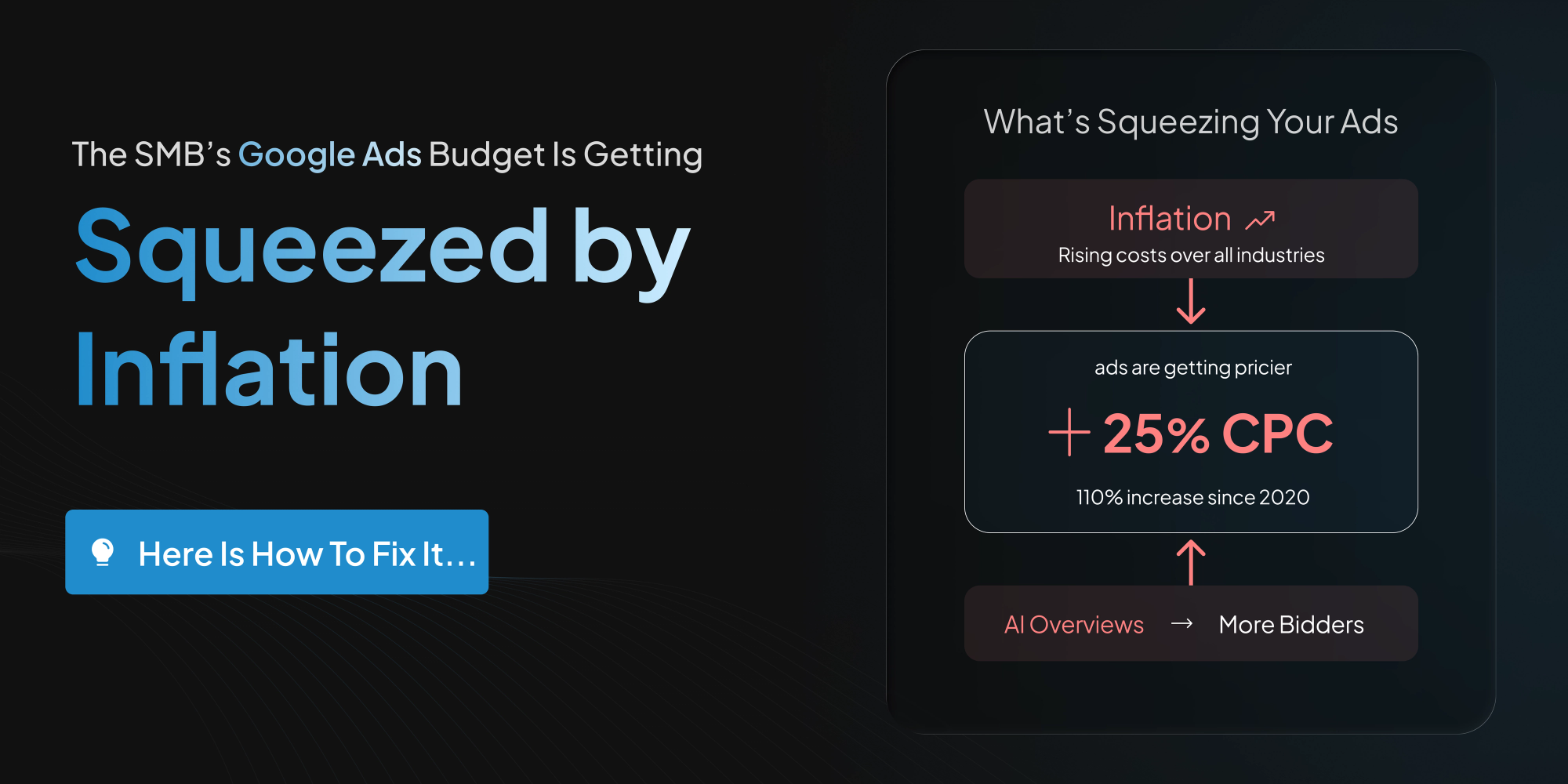
Google Ads just got 10 to 25% more expensive this year. And that’s on top of a 110% increase since 2020.
If you’re a small business owner staring at your ad spend wondering why your cost per click keeps climbing while your results stay flat, you’re not imagining things. The math has genuinely changed. Every industry saw double-digit CPC increases. Restaurants jumped 28%. Home services, 22%. E-commerce, 19%.
But here’s what makes this moment different from the usual “ads are getting pricier” conversation.
This time, it’s not just competition driving costs up. It’s a structural shift. Google’s AI Overviews are eating organic traffic, which pushes more businesses into paid ads, which floods the auction with more bidders, which drives CPCs higher for everyone. Add real-world inflation on top of that, where 41% of SMB owners now say inflation is their single biggest business concern, and you’ve got a squeeze from both sides. Higher costs to acquire customers. Tighter margins once you get them.
The instinct most business owners have right now is to cut. Pull back the ad budget. Reduce spend. Wait it out.
That instinct is wrong. And I’m going to show you exactly why.
The Businesses That Cut Are the Ones That Lose
Let me tell you what we see happen when SMBs slash their Google Ads budget during a cost squeeze.
They lose impression share first. Their ads show up for fewer searches. The competitors who maintained or increased their spend pick up that traffic. And because Google’s algorithm rewards accounts with consistent spend history and strong conversion data, the business that cut its budget doesn’t just lose today’s clicks. It damages the account’s performance signals, which means when they eventually increase spend again, their CPCs come back even higher than before.
We’ve seen this pattern play out across dozens of accounts. The recovery cost is almost always more than what the business “saved” by cutting.
Meanwhile, 68% of small businesses are actually planning to increase their marketing budgets in 2026. Not because they have more money. Because they’ve figured out that in an inflationary environment, visibility is survival. If your competitor is bidding on the same keywords you stopped bidding on, those customers aren’t waiting for you to come back. They’re buying from whoever showed up.
The real question isn’t “should I spend less on Google Ads?” It’s “how do I make every dollar work harder?”
Here are six ways to do exactly that.
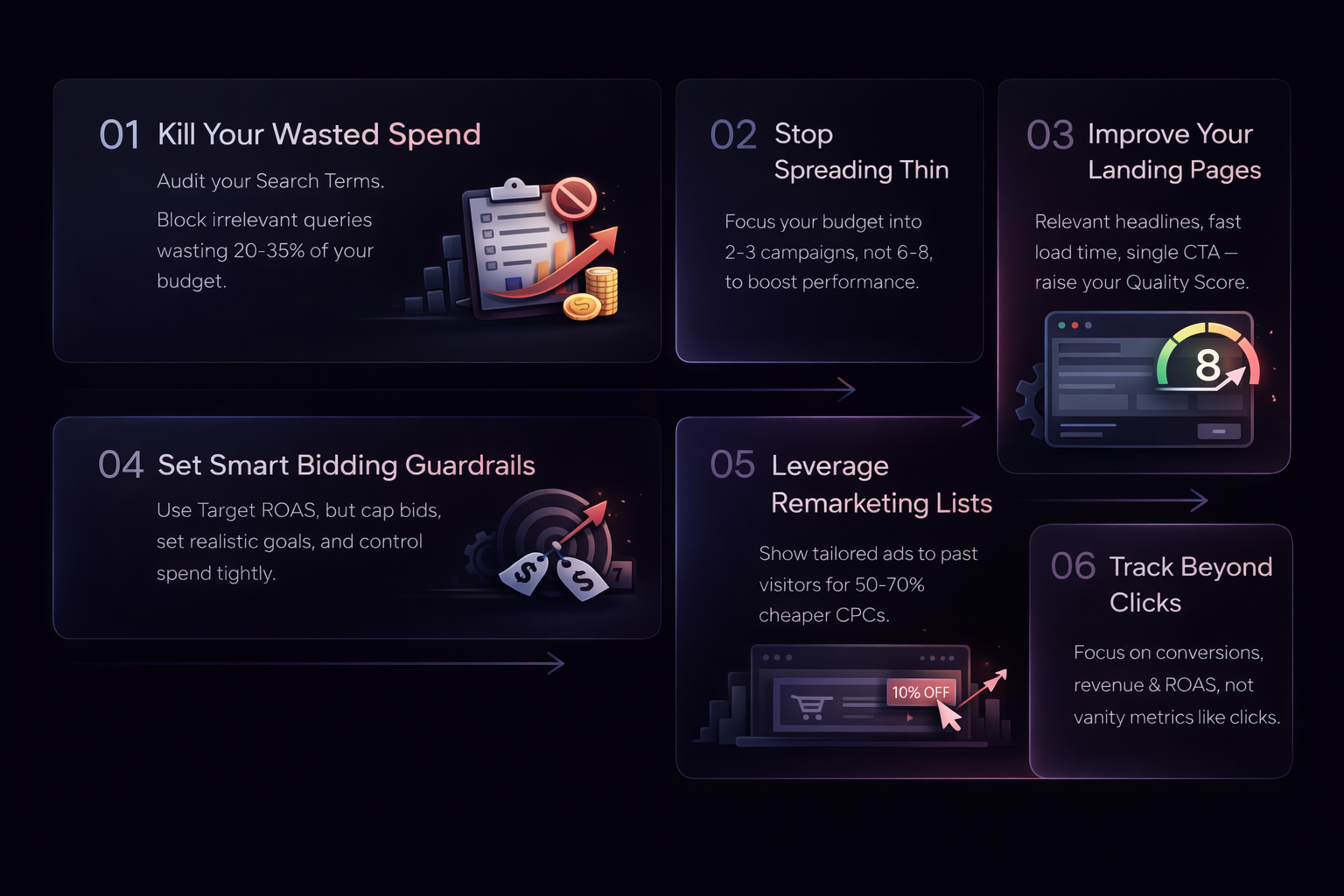
1. Kill Your Wasted Spend Before You Touch Your Budget
Before you think about strategy, start with the leak. Most SMB Google Ads accounts are bleeding money in places the business owner never looks.
Pull your Search Terms report right now. Not the Keywords report. The Search Terms report. This shows you the actual queries people typed before clicking your ad.
In our experience managing 2,578+ campaigns, the average SMB account wastes between 20% and 35% of its spend on irrelevant search terms. We’re talking about queries that have nothing to do with your business but match your keywords broadly enough to trigger your ads.
A plumber bidding on “pipe repair” showing up for “bagpipe repair tutorial.” A jewellery store bidding on “custom rings” getting clicks from people searching “ring doorbell custom settings.” These aren’t hypotheticals. These are real examples from accounts we’ve audited.
The fix takes one afternoon:
Go through your Search Terms report for the last 90 days. Sort by cost, highest first. Every query that isn’t a genuine potential customer gets added to your negative keyword list. Be aggressive. You’d rather miss a few edge cases than keep paying for clicks that will never convert.
If you’ve never done a negative keyword audit, you’ll likely save 15-25% of your monthly spend in the first week alone. That’s not a strategy improvement. That’s found money.
2. Stop Spreading Your Budget Across Too Many Campaigns
This is the single most common mistake we see in SMB accounts. And it’s the easiest one to fix.
A business with a $3,000 monthly budget running eight campaigns across four different service lines, with separate campaigns for mobile and desktop, with brand campaigns mixed in with non-brand. Each campaign gets roughly $375 a month. That’s $12 a day.
At a $4 CPC (the average across industries), that’s three clicks per day per campaign. Google’s machine learning needs data to optimize. It needs volume. Three clicks a day gives it nothing to work with. So the algorithm never exits the learning phase, your quality scores stay mediocre, and your CPCs stay inflated.
The fix: consolidate.
If your budget is under $5,000 a month, you should be running two to three campaigns maximum. One for your highest-converting service or product category. One for brand terms (these are cheap and protect your brand from competitors). And maybe one for a secondary offering if the volume supports it.
We restructured the campaigns for KindtoKidz, an Australian toy brand, around this exact principle. Instead of spreading thin, we concentrated budget into single-theme ad groups with tight keyword clusters and dedicated landing pages. The result: 23.34 ROAS. That’s $23 back for every $1 spent. AUD 151K+ in conversion value.
Fewer campaigns. More budget per campaign. Better data for the algorithm. Lower CPCs. Higher ROAS. The math is simple.
3. Your Landing Pages Are Costing You More Than Your CPCs
Here’s something most business owners don’t realize: your landing page quality directly affects how much you pay per click.
Google Ads uses a metric called Quality Score. It’s rated 1 to 10 for each keyword. And it’s heavily influenced by your landing page experience: how relevant the page is to the ad, how fast it loads, and how easy it is to navigate on mobile.
A keyword with a Quality Score of 3 might cost you $8 per click. That same keyword with a Quality Score of 8 might cost $3. Same keyword. Same auction. Same competitors. The difference is your landing page.
Here’s a quick diagnostic. Pull up Google Ads, go to your Keywords tab, and add the “Quality Score” column if it’s not already showing. Any keyword below a 5 is actively inflating your costs.
For those underperforming keywords, check three things on the landing page:
First, does the headline on the landing page match the promise in the ad? If your ad says “Free Kitchen Remodeling Estimate” and the landing page headline says “Welcome to Our Home Services Company,” that disconnect kills your Quality Score and your conversion rate.
Second, does the page load in under 3 seconds on mobile? Run it through Google’s PageSpeed Insights. If your LCP is above 2.5 seconds, Google is penalizing you with higher CPCs. Compress images to WebP, defer non-critical scripts, and consider a faster host.
Third, is there one clear call to action above the fold? Not three buttons. Not a wall of text. One action you want the visitor to take, visible the instant the page loads.
We build every landing page in our Conversion-Led Design Studio around these three principles. Because the cheapest click in the world is worthless if the page it lands on doesn’t convert.
4. Use Smart Bidding, But Set the Right Guardrails
Google’s smart bidding strategies (Target CPA, Target ROAS, Maximize Conversions) are genuinely powerful in 2026. The machine learning behind them is better than it’s ever been.
But here’s where SMBs get into trouble: they turn on smart bidding with no guardrails and let Google decide what a conversion is worth.
When you set a Target ROAS of 400% (a 4X return), Google will optimize your bids to hit that target across the account. But if you don’t set minimum and maximum bid limits, Google might blow your entire daily budget on a handful of high-CPC clicks that it thinks will convert, leaving nothing for the lower-cost clicks that actually make up the bulk of your revenue.
Set your Target ROAS based on your actual business math. Not what sounds good. Not what your competitor told you on a podcast.
Here’s the formula: take your average customer lifetime value, subtract your cost of goods, and figure out the maximum you can afford to pay for a customer while still making a profit. Then work backward to your target ROAS.
If your average customer is worth $500 in lifetime value, your COGS is $200, and you want at least a 50% profit margin on your ad-acquired customers, your maximum customer acquisition cost is $150. If your average order from Google Ads is $100, your minimum ROAS target is $100/$150 = 0.67. But because not every click converts, and because you need margin for error, a realistic target ROAS for this business would be 300% to 400%.
Set it. Let the algorithm optimize. But review the results every two weeks and adjust.
5. Own Your Remarketing List (It’s the Cheapest Traffic You’ll Ever Get)
If you’re spending money to drive cold traffic to your website but not running remarketing campaigns, you’re leaving the easiest conversions on the table.
Remarketing CPCs are typically 50-70% cheaper than prospecting CPCs. Because you’re not competing in the broad keyword auction. You’re showing ads to people who already visited your site, already know who you are, and just need a nudge to come back and buy.
The basics: install the Google Ads remarketing tag on your site if you haven’t already. Create audience lists for people who visited your product or service pages but didn’t convert. Build specific ads that address why they might have hesitated. “Still thinking about it? Here’s 10% off your first order.” Or “Not sure if we’re the right fit? See what our clients say.”
The advanced move: segment your remarketing lists by intent signal. Someone who visited your pricing page is much closer to buying than someone who read a blog post. Bid higher on the pricing page visitors. Bid lower on the blog readers. Same remarketing budget, dramatically different results.
For SMBs with limited budgets, remarketing should typically get 15-20% of your total Google Ads spend. It’s often the highest-ROAS campaign in the entire account.
6. Track What Actually Matters (and Stop Obsessing Over Clicks)
Here’s where I need to be blunt.
Most SMBs are tracking the wrong metrics. They look at clicks, impressions, CTR, and cost per click. And while those metrics aren’t useless, they tell you almost nothing about whether Google Ads is actually making your business money.
The only metrics that matter for an SMB are these:
Cost per qualified lead. Not cost per conversion. Cost per qualified lead. If you’re a B2B service company and half your form submissions are spam or unqualified, your real cost per lead is double what Google Ads tells you. Connect your CRM to Google Ads (yes, this is possible and it’s free) so you can see which keywords and campaigns produce leads that actually turn into revenue.
ROAS on real revenue. Not estimated conversion value. Not “all conversions” which includes newsletter signups and PDF downloads. Track the campaigns and keywords that produce customers who pay you money. Everything else is noise.
Impression share on your top 10 keywords. This tells you how much of the available market you’re capturing. If your impression share on a high-intent keyword is 40%, that means 60% of the time someone searches for your most important term, they see a competitor instead of you. That’s not a metric problem. That’s a revenue problem.
At NFlow, we track these three metrics obsessively for every client. Because our average 7.5X ROAS across 138+ brands doesn’t come from spending more money. It comes from spending the right money on the right terms and knowing exactly which dollars are producing which results.
The Real Cost of “Waiting It Out”
Let’s do some quick math.
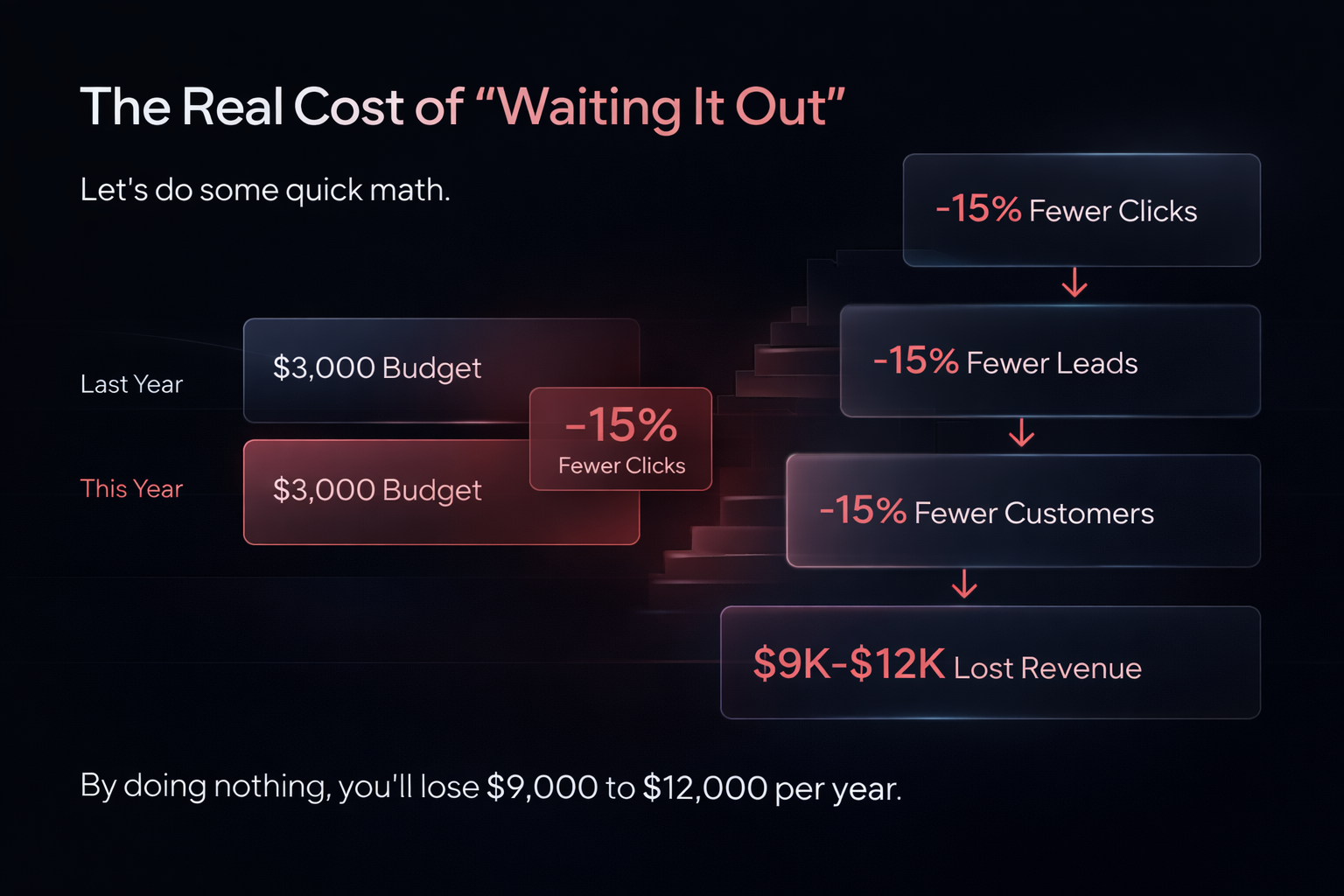
If your Google Ads CPC increased 15% this year (conservative, based on what we’re seeing across industries), and your monthly budget stayed flat at $3,000, you’re effectively buying 15% fewer clicks than you did last year. If your conversion rate stayed the same, that’s 15% fewer leads. At a 20% close rate, that’s 15% fewer customers. If your average customer is worth $2,000 annually, that’s potentially $9,000 to $12,000 in lost revenue per year.
From doing nothing. Just standing still while costs rise.
The businesses that win in this environment are the ones who treat their Google Ads account like a machine that needs tuning, not a faucet you turn on and forget. They audit their wasted spend. They consolidate their campaigns. They fix their landing pages. They set smart guardrails on their bidding. They remarket to warm audiences. And they track the metrics that actually connect to revenue.
None of these six things require you to spend a dollar more than you’re spending today. They require you to spend it smarter.
Your Next Move
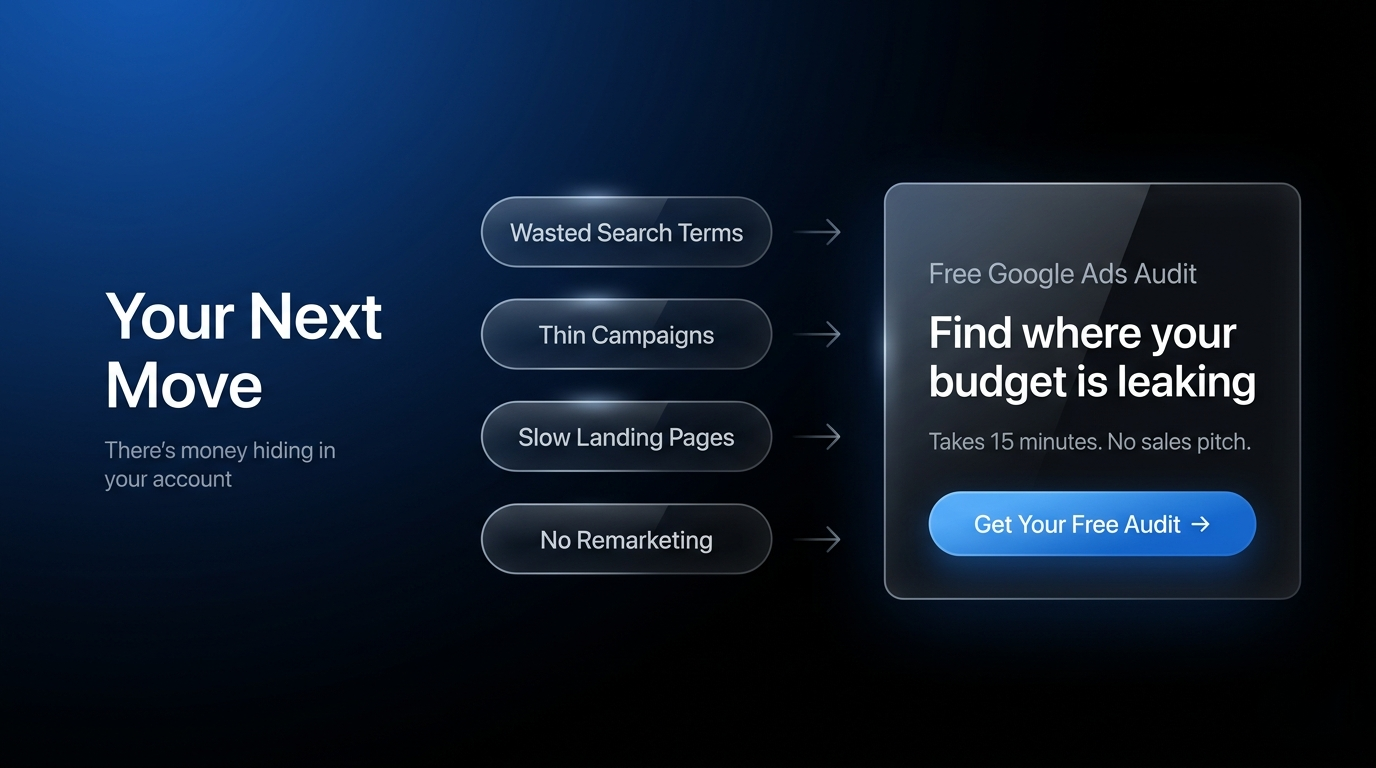
If your ROAS is sitting below 4X right now, there’s almost certainly money hiding inside your account. Wasted search terms, thin campaigns, slow landing pages, or missing remarketing.
We’ll find it for you. Our free Google Ads audit takes 15 minutes of your time, and we’ll walk you through exactly where your budget is leaking and what to fix first. No sales pitch. Just the data.