

Most agencies eventually hit the same wall. Clients want better rankings, rankings need backlinks, and nobody on the team has the time or contacts to build them properly. White label link building solves that by letting you sell link building under your own brand while a specialist partner does the actual work. This guide walks through how the model works, what it costs, how to price it, and how to avoid the providers who will get your clients penalized.
What Is White Label Link Building?
White label link building is when a specialist provider builds backlinks for your clients, and you resell that work under your own agency's brand as if your team did it.
A backlink is simply a link from another website to your client's site. Think of it as a vote of confidence: the more relevant and trustworthy the site giving the vote, the more it counts with Google. The difference from a regular link building agency is who the client talks to. With a direct hire, the business works with the link builder. With white label, the business only ever deals with you. It usually sits inside a wider set of SEO services, since links work best alongside solid content and technical fixes.
How White Label Link Building Actually Works
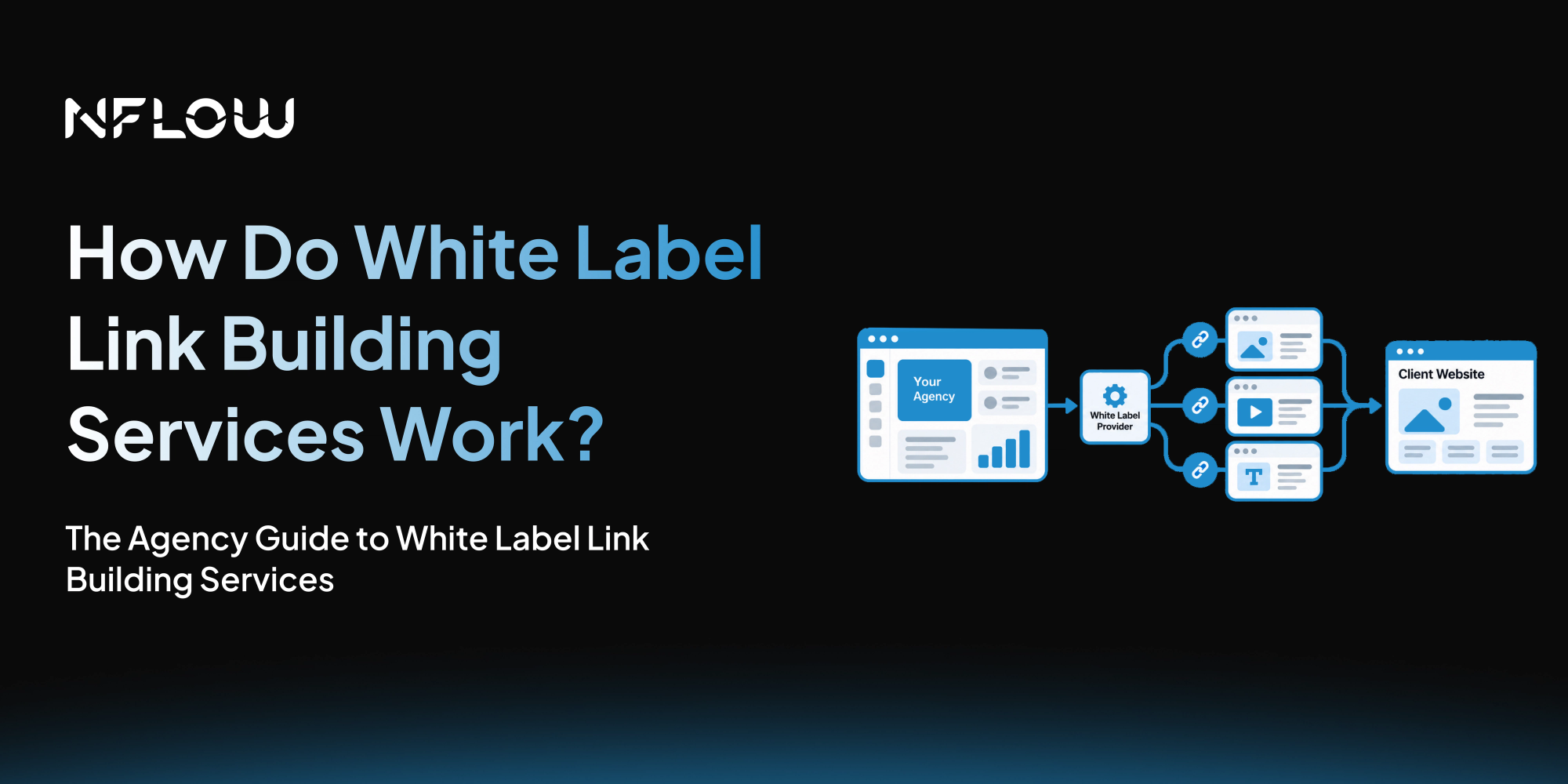
White label link building works in three layers: you win and scope the client, your provider quietly fulfills the links, and you deliver the results under your brand.
It starts on your side. You sell an SEO or link building package, agree on target pages and keywords with the client, and decide how many links per month fit their budget. That scope then goes to your provider as a brief, usually through a shared order form or project dashboard.
Behind the scenes, the provider does the heavy lifting. Their team finds relevant websites, pitches content or link placements to site owners, writes the articles, and gets the links published. A typical month for a small client might mean 5 to 10 placements, with turnaround on each running anywhere from two to six weeks depending on the site.
You own the client relationship completely. The provider never contacts your client, and every report goes out with your logo and branding. If the client has a question or a complaint, it comes to you, and you route it to the provider privately.
What's Included in White Label Link Building Services
Most white label link building services cover the full cycle: finding link opportunities, earning placements, creating the content, and reporting on every live link.
Prospecting and outreach. The provider searches for websites in your client's niche that accept contributions or might reference them, then emails the site owners with a pitch. This is the slowest and most labor heavy part of the job, which is exactly why agencies outsource it.
Guest posting. A guest post is an article written by the provider and published on someone else's website, with a link back to your client placed naturally inside it. Good guest posting services write content the host site would genuinely want to publish, not thin articles built only to carry a link.
Digital PR and HARO style placements. Digital PR means getting your client mentioned in news sites and industry publications by giving journalists useful quotes, data, or stories. HARO (Help a Reporter Out) was a well known service connecting journalists with expert sources, and today several similar platforms fill that role.
Niche edits, also called link insertions. Instead of writing a new article, the provider asks a site owner to add your client's link into an article that already exists and already ranks. These tend to be faster to get, but quality varies enormously.
Reporting and link tracking. You should get a report listing every live URL, the anchor text used, the target page, and basic metrics for each linking site. Solid providers also recheck links over time and replace any that get removed.
Types of Links White Label Providers Build
White label providers typically build four kinds of links, and they are far from equal in value.
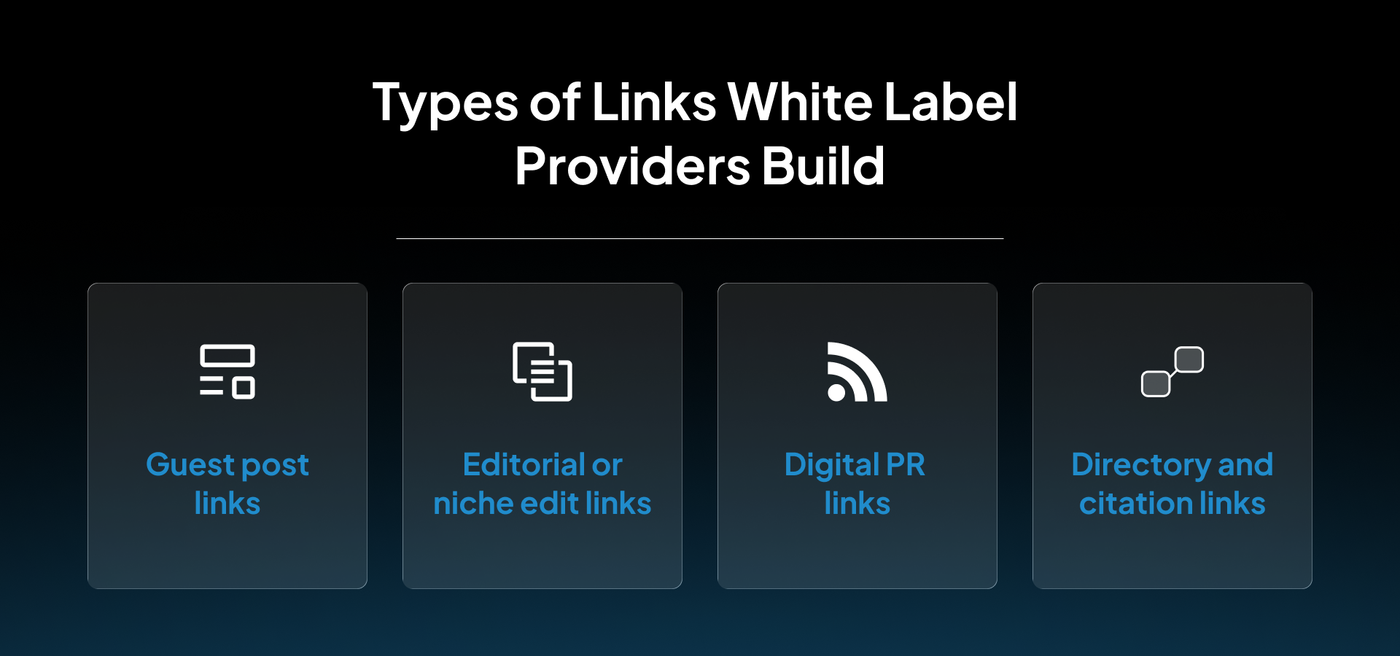
Guest post links come from new articles written for another site, and they give you the most control over context and anchor text.
Editorial or niche edit links are added to existing, already indexed content, so they can pass value quickly when the host page has real traffic.
Digital PR links come from news and media coverage, and they're the hardest to earn but usually the most authoritative links a small business will ever get.
Directory and citation links are listings on business directories like Yelp or industry databases. They still matter for local SEO consistency, but they carry very little ranking weight on their own anymore, so don't let a provider pad a package with them.
White Label Link Building Pricing
White label link building is usually priced per link, per package, or as a monthly retainer, with most quality placements costing somewhere between $100 and $500 per link at wholesale.
Per link pricing is the most common and the easiest to resell, since you know your exact cost per placement. Packages bundle a set number of links at a slight discount, while retainers cover a monthly volume plus strategy and reporting.
As a rough guide in the US market (these are typical ranges, so confirm current rates with any provider you shortlist):
Three things move the price. Domain authority is a score from 0 to 100, created by SEO tools like Moz or Ahrefs, that estimates how strong a website's backlink profile is. Higher scores cost more. Niche relevance matters too, because a link from a legal blog for a law firm client is harder to land than a link from a general lifestyle site. And content quality adds cost, since a well researched 1,500 word article takes real writing time.
Be wary of anything priced far below these ranges. A $20 link almost always means a low quality site, a link network, or both.
Agency Margins: Pricing It to Clients
Most agencies mark up white label link building by 50% to 100% over wholesale, which covers account management, strategy, and the risk of standing behind the work.
Your client price isn't just the link cost plus profit. You're also paying for the time spent on strategy calls, reviewing drafts, checking link quality, and explaining results. If you price too close to wholesale, one difficult client can wipe out your margin for the month.
Here's a simple example. Say your provider charges $200 per mid authority guest post, and a client signs up for 6 links a month. Your cost is $1,200. If you charge the client $2,100 a month for a "6 link authority package," you keep $900, a 75% markup on cost or roughly 43% gross margin. Spend two to three hours a month managing that account and the margin still holds up well, which is why this model works for small agencies.
A tip from experience: sell outcomes and packages, not individual links. Clients who see a per link price start comparing you with cheap marketplaces. Clients who buy a monthly authority plan tied to their target pages rarely do.
How to Vet a White Label Link Building Provider
Vetting a provider comes down to one question: can they show you real, live links on real websites that get genuine traffic, and are they willing to be transparent about how they got them?
Start with the red flags. The biggest one is a PBN, or private blog network: a group of websites owned by the same person or company, set up only to sell links. They often look fine at a glance, but Google actively hunts for these networks, and when it finds one, the links become worthless or even harmful to every site they point to. Other warning signs include guaranteed domain authority numbers that seem too good for the price, sites with no real organic traffic, and "write for us" sites that publish on every topic from crypto to pet food. Paid placements should also be marked the way Google expects; see how Google expects paid links to be marked.
Good link quality looks like this: the linking site covers topics related to your client, ranks for its own keywords, gets real visitors, and publishes content a human would actually read. A modest site in the right niche usually beats a high authority site that's completely off topic.
Ask for sample reports and a handful of live example links before you commit. Check those sites yourself in Ahrefs or Semrush for traffic trends. A provider that refuses to share examples, or only shares heavily redacted ones, is telling you something. Any serious partner should be able to point you to real client results before you sign anything.
Risks of White Label Link Building
White label link building carries real risk, and because your brand is on the work, the consequences land on you, not your provider.
The biggest risk is a Google penalty or a quiet loss of rankings. Google's spam policies specifically target link schemes, and low quality or paid link networks can lead to links being ignored at best, or a manual action at worst. Recovering a client from that can take months.
There's also brand risk. If your client's link shows up on a spammy site full of gambling ads or spun content, they'll notice, and they'll blame you. Some clients check every link, so assume yours will too.
Finally, you're dependent on someone else's quality control. If the provider cuts corners during a busy month, you may not notice until the damage is done. That's why spot checking a sample of links every month isn't optional.
White Label Link Building vs. Doing It In House
For most agencies under 20 or 30 SEO clients, white label link building is cheaper and faster than hiring, while in house work gives you more control once you have steady volume.
On cost, a dedicated outreach specialist in the US often runs $45,000 to $65,000 a year before tools, and link building tools alone can cost several hundred dollars a month. Unless you have enough clients to keep that person fully busy, paying per link through a white label partner is usually the better deal.
On speed, a provider already has site owner relationships and a working outreach system, so they can start delivering within weeks. An in house hire needs months to build contacts, and they can only handle so many campaigns before quality slips.
The trade off is control. In house, you see every pitch, every site, and every draft. With white label SEO work of any kind, you're trusting a process you can't fully watch, so you make up for it with clear standards and regular audits.
How AI Search Is Changing Link Building
AI search tools like Google's AI Overviews and ChatGPT lean heavily on brand mentions and trusted sources, so the links that matter most now are the ones that also build a brand's reputation, not just its backlink count.
Traditional link building focused on the link itself. Generative engine optimization (GEO), the practice of improving how brands show up in AI generated answers, rewards being mentioned consistently in credible, relevant sources, even without a clickable link. In practice, that pushes value toward digital PR and editorial placements on respected industry sites, and away from volume guest posting on generic blogs. Backlinks still matter a great deal for traditional rankings; the shift is in which ones are worth paying for.
Conclusion
White label link building works well when you treat the provider as part of your team and hold them to your standards, not theirs. The decision really comes down to how many link building clients you have, how much margin you need, and whether you're willing to check the quality of every month's work. Get those right, and you can offer link building confidently without hiring a single outreach specialist.
Frequently Asked Questions
Is white label link building safe for SEO?
White label link building is safe when the provider earns links on real, relevant websites with genuine traffic, and risky when the provider uses private blog networks or link farms. The safety depends entirely on the provider's methods, so always review sample links before hiring one.
How much does white label link building cost?
White label link building typically costs between $100 and $500 per link at wholesale in the US market, with digital PR placements often costing more. Price depends on the linking site's authority, how relevant it is to your client's niche, and the quality of the content.
Will my clients know it's outsourced?
Your clients won't know the work is outsourced if you use a genuine white label provider, because all reports carry your branding and the provider never contacts your clients directly. Most providers also sign an NDA to protect the relationship.
How long until link building shows results?
Link building usually takes three to six months to show a clear impact on rankings, since Google needs time to discover and evaluate new links. Competitive niches can take longer, and results build gradually rather than all at once.
What's the difference between white label link building and guest posting services?
Guest posting services focus on one tactic, publishing articles on other sites with a link back, while white label link building is a broader resold service that can include guest posts, niche edits, digital PR, and reporting under your brand. Guest posting is often one part of a white label package.