

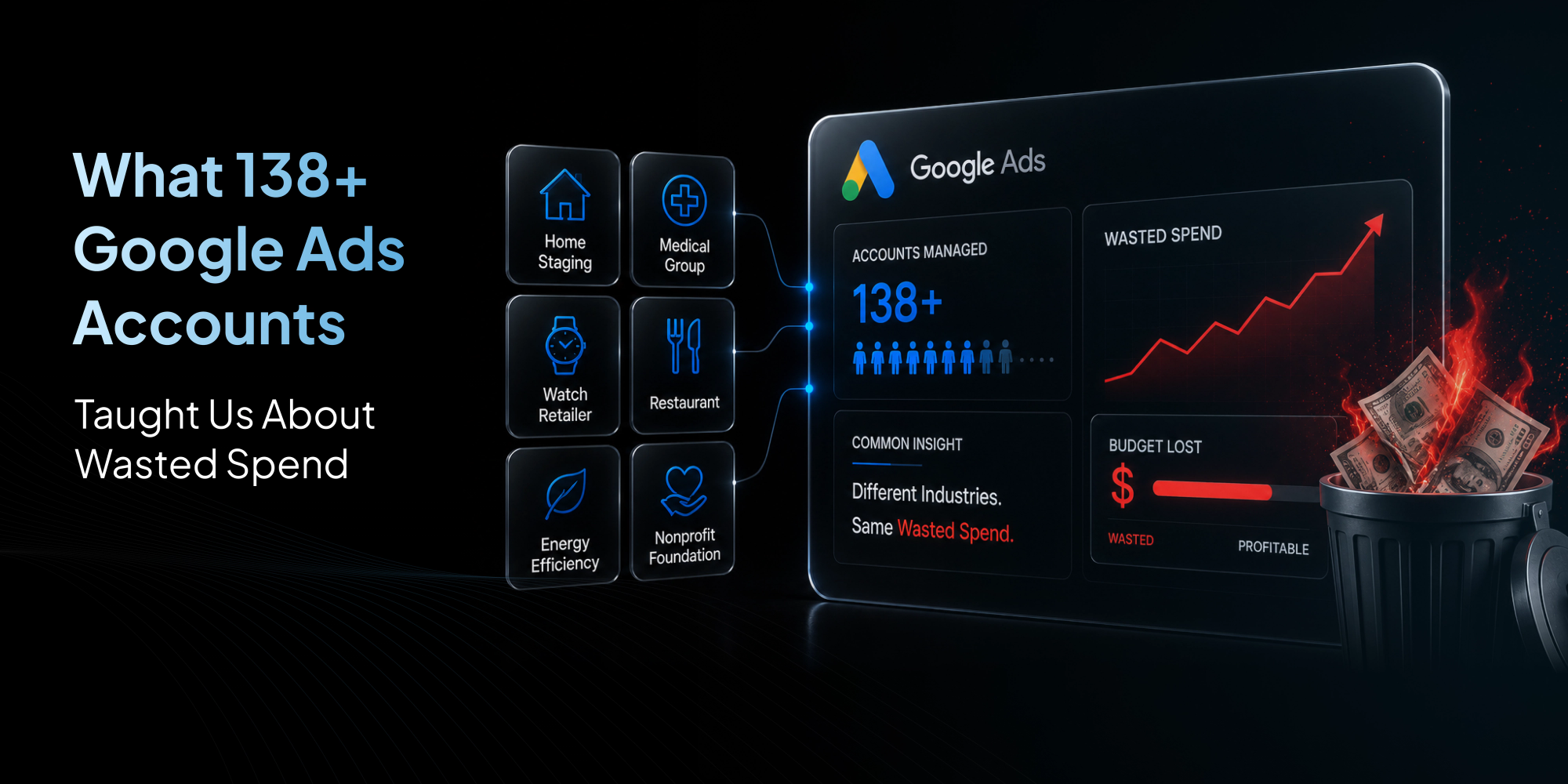
At NFlow, we have managed more than 138+ Google Ads accounts. We worked with a home staging company, a medical group, a watch retailer, a restaurant, an energy efficiency firm, and a nonprofit foundation. Every account was different. The wasted spend looked the same.
This is not a list of four generic lessons. It is what we actually found after analysing every decision, every tracking setup, every search term, and every conversion path across 138+ accounts. Here is how the budget gets lost, why it happens, and what the best performing accounts did differently.
The Real Reasons Budget Disappears
Wasted spend does not happen because Google is greedy. It happens because of three root causes that show up in almost every account.
First, advertisers assume their tracking is correct. It almost never is. Second, advertisers trust default settings. Google defaults are designed to maximize spend, not minimize waste. Third, advertisers stop looking. They set up campaigns, see some results, and never revisit the structure.
These three causes combine to create a slow leak. No single click looks expensive. But over a quarter, the total is painful.
How We Found the Waste
We identified wasted spend by starting with the same three reports every time. The search term report showed us what Google thought the business was. The conversion action report revealed if the data was trustworthy. The campaign changed history and told us how often decisions were being made and by whom.
Then we asked a short list of audit questions. Is your conversion tracking counting one per click per gclid or one per conversion action? Are there search terms that have spent money with zero conversions in the last 90 days? Has anyone paused a campaign or adjusted bids in the last 30 days? The answers to these questions uncovered the majority of waste within the first 15 minutes.
What the Best Performing Accounts Had in Common
About 15 percent of the accounts we managed were top performers. They consistently maintained a cost per acquisition below target and scaled without breaking. They shared three traits.
First, they had clean conversion data. They audited their tracking every month. They removed spam leads and offline conversion errors. Second, they used broad matches only after building a strong negative keyword list. Third, they did not touch campaigns every day. They made changes based on data, not anxiety.
These accounts also spent less time in the Google Ads interface. They spent more time understanding their customer journey.
Counterintuitive Findings That Surprised Us
Analysing 138+ accounts revealed several insights that go against conventional advice.
Smaller budgets often had less waste than larger budgets. When a client spent 2000 dollars a month, every dollar mattered. They were more disciplined. When clients spent 100,000 dollars a month, waste crept in because nobody wanted to touch a running machine.
More automation did not always improve performance. We saw accounts where Smart Bidding was turned on too early, before the account had enough conversion history. The algorithm spent aggressively while it learned. Accounts that waited until they had 50 conversions per campaign per month performed better with automation.
The highest CTR campaigns were rarely the highest ROI campaigns. One retail client had a campaign with a CTR of 12 percent. It was also their most expensive cost per acquisition. The high CTR came from curiosity clicks, not purchase intent.
Accounts with fewer campaigns often performed better. An account with 10 tightly structured campaigns consistently outperformed accounts with 40 fragmented campaigns. Complexity creates management blind spots.
Most wasted spend came from a handful of recurring issues rather than hundreds of small mistakes. In every audit, 80 percent of the waste was caused by three or four problems. Fix those, and the rest took care of itself.
Industry Differences That Matter
The patterns were universal, but the specifics varied by industry.
Retail accounts tended to waste budget through search intent and product overlap. A clothing retailer running broad matches for jackets would trigger impressions for people searching for jacket repair or jacket reviews. The waste came from mismatched intent.
Service businesses struggled more with lead quality and tracking. A medical aesthetics clinic counted every form submission as a conversion. But many of those submissions were questions about pricing or side effects, not booked appointments. The tracking looked fine. The waste was invisible.
Local businesses often overpaid for branded searches. A restaurant ranked first organically for their name but still bid aggressively on that keyword. The waste came from paying for traffic they already owned.
B2B advertisers lost more budget through poor conversion attribution. One B2B client counted a whitepaper download as a conversion. But that lead took three months to close. The algorithm optimized for downloads, not revenue. The waste was in the attribution window.
The Four Most Expensive Mistakes We Found Across All Accounts
Even with industry differences, four mistakes appeared in almost every account. These are the patterns that cost the most money.
The Phantom Conversion Problem
Most accounts we took over had conversion tracking installed. Few had it installed correctly. In one audit, a home staging company was getting leads, but their tracking counted every form submission, including spam. We found that 40 percent of those leads never replied to a follow up. They were spending money on people who had no intent.
The behavioral bias here is the illusion of control. When you see a conversion in your account, your brain treats it as a done deal. You increase bids. You add more keywords. You reward the wrong behavior. In reality, the conversion data was misleading the algorithm.
Fix this before you change anything else. Verify every conversion action. Use Google Tag Manager and test with real submissions. Audit your offline conversion import. If you cannot prove a conversion leads to revenue, you are optimizing for a ghost.
Broad Match Without a Safety Net
Broad matches are useful. It is also expensive, but not on day one. The real damage appears after Smart Bidding begins learning from poor conversion signals. We saw this repeatedly in accounts serving multiple industries.
One client was a medical aesthetics clinic that wanted to reach people looking for treatments. Google interpreted their broad match keywords as relevant to users searching about side effects, medication reviews, and general health questions. Those users had no purchase intent. The clinic paid for those clicks and got nothing.
The watch retailer had a similar experience. They sold luxury mechanical watches. Google interpreted "watch repair" as relevant. Their budget went toward users who wanted servicing rather than buying. We blocked those queries and saved 18 percent of their monthly budget.
The solution is not to abandon broad matches. It is to layer it with a tight negative keyword list. Build that list before you launch. Then monitor search terms daily for the first two weeks.
Audience Layering Without Exclusions
Every advertiser knows to target market audiences or custom segments. Few exclude anyone. An energy efficiency company ran remarketing to past visitors. They did not exclude people who had already converted. So the same people who scheduled a consultation saw the same ads again. They clicked again. The company paid for those clicks and generated no new business.
This is status quo bias. Advertisers set up remarketing, see it running, and never revisit the exclusions. They assume more impressions equals more conversions. It does not. When you target people who have already completed your goal, you are paying to remind them of what they already did.
Audit your audience exclusions every month. Remove converted users. Remove users who have not engaged in 90 days. Remove your own employees. The staging company had their own staff clicking on ads to check landing pages. Those clicks looked like engagement but were pure waste.
Budget Allocation Based on Vanity Metrics
The hardest lesson we learned came from accounts that spent heavily on top of the page impression share. Managers wanted to be first for every search. They sacrificed efficiency for visibility. A law firm client insisted on 90 percent impression share for their branded terms. They were already ranking organically first. They paid Google for clicks they would have gotten free.
Loss aversion drives this behavior. Advertisers fear losing visibility more than they value the cost of that visibility. They trade profit for peace of mind.
Shift your budget to terms where Google Ads outperforms organic. Review whether branded campaigns are actually generating incremental conversions instead of assuming they are necessary. Use impression share targets only for competitive non branded terms where your organic ranking is weak. The data from our accounts shows that branded ad spend rarely pays back when you already rank first.
The Real Cost of Wasted Spend
Across 138+ accounts, we found that typical wasted spend fell between 15 and 30 percent of the total budget. That is not a rounding error. That is a month of lost revenue for a small business. The causes are consistent: bad tracking, broad match without governance, lazy audience exclusions, and vanity driven budget decisions.
Every dollar wasted is a dollar your competitor can use to take your spot. Fix the tracking. Build your negative keyword list. Exclude the wrong audiences. Review your branded campaigns. The patterns are the same. The solution is attention to detail and the discipline to stop doing what feels safe.
If you want NFlow to audit your account and find your wasted spend, we still have room for two new clients this quarter. Contact us with your monthly budget and the biggest problem you are facing. We will show you where the money is going.