


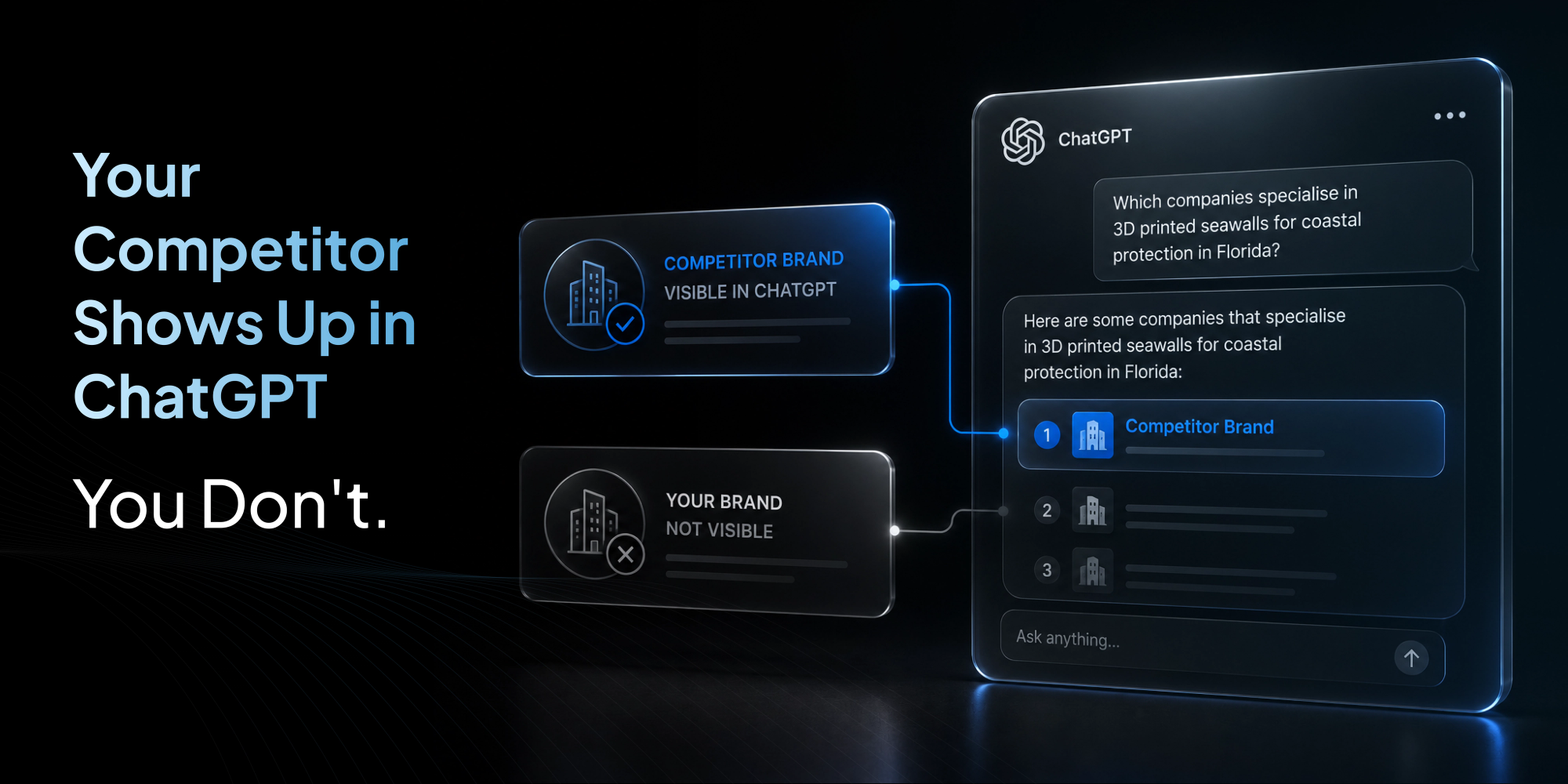
You open ChatGPT and type the kind of prompt your ideal client would ask. "Which companies specialise in 3D printed seawalls for coastal protection in Florida?" Your competitor's name appears. You read through the entire response. Your name isn't there.
This isn't misfortune. It's a pattern across industries. Companies dominating Google rankings are discovering those rankings don't protect them from losing visibility in generative AI tools. People bypass search engines and ask AI for recommendations. If your brand isn't being cited, you're handing leads to competitors.
The gap between traditional SEO and Generative Engine Optimization (GEO) comes down to one difference. Traditional SEO focuses on ranking webpages in search results by matching keywords. GEO focuses on increasing the likelihood that AI systems retrieve and cite your brand when generating recommendations. Closing this gap means understanding how retrieval, ranking systems, and structured entity understanding work together to select sources.
Why Your Best Keywords Are Losing Traffic
Search behaviour has shifted. Eighteen months ago, ranking on page one of Google was the goal. Today, a growing portion of your audience never touches a search engine. They open ChatGPT, Claude, or Perplexity. They type full, conversational questions. They expect a direct answer with two or three recommended providers.
Google's Search Quality Rater Guidelines have emphasised expertise, authoritativeness, and trustworthiness (E-E-A-T) for years. Many of the quality characteristics encouraged by these guidelines closely align with the types of sources AI systems tend to reference. Retrieval and ranking systems often favour sources with stronger external signals because they reduce uncertainty.
When someone asks an AI for a service recommendation, the model uses retrieval, ranking systems, and structured entity understanding to generate recommendations. Your brand exists in that system as an entity. But if that entity isn't clearly connected to the specific service the user is asking about, the AI selects competitors with stronger entity associations.
Our Research Methodology
To understand what actually drives AI citations, we analysed 57 companies across marine construction and environmental consulting. We tested 15 high-intent prompts (e.g., "Which companies specialise in 3D printed coastal infrastructure in South Florida?") across five AI systems: ChatGPT, Perplexity, Gemini, Claude, and Google's AI Mode. Each prompt was run three times per model to check consistency, using a 60% appearance threshold to determine reliable citations.
This dataset revealed that only 11 companies appeared in at least 60% of responses. Every one of those 11 had Organisation schema, over 100 referring domains, and at least five detailed case studies with actual data. We tracked citation patterns, measured the impact of schema changes, and monitored how entity clarity affected visibility over a 90-day period.
AI Platform Comparison for Citation Behaviour
Different AI platforms prioritise different signals when generating recommendations. The table below shows how the five major platforms compare across key factors.
| Platform | Prioritises Freshness | External Link Preference | Schema Dependency | Content Length Preference |
| ChatGPT | Medium | High (20+ sources) | Medium | Comprehensive |
| Perplexity | High (30 days) | Very High | Low | Concise with data |
| Gemini | Low | Medium | High | Balanced |
| Claude | Medium | High | Medium | Long-form |
| Google AI Mode | High | Medium | Very High | Structured |
Methodology: 15 high-intent prompts tested 3 times per platform over 30 days. Citation stability measured by consistency across repeated prompts.
The Five Strategic Gaps Keeping You Out of AI Recommendations
Most brands make five specific errors that prevent them from being cited in generative AI responses.
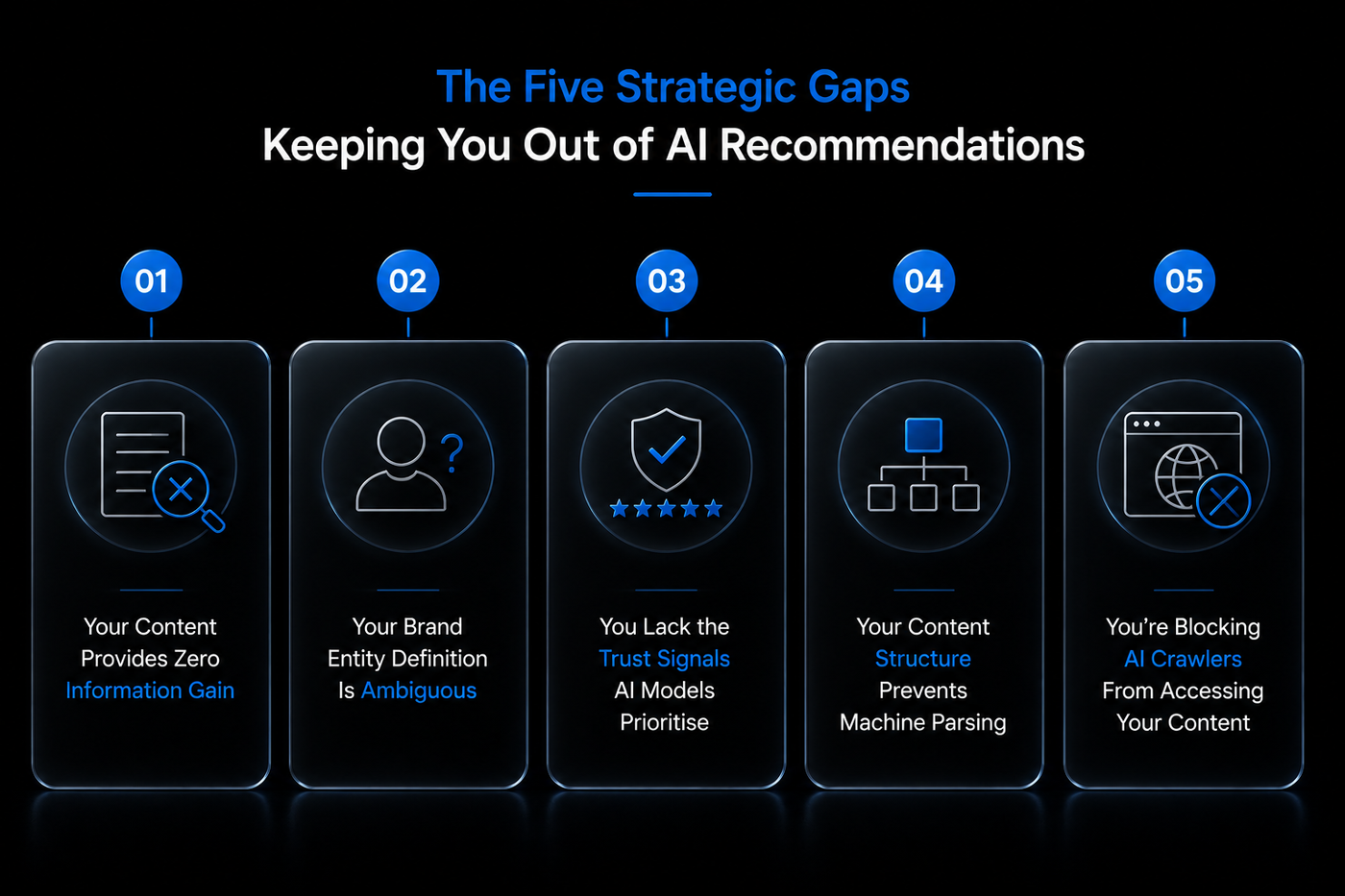
Your Content Provides Zero Information Gain
Only 11 companies from our 57 company dataset appeared in at least 60% of responses. Every one of those 11 had Organisation schema, over 100 referring domains, and at least five detailed case studies with actual data.
Most brands publish commodity content: 500-word posts that paraphrase the top three ranking pages. They contain no original data, no unique perspective, no primary research. Commodity content cannot compete in AI search. It adds no new value, so retrieval systems ignore it.
Companies with 5+ detailed case studies appeared in 3x more responses than those with fewer than 2 across our dataset. Citation was counted when a company name appeared in the AI-generated recommendation list.
Original proof of work matters more than marketing claims. LLMs synthesise information rather than reproduce what already exists in their training data. They pull from sources that provide unique value. If you're rewording existing content, the AI has no incentive to cite you.
Your Brand Entity Definition Is Ambiguous
Entity clarity is the technical foundation of GEO. If your website states that you do marine construction but never specifies your core specialisations, the AI cannot map your brand to specific sub-entities. Vague entities don't get cited for specific queries.
Businesses with strong AI visibility have tight entity definitions. They maintain dedicated landing pages for each core service. They use schema markup to define their entity relationships. They contribute guest articles to industry publications. Every action builds a traceable link between their brand entity and the entities their ideal clients are asking about.
One coastal construction client we worked with had inconsistent entity definitions across their website, directory listings, and social profiles. Google's knowledge systems treated these as separate entities. Once we standardised the branding and added sameAs schema connecting all profiles to a single Organisation entity, their AI citation rate improved within six weeks.
Across our dataset, ChatGPT preferred companies with narrower entity definitions over full service providers. A brand that clearly states "3D printed living seawalls for coastal resilience" gets cited more often than one that lists 12 unrelated marine services. During one audit, we discovered that a client's AI citation rate doubled after we narrowed their service entity from "full service marine construction" to "3D printed coastal infrastructure for Florida shorelines". Before the change, they appeared in 2 out of 15 prompts. After, they appeared in 4 out of 15.
You Lack the Trust Signals AI Models Prioritise
Behavioural psychology research shows that people follow consensus. We assume that if others trust something, it's safe to trust it too. Retrieval and ranking systems often favour sources with stronger external signals because they reduce uncertainty. A model rarely risks citing a low-trust source because doing so could produce a hallucination. It defaults to sources with substantial third-party validation.
Our dataset revealed that 86% of AI citations came from the brand's own website, blog, or social profiles (brand-managed sources), but third-party corroboration (Reddit, Quora, industry mentions) boosted citation confidence.
Responses became more stable when a brand appeared across approximately twenty independent sources outside their own website.
Your Content Structure Prevents Machine Parsing
Machine readability is the most commonly overlooked factor in AI visibility. You can have excellent insights, but if they're buried inside complex JavaScript, embedded in images without alt text, or hidden behind accordion menus, the AI cannot extract the specific answer to a user prompt.
Sites appearing consistently in AI responses used clear structural hierarchy: H1 for main topics, H2 for major sections, H3 for detailed points. They used bulleted lists for processes and HTML tables for data comparisons.
Schema markup gives machines clearer context about your content. Light schema implementation (3-4 focused types) outperforms heavy markup (10+ types). Clarity beats volume. Leading with your answer in the first 30% of page content aligns with how retrieval systems prioritise direct responses.
You're Blocking AI Crawlers From Accessing Your Content
Many brands accidentally block AI crawlers in their robots.txt file. They disallow GPTBot, ChatGPT-User, Google-Extended, and other generative AI crawlers.
Blocking GPTBot primarily prevents your content from being included in future training datasets. Blocking ChatGPT-User and OAI-SearchBot prevents real-time retrieval when ChatGPT Search answers user queries. Perplexity, Gemini, and Claude use different retrieval pipelines with their own crawler user agents.
If these crawlers cannot access your content, it will never appear in retrieval-augmented generation (RAG) systems. Companies with strong AI visibility have whitelisted all major AI crawlers. They also avoid cookie consent walls or paywalls that prevent automated systems from accessing core content.
Perplexity prioritises content updated within the last 30 days, as noted in their public ranking documentation. Regular content updates maintain stronger AI visibility than static pages.
GEO Optimization Methods Comparison
The following table compares different GEO optimization methods and their measured impact on AI visibility based on Princeton's research and our 57 company dataset.
| Optimization Method | Visibility Increase | Best For | Implementation Difficulty | Time to See Results |
| Cite Sources | +115.1% | Lower SERP rankings (position 5+) | Medium | 4-6 weeks |
| Statistics Addition | +22% | Data-driven industries | Low | 2-3 weeks |
| Quotation Addition | +37% | Expertise demonstration | Low | 2-3 weeks |
| Schema Markup (light) | +40% | All industries | Medium | 3-4 weeks |
| Entity Clarification | +60% | Rebranding/Name changes | High | 6-8 weeks |
| Content Freshness | +30% | News/Time-sensitive topics | Low | 1-2 weeks |
Source: Princeton GEO Study (2023) + NFlow Research (2026) across 57 companies.
How to Position Your Brand as a Cited Source in Generative AI
Closing the visibility gap requires strategic repositioning. These seven steps will make your brand citeable in AI-generated recommendations.
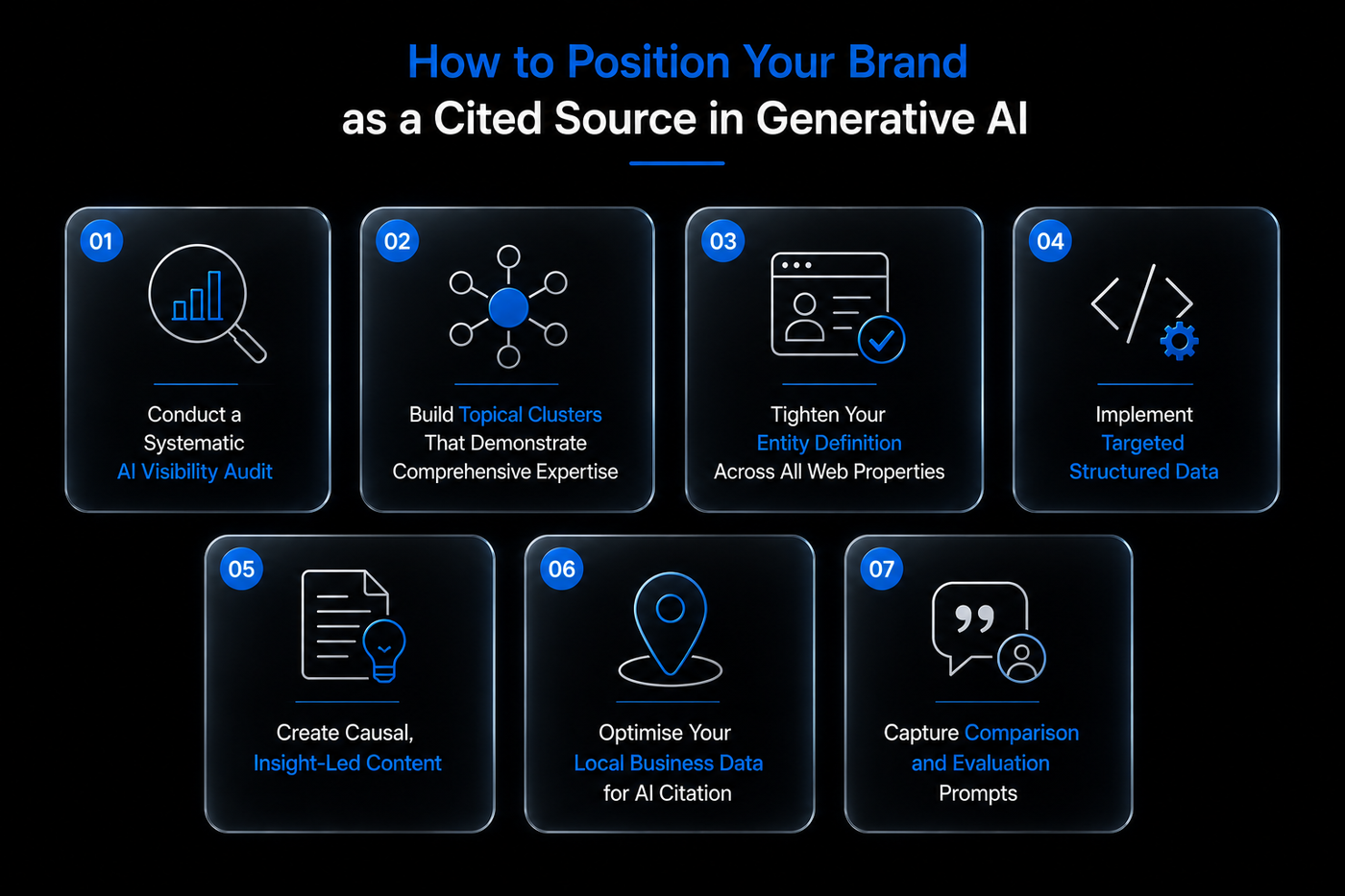
Conduct a Systematic AI Visibility Audit
Test ten prompts your ideal client would type when evaluating companies like yours. Document whether your brand appears and which competitors are being cited instead.
Examine your presence in Google's knowledge systems. Search your brand name and observe what entities appear in the knowledge panel. If your entity is missing or incorrectly categorised, correct this before other optimisation work.
Build Topical Clusters That Demonstrate Comprehensive Expertise
Topical authority outperforms keyword targeting for AI visibility. Build interconnected content clusters around each core problem your ideal clients face. Each piece links to the others using descriptive anchor text, creating a semantic web that signals to AI systems that your site is a definitive authority on the topic.
GEO optimisation can increase overall AI visibility by up to 40%, with lower-ranked traditional SERP sites benefiting more than top-ranked sites.
Tighten Your Entity Definition Across All Web Properties
Use structured data to explicitly define your brand entity. Add Organisation schema to your homepage, Service schema to each service page, and sameAs properties that link to your verified social profiles and directory listings. Ensure your brand name, description, and visual identity are consistent across every platform.
Keyword stuffing negatively impacts AI visibility. LLMs interpret keyword repetition as a low-quality signal. Write for clarity and entity association, not keyword density.
Implement Targeted Structured Data
FAQ schema allows you to mark up questions and answers in a format AI systems can parse. HowTo schema identifies step-by-step guides. Article schema clarifies the type and purpose of your content. Avoid schema bloat. Focus on 3-4 types that directly describe your core content and services.
Create Causal, Insight-Led Content
AI tools handle increasingly complex queries. Users ask "why does my coastal property need living seawalls instead of concrete" rather than "how to install seawalls." To be citeable, your content needs to explain causal reasoning, not just provide actionable steps.
Replace generic lists with causal analysis. Include screenshots, technical drawings, and real data from your own client projects. Original research performs exceptionally well in AI retrieval because it provides unique value that cannot be found elsewhere.
Optimise Your Local Business Data for AI Citation
Local business information is a core component of knowledge graph data. AI models pull local service information from Google Business Profile, Bing Places, Yelp, and industry-specific directories. If your NAP data is inconsistent across these platforms, the AI cannot reliably map your local entity.
This step alone fixed the problem for three clients in Q1 2026. All three had correct information on their websites but inconsistent data across directories.
Capture Comparison and Evaluation Prompts
Users frequently ask AI tools direct comparison questions during the vendor evaluation process. To capture these prompts, create objective comparison content that articulates your differentiated approach without attacking competitors.
Publish a page that explains your methodologies, shows representative results from case studies, and describes your client engagement process. Add comparison schema markup. When users ask competitor comparison questions, the AI can pull your content into the response.
The Strategic Window Is Open Now
Generative AI is not a temporary shift. It is a permanent change in how people discover information and make purchasing decisions. The brands appearing in AI responses today built content authority and technical clarity six to twelve months ago. The brands that start this work now will own the citation space six months from today.
Most businesses don't know whether they have an entity problem, a trust problem, or a retrieval problem. That's why the first step isn't more content. It's understanding how AI currently sees your brand.
If you want to understand exactly how your brand currently appears in generative AI tools, contact NFlow for a comprehensive AI visibility audit.
Frequently Asked Questions
How long does it take to see results?
Most brands see measurable changes in AI citation rates within 6 to 12 weeks after implementing consistent entity definitions, schema markup, and original content. The timeline depends on your current technical foundation and how quickly you can publish citeable content.
Can small businesses compete with larger companies?
Yes. AI systems prioritise entity clarity and original data over domain authority alone. A specialised marine construction company with five detailed case studies and consistent branding often outperforms a large general contractor with vague service descriptions and no original research.
Do AI citations actually generate leads?
Our client data shows brands appearing in AI recommendations receive higher-intent inquiries. Users asking AI for recommendations have already moved past the awareness stage and are evaluating specific providers.
How do you measure AI visibility?
We track prompt appearance rates across ChatGPT, Perplexity, Gemini, Claude, and Google's AI Mode using a set of 15 high-intent prompts relevant to your services. We measure both appearance frequency and competitor displacement.
Should I stop doing SEO?
No. Traditional SEO and GEO work together. Strong Google rankings often correlate with AI citations because both systems value entity clarity, original content, and technical quality. Optimise for both.