

Every business owner weighing this eventually asks the same thing: are SEO services worth it, or am I about to pour money into a slow-moving channel I can't even measure? Fair question. You've probably heard both the hype and the horror stories. So instead of a vague "it depends," you're going to get a direct answer, the honest conditions attached to it, and enough detail to decide for your own business.
What Are SEO Services, and What Do You Actually Pay For?
SEO services are the ongoing work of making your website the result search engines show when someone looks for what you sell. That's a lot more than stuffing keywords into a page. You're paying for strategy (figuring out what your buyers actually search and how to win those searches), technical fixes so Google can read and trust your site, content that answers real questions, authority building so your site earns credibility across the web, and measurement that ties all of it back to revenue. Done right, it's a system, not a checklist.
Are SEO Services Really Worth the Investment?
Yes, for most businesses that sell something people search for and can afford to think in months rather than days. But that sentence has conditions, and they matter. SEO creates a genuine positive return when three things line up: people are already searching for your product or service, your website can turn visitors into buyers, and you can wait a few months for momentum to build. The confidence behind that isn't just vendor optimism, either. In one widely cited industry survey, 91% of marketers reported that SEO had a positive impact on their website performance and marketing goals (SE Ranking). When those conditions are true, the return compounds, because the traffic you earn this year keeps working next year without you paying again for each click. Where it falls apart is when any one of those is missing: no search demand, a site that doesn't convert, or a need for sales by Friday. So the honest version of "worth it" isn't universal. It's worth it under the right conditions, which most established businesses can meet.
How Does SEO Make Money for a Business?
SEO makes money by putting your business in front of people at the exact moment they're looking to buy, then letting that visibility turn into customers. The chain is simple to follow. Better rankings mean more visibility, and that visibility is worth a lot: organic search drives more than half of all website traffic, making it the top driver of visits for most sites (Digital Silk). Position matters enormously within that, too. The top organic result is around ten times more likely to get clicked than a result sitting down in tenth place (SE Ranking). So the chain runs like this: visibility brings qualified traffic (visitors who want what you offer rather than random clicks), some of those visitors become leads, a portion of those leads become paying customers, and those customers become revenue you didn't have to buy ad space to reach. The jump from traffic to real leads is where a lot of SEO quietly succeeds or fails, and it's worth understanding how an SEO agency turns search traffic into qualified leads before you judge any campaign.
What Makes SEO More Valuable Than Paid Advertising Over Time?
The core difference is that SEO builds an asset you own, while paid ads rent you attention that vanishes the moment you stop paying. Here's how that plays out in the SEO vs PPC comparison:
-
Long-term traffic: A page that ranks keeps pulling in visitors for months or years. An ad stops the second your budget runs out.
-
Cost per acquisition: CAC means the average cost to win one customer. With ads, that cost stays roughly flat forever. With SEO, your cost per customer tends to drop over time as past work keeps producing.
-
Compounding visibility: Every piece of content and every bit of authority adds to the last. The results stack instead of resetting each month.
-
Dependency on ad spend: PPC (pay-per-click advertising) is a tap you have to keep running. SEO reduces how dependent you are on buying every single visit.
This isn't an argument to drop ads. PPC is excellent for speed and testing. It's why SEO vs PPC isn't either/or for most businesses, but a question of what each does best.
How Long Does It Take to See Results From SEO?
SEO typically takes several months to show meaningful traction, and anyone promising rankings in two weeks is selling you something that won't last. A realistic path looks roughly like this:
-
Early months: Technical cleanup and foundational content start registering; you see small movements and indexing improvements.
-
A few months in: Traffic to targeted pages begins to climb as content matures and earns trust.
-
Mid-stretch: That traffic starts producing leads and inquiries, not just visits.
-
Later: Rankings firm up for competitive terms and your overall authority strengthens, which makes each new page rank faster.
Timelines vary with competition and budget, but the pattern holds: quiet, then building, then compounding.
How Much Do SEO Services Cost?
SEO services cost anywhere from a few hundred to several thousand dollars a month, and the range is wide because the work scales with your situation. What moves the price:
-
Competition: More rivals fighting for the same terms means more work to win.
-
Website size: A ten-page site needs far less than a thousand-page one.
-
Location: Ranking in one town differs hugely from ranking nationally.
-
Industry: Some sectors demand deeper expertise and documentation.
-
Technical complexity: A messy or custom-built site takes more to fix.
-
Content requirements: More pages and deeper topics mean more production.
-
Link-building needs: Earning authority in competitive fields costs more effort.
Treat any figure as guidance, not a fixed menu, and if you want the full picture, our honest breakdown of how much SEO services cost walks through each pricing model. The real cost depends on how far you are from where you want to rank. When you're comparing quotes, the cheapest option is rarely the one with the best return, and that's a real factor in whether these services are worth it for you.
How Do You Calculate the ROI of SEO?
You calculate SEO ROI by comparing the revenue SEO brought in against what you spent to get it, as a percentage. ROI means return on investment, or how much you made relative to what you put in. Here's the formula:
SEO ROI = (Revenue Generated from SEO − SEO Investment) ÷ SEO Investment × 100
Let's break down each part in plain terms. Revenue Generated from SEO is the money traceable to organic search, meaning sales or leads that came through visitors who found you in search results. SEO Investment is everything you spent to make that happen: agency fees, content, tools, whatever went in. You subtract what you spent from what you earned, divide by what you spent, and multiply by 100 to get a percentage. A result of 200 means you tripled your money.
Now, a warning on measuring this. Rankings alone aren't a reliable ROI metric, because ranking first for a term nobody buys from earns you nothing. What counts is whether that SEO ROI shows up as actual revenue (leads, sales, customers), not a screenshot of position one. Track the money, not just the rank.
When Are SEO Services NOT Worth It?
SEO services are a poor fit, and sometimes a flat-out waste of money, in several real situations, and pretending otherwise would be dishonest. Here's where it genuinely doesn't pay:
Unrealistic expectations. If you expect to outrank established competitors in a month, you'll cancel in frustration right before the work would have paid off. The mismatch between expectation and reality kills more SEO investments than bad SEO does.
Very short-term business goals. If you're trying to clear inventory this quarter or you're not sure the business exists in a year, SEO's slow build works against you. Paid ads fit short horizons far better.
No conversion-ready website. If your site can't turn a visitor into a lead (confusing layout, no clear way to contact you, nothing that persuades), then sending more traffic to it just means more people leaving. Fix the leaky bucket first.
Extremely limited budget. Underfunded SEO tends to produce underfunded results. Consider that roughly 90% of pages get no organic traffic at all, often because of weak keyword targeting and a lack of backlinks (The SEO Works), which is exactly what happens when effort is spread too thin to compete. A tiny budget split across content, technical work, and authority building usually isn't enough to move anything, and you'd often see more from putting that money into ads or direct outreach.
Poor product-market fit. If people aren't buying what you offer, ranking for it won't fix that. SEO amplifies demand; it can't manufacture it. Get the offer right before you pay to be found.
If one of these describes you, the honest answer to whether SEO is worth it right now is no, or not yet.
What Types of Businesses Benefit Most From SEO?
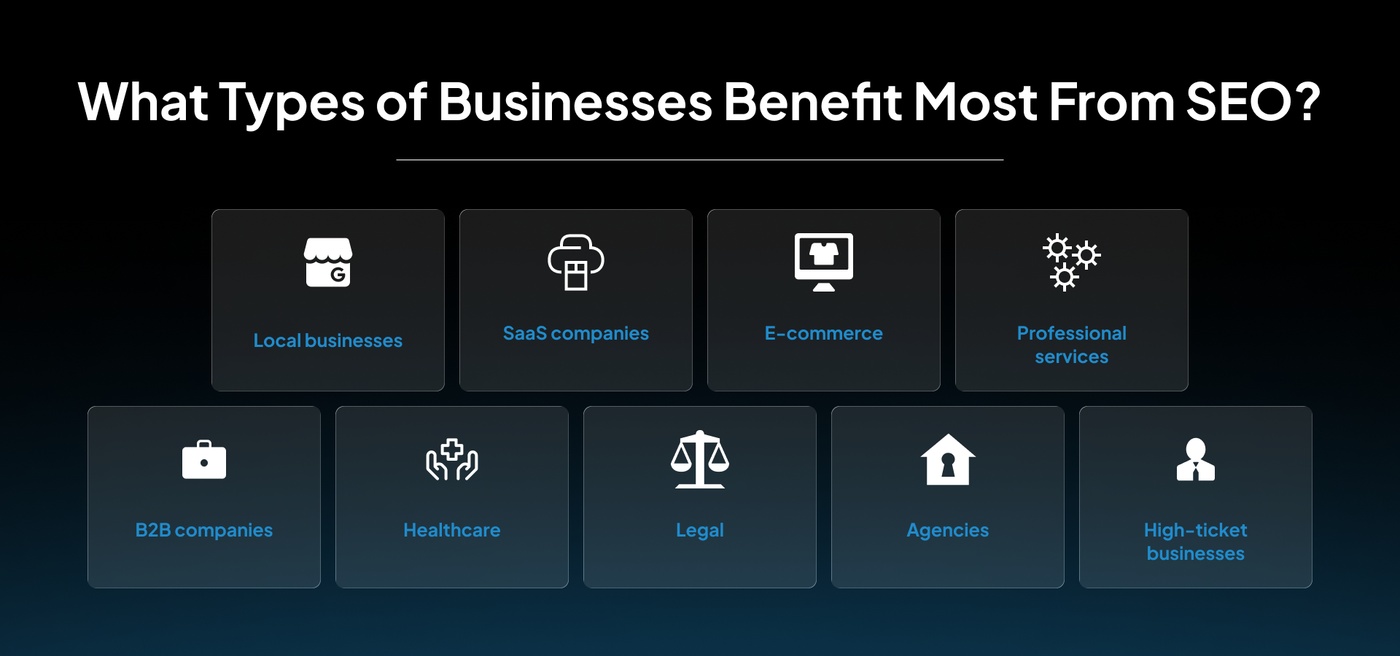
Businesses whose customers actively search before buying get the most out of SEO. Quick rundown:
-
Local businesses: People search "near me" with intent to visit or call, which is why the right SEO services for local business visibility are often the fastest win.
-
SaaS companies: Buyers research software heavily before signing up.
-
E-commerce: Shoppers search for products constantly.
-
Professional services: Accountants, consultants, and similar get found through problem-based searches.
-
B2B companies: Long buying cycles that start with research.
-
Healthcare: Patients search symptoms and providers.
-
Legal: High-value cases often begin with a search.
-
Agencies: Clients look for specialists online.
-
High-ticket businesses: One customer from search can pay for months of work.
Is SEO Still Worth It With AI Search and Google AI Overviews?
Yes, AI search raises the stakes for good SEO rather than ending it, because the same signals that earn rankings now earn citations. This shift is real and already large: AI Overviews appeared in about 34.9% of Google searches by the end of 2025, up from roughly 25.9% six months earlier (MarketingCharts, citing Comscore). And more than 58% of US searches now end without a single click (Tenet), as people get answers right on the results page. AI Overviews (Google's AI-generated answers at the top of results), along with tools like ChatGPT and Perplexity, pull from sources they consider credible and relevant. They don't invent trust; they borrow it from content that already demonstrates it. That's where entity optimization comes in, meaning you make it clear to machines exactly who you are, what you do, and how you connect to the topics you want to be known for. If you're new to this shift, our explainer on what AI SEO is and why it matters is a good starting point. First-hand expertise, real brand mentions across the web, and being cited by trusted sources all push you into those AI answers. Worth keeping in perspective, though: ChatGPT and Perplexity together still drive less than 1% of search referral traffic (Link-Assistant), so classic search optimization still carries most of the weight. The work hasn't changed as much as it sounds. Helpful, credible, well-structured content is what both traditional search and AI search reward.
What Makes an SEO Strategy Actually Worth the Money?
Effective SEO invests in foundations that compound, while cheap SEO sells you activity that looks busy and produces little. What separates the two:
-
Technical foundation: A fast, crawlable, error-free site.
-
Search intent: Targeting what people actually mean when they search, not just the words.
-
Helpful content: Pages that answer the question better than the current top result.
-
Topical authority: Covering a subject thoroughly enough that search engines see you as a go-to source on it.
-
Internal linking: Connecting your pages so authority and context flow between them.
-
Digital PR and backlinks: Earning links and mentions from reputable sites.
-
Conversion optimization: Turning the traffic into leads and sales.
-
Measurement: Tracking revenue, not vanity metrics.
Cheap SEO skips most of this and bills you for keyword reports.
How Do You Know If an SEO Agency Is Actually Doing Good Work?
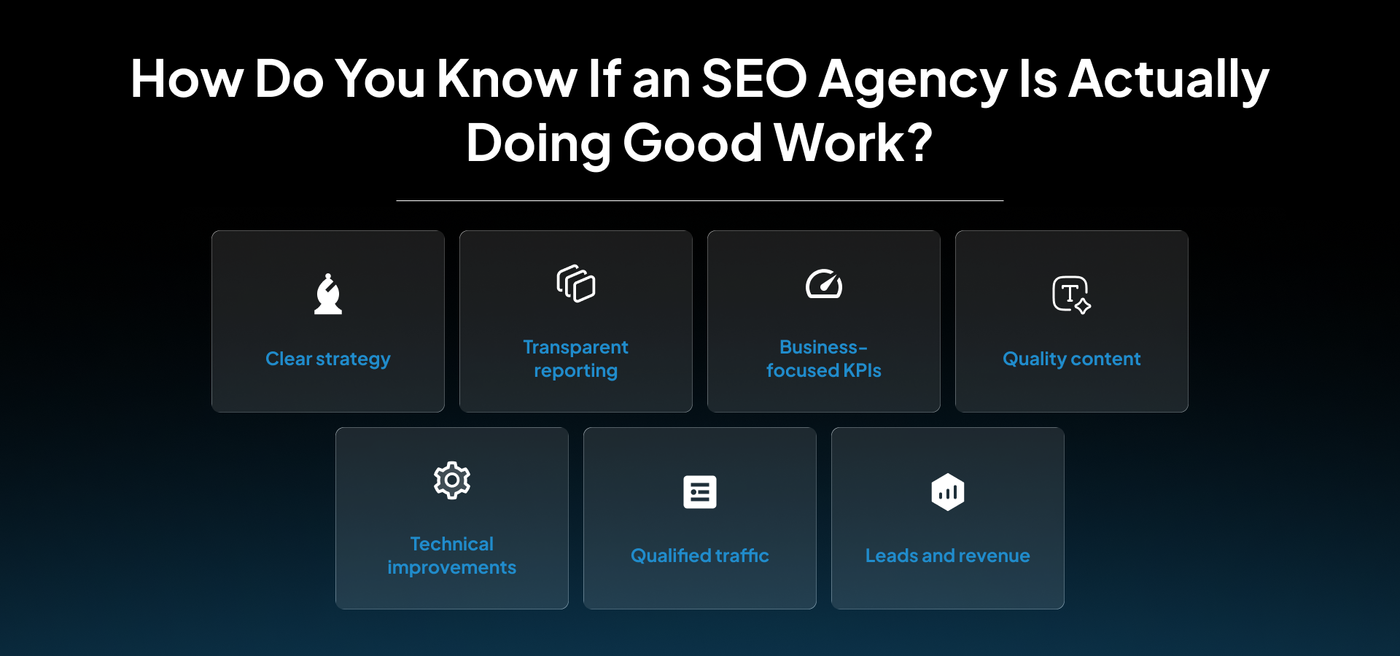
Good SEO work shows up as business results and clear reporting, not jargon and promises. A practical checklist:
-
Clear strategy: They can explain what they're doing and why, in plain terms.
-
Transparent reporting: You see what was done each month without chasing them.
-
Business-focused KPIs: They track leads and revenue, not just rankings.
-
Quality content: What they publish is genuinely useful, not filler.
-
Technical improvements: Your site gets measurably healthier.
-
Qualified traffic: Visitors who match your buyers, not random numbers.
-
Leads and revenue: The traffic turns into money over time.
If an agency only ever shows you ranking charts, ask where the revenue is. When you're actively comparing providers, our guide on how to choose the right AI SEO agency covers the questions that separate real partners from the rest.
SEO vs. Doing It Yourself: Which Is Better?
DIY SEO makes sense when your market is low-competition and you have the time to learn; hiring specialists makes sense when the stakes or the complexity outrun what you can handle yourself. If you run a small local business in a quiet niche, you can learn the basics and get real results on your own, because the fundamentals aren't secret. The trouble is that SEO has a long feedback loop, so a mistake can cost you months before you notice. A seasoned organic SEO agency saves you that time, sidesteps the common errors, and tends to get you results faster because they've already made the mistakes on someone else's budget. The real question is what your time is worth and how competitive your space is.
What Should You Expect From an SEO Agency in the First 6–12 Months?
Expect a build, not a bang, because the first year is about laying groundwork that pays off increasingly as it goes. Roughly how it unfolds:
-
Months 1–3: Audit, strategy, technical fixes, and the first content. Mostly setup; few flashy wins.
-
Months 3–6: Content gains traction, traffic starts rising, early rankings appear.
-
Months 6–12: Leads and revenue become visible, competitive rankings strengthen, and momentum compounds.
Anyone promising top rankings in month one is managing your excitement, not your results.
So, Are SEO Services Worth It?
Yes, SEO services are worth it when your buyers search, your site converts, and you can commit to the timeline, which covers most established businesses. But "worth it" earns that yes through conditions, not blanket optimism. It's worth it if your goals reward long-term visibility rather than a one-time spike, if your competition isn't so entrenched that no reasonable budget can touch it, if you're investing for the horizon where SEO actually delivers, and if the execution is genuinely good rather than cheap activity dressed up in reports. Get those right and SEO becomes one of the few marketing investments that keeps paying after you've stopped spending. Get them wrong, with an unrealistic timeline, weak site, poor fit, or bargain-bin provider, and even the idea of SEO being worth it falls apart. So the answer is yes, honestly and with conditions, which is the only kind of yes worth trusting.
Conclusion
SEO isn't a magic switch or a scam; it's a long-term investment that rewards businesses whose customers search, whose sites convert, and whose owners can think past the next quarter. Judge it by revenue over time, not rankings this week, and it holds up as one of the most durable channels you can build. If you're weighing it for your own business, the smartest next step is an honest assessment of whether your site and market are ready, and a good organic SEO agency will tell you that straight, even when the answer is "not yet."
FAQ
Is SEO still worth it in 2026?
Yes. As long as people turn to search, including AI-powered answer engines, to find products and answers, showing up credibly in those results pays off, and that visibility compounds over time.
How much should a business spend on SEO?
It depends on your competition, website size, and goals, ranging from a few hundred to several thousand dollars a month. Spend enough to cover real strategy, content, and technical work, because underfunded SEO usually produces underfunded results.
How long does SEO take to work?
SEO typically takes several months to show meaningful traction, with the biggest gains compounding after six to twelve months. Anyone promising top rankings in a few weeks is overpromising.
Can SEO really increase sales?
Yes, by bringing in people who are actively searching for what you sell and guiding them toward becoming customers. The key is a website that converts that traffic, not just attracts it.
Is SEO better than PPC?
Neither is simply better. In the SEO vs PPC question, PPC delivers fast, paid traffic that stops when you stop paying, while SEO builds traffic you own that keeps working over time. Many businesses use both.
Is SEO worth it for a small business?
Often yes, especially for local or niche businesses where competition is manageable and customers search before buying. Whether SEO is worth it for small businesses comes down to search demand, a conversion-ready site, and a realistic timeline.
Can I do SEO myself?
Yes, particularly in low-competition markets where you have time to learn the fundamentals. In competitive spaces, hiring specialists usually gets better results faster and avoids costly mistakes.
How do I know if my SEO investment is working?
Track qualified traffic, leads, and revenue from organic search over time, not just keyword rankings. If those business numbers are climbing, your SEO ROI is real; if only rankings move, dig deeper.